Triad NC rent and buy numbers, July 2026
The Triad is one of the more affordable metros in the Southeast, and both sides of the buy-versus-rent equation have shifted meaningfully in the last 18 months. Rents are essentially flat. Home prices are up modestly. Rates are still elevated but not stuck. That mix creates a genuinely close decision, which is why the framework matters more than the calculator.
| Market metric (July 2026) | Winston-Salem | Greensboro | Triad-wide reference |
|---|---|---|---|
| Median 2-bedroom apartment rent | $1,175 to $1,247 | $1,250 to $1,304 | ~$1,225 |
| Median home sale price | ~$285,000 | ~$310,000 | ~$300,000 |
| Median days on market (resale) | 18 to 24 days | 16 to 22 days | ~20 days |
| Property tax rate (city + county) | ~1.28% | ~1.35% | ~1.30% |
| Home value change YoY | +2.1% | +1.8% | +2.0% |
| Apartment rent change YoY | -7% | +3% | flat |
Sources: Rent.com July 2026 update, Apartments.com July 2026 rent trends, Triad MLS median sale data, Zillow ZHVI May 2026 release. Sam Khater, Chief Economist at Freddie Mac, framed the rate environment in the June 25, 2026 Primary Mortgage Market Survey: "The 30-year fixed averaged 6.49 percent and the 15-year 5.84 percent. Elevated rates continue to soften demand, and builders are absorbing the gap with concession packages."
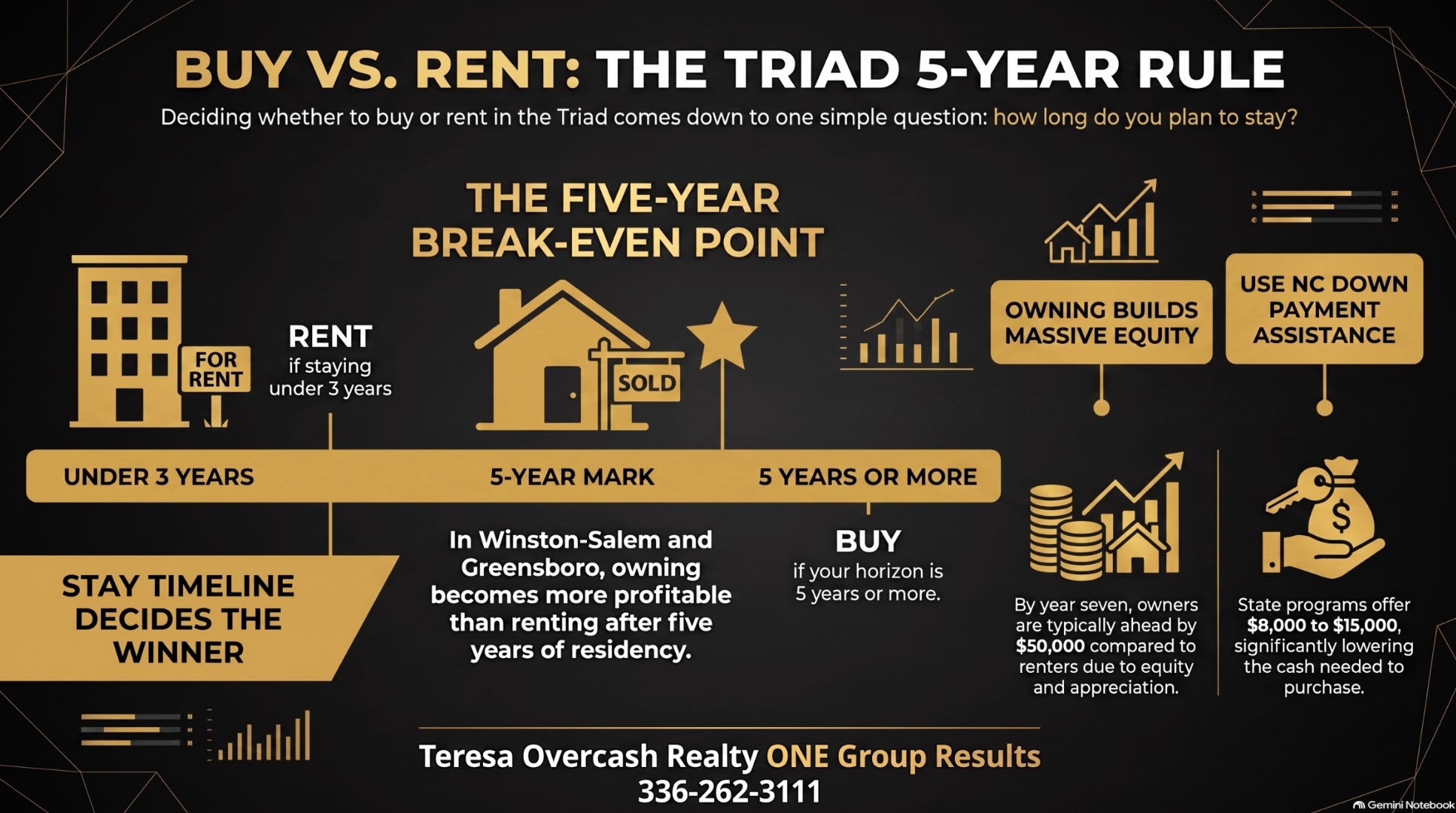
The 5-year Triad break-even math
Break-even is the year at which the true cost of owning matches the true cost of renting a comparable home. Below that year, renting wins on cash. Above it, owning wins because of equity, appreciation, and tax treatment. Nationally, Zillow senior economist Orphe Divounguy published a June 2026 finding that the average break-even period has fallen to "six years, down from 7.5 years in early 2024, as rents softened and inventory expanded." The Triad breaks even faster than the national average because home prices are lower relative to rent than in coastal or ski-town markets.
| Scenario ($300K home, $1,225 rent, 6.49% rate) | Year 1 | Year 3 | Year 5 | Year 7 |
|---|---|---|---|---|
| Total cash spent renting | $14,700 | $45,318 | $77,940 | $112,660 |
| Total cash spent owning (5% down) | $32,400 | $70,900 | $110,600 | $151,700 |
| Estimated home equity built | $5,700 | $27,500 | $56,300 | $88,900 |
| Net position (own minus rent minus equity) | +$12,000 | -$1,900 | -$23,600 | -$50,100 |
Read the last row. In year one, renting is ahead by $12,000 (you avoided closing costs and down payment). By year three you are roughly even. By year five, owning is ahead by $23,600. By year seven, owning is ahead by $50,100 and climbing. The compounding effect of principal paydown, modest appreciation, and rent inflation makes years five through ten the highest-value years to be an owner.
Assumptions in that table matter more than the final numbers. Rent is escalated at 2.5 percent annually. Home value is escalated at 2.0 percent annually (Zillow forecasts near-zero national growth for 2026, so this is a Triad-favorable but not aggressive assumption). Property tax is $3,900 annually. Insurance is $1,800 annually. Maintenance is 1 percent of home value annually. Closing costs are 3 percent up front. This is a Triad-realistic base case, not a marketing pitch.
The property-tax and homestead math nobody explains
North Carolina property tax is where most out-of-state buyers get pleasantly surprised. NC has among the lowest effective property tax rates in the Southeast, and the state homestead exclusion for permanent residents can add real annual savings. Here is how the math actually works on a Triad home.
| Ownership cost item | $300K Triad home, no discounts | $300K Triad home, NC resident + primary | Annual delta |
|---|---|---|---|
| County property tax | $1,725 to $2,100 | $1,725 to $2,100 | $0 |
| City property tax (WS or GSO) | $1,200 to $1,750 | $1,200 to $1,750 | $0 |
| Homestead exclusion (elderly/disabled, income-tested) | Not applied | Up to $25,000 assessed value excluded | ~$325/year |
| Homeowner insurance | $1,600 to $2,100 | $1,600 to $2,100 | $0 |
| Mortgage interest tax deduction (Fed) | Only if itemizing | Only if itemizing | Situational |
| Standard deduction impact (2026 single/joint) | $14,600 / $29,200 | $14,600 / $29,200 | Situational |
The honest answer on the mortgage-interest deduction is this: for a Triad home under $400,000, most buyers do not itemize because the standard deduction is bigger than their interest plus tax deductions. Do not build your buy decision on tax savings that will not materialize. Build it on rent avoidance plus equity build plus stability. If you are a higher-income buyer with a $500,000+ home and other itemizable expenses, the tax picture flips.
Run your own numbers
The numbers above use Triad median inputs. Your numbers are yours. Rate quotes, insurance quotes, and property tax rates vary by ZIP code and lender. Use the mortgage calculator to plug in your actual purchase price, down payment, rate quote, and tax rate. Then subtract your current rent to see the honest year-by-year gap.
Angie Wilmoth at Glory Mortgage in Winston-Salem is one of the lenders who runs full break-even projections for buyers, not just monthly payment quotes. She put it plainly in a March 2026 buyer session I taught: "Buyers get a monthly payment number and think that is the answer. It is not. The answer is total cost of ownership over your realistic stay period, minus your equity and minus your rent avoidance. Any lender who cannot show you that math is not doing the whole job."
The stay-timeline question is everything
Every buy-versus-rent decision comes back to one honest question: how long will you actually stay? Not how long you hope to stay. How long you will realistically stay. Job change, family growth, marriage, health, care of parents, and school district decisions are the five factors that break stay timelines in the Triad.
| Stay timeline | Typical buyer profile | Recommendation | Why |
|---|---|---|---|
| Under 2 years | Job trial, military assignment, medical residency | Rent | Transaction costs alone (7-8% round trip) eat any equity build |
| 2 to 3 years | Recent grad, career flex, short marriage horizon | Rent with condition | Buy only if job and personal life are truly locked in for 3+ years |
| 3 to 5 years | Stable career, growing family | Toss-up, favor buying if 5% down | Break-even lands right in this window; equity + rent inflation carry the decision |
| 5 to 7 years | Established household, school-age kids | Buy | Ownership is clearly ahead by year 5 in Triad math |
| Over 7 years | Long-term Triad household | Buy, and prioritize the right neighborhood over the perfect house | Compounding equity, rent inflation, and location optionality all favor ownership |
If your stay timeline is short, you should not be putting yourself in a multiple-offer position at all. Rent for another 12 to 18 months and re-evaluate.
Hidden costs on both sides
Both sides of this decision have costs the surface-level calculators skip. Below is the version I walk clients through before they sign anything.
| Hidden cost category | Renting side | Buying side |
|---|---|---|
| Upfront cash out of pocket | First month + security deposit (usually $2,400 to $3,000) | Down payment + closing costs + reserves ($15K to $30K on a $300K home at 5% down) |
| Insurance | Renter policy $180 to $260 per year | Homeowner policy $1,600 to $2,100 per year |
| Maintenance | Zero direct spend | 1% of home value annually, ~$3,000 per year on a $300K home |
| Emergency repairs | Landlord absorbs | Owner absorbs (HVAC $6K-$12K, roof $8K-$18K, water heater $1,200-$2,500) |
| Annual rent increase | 2.5% to 5% typical Triad | Locked payment on fixed-rate loan |
| Selling / moving cost | Move-out cleaning + moving truck (~$1,500) | Broker fee, closing costs, seller concessions (5-8% of sale price) |
| Amenity access | Pool, gym, cleaning often included | Owner pays HOA + utilities directly |
Notice the last row. That amenity-access line is where I see a lot of Triad renters undervalue their current situation. If your apartment includes gym, pool, water, garbage, and pest control, that is $200 to $350 per month of embedded value. A $1,225 apartment rent with those amenities is closer to $1,500 in true cost comparison. The buy-versus-rent math has to compare apples to apples.
NC-specific decision factors
North Carolina has three quirks that change the buy-versus-rent decision compared to a national calculator. Any advisor who is not naming these is guessing on your behalf.
First, the NCREC Form 2T due-diligence framework. NC buyers do not use contingency-style clauses the way most states do. You have a due-diligence period, ending on the Termination Date, during which you can walk away for any reason and forfeit only your due-diligence fee. That means your risk of buying and needing to exit fast is genuinely lower than in most states, but only if you understand and use the due-diligence period correctly. Rushed buyers waive DD or accept an aggressive short window and lose the safety net.
Second, the property-tax billing calendar. NC taxes are billed in July and due January 5. Buyers who close in August find themselves prorated for 5 months of tax at closing plus a full year bill six months later. Cash-flow planning matters. Ask your lender about escrow versus non-escrow — both are options in NC.
Third, the NCHFA down payment programs. The NC Housing Finance Agency runs several first-time buyer programs (NC Home Advantage, NC 1st Home Advantage, NC Foreclosure Prevention) that combine below-market rates with down payment assistance of $8,000 to $15,000. If you qualify, the buy-versus-rent math tilts sharply toward buying because your effective down payment need drops to $3,000 to $5,000.
Related guides for the Triad decision
- About Teresa Overcash — 30-year NC broker behind this framework
- NC real estate glossary — every term above defined
- Moving to Winston-Salem NC — complete relocation guide
- Ardmore, Winston-Salem — classic first-home neighborhood
- Buyer Match Method — how we tour smart
- Winston-Salem market report — current sold data
- Winston-Salem homes for sale — live MLS + off-MLS
FAQs about buy vs rent in the Triad NC
What is the break-even point for buying in the Triad NC in 2026?
The Triad break-even lands near five years for a Winston-Salem or Greensboro buyer at median inputs. Zillow puts the national average at six years as of June 2026. The Triad is faster because home prices are lower relative to rent than in coastal and mountain markets.
Is it cheaper to rent or buy in Winston-Salem NC right now?
In year one, renting is cheaper by roughly $12,000 to $18,000 (you avoided down payment and closing costs). By year three the two are roughly equal. By year five, owning is ahead by $20,000 to $25,000 including equity build. The answer depends entirely on your stay timeline.
What does it cost to buy a $300,000 home in the Triad?
At 5 percent down and a 6.49 percent rate, expect a $285,000 loan with a principal-and-interest payment near $1,798, plus $325 monthly for property taxes and $150 for insurance. All-in monthly PITI runs about $2,275. Closing costs at 3 percent add roughly $9,000 to your cash-to-close.
How much do I need to put down to buy in NC?
Conventional loans allow 3 percent down. FHA allows 3.5 percent. VA and USDA allow 0 percent for eligible buyers. NCHFA down payment assistance can add $8,000 to $15,000. On a $300,000 Triad home, realistic cash-to-close ranges from $12,000 (with NCHFA + 3% down) to $30,000 (5% down without assistance).
Are rents going up in the Triad in 2026?
Mixed picture. Winston-Salem 2-bedroom rents are down 7 percent year over year per Rent.com. Greensboro 2-bedroom rents are up 3 percent per the same source. Zillows national forecast calls for 3.1 percent single-family rent growth in 2026. Plan for 2.5 to 3.5 percent annual rent inflation over a 5-year horizon.
Should I wait for lower mortgage rates before buying in the Triad?
Only if you have a stable rental situation and can wait 18 to 24 months. Freddie Mac and MBA forecasts do not project sub-6 percent rates before late 2026 or early 2027. Waiting for rates while paying $1,225 per month in rent costs $14,700 per year in cash that builds no equity. Sometimes waiting pays. Sometimes it costs.
What is the biggest mistake Triad buyers make on this decision?
Overestimating stay timeline. Buyers routinely tell me they will stay 7 to 10 years and end up moving in year 3 or 4 because of a job change, family need, or care-of-parents shift. If you are honest that your realistic stay is 3 to 5 years, rent longer and buy when the timeline lengthens. Buying and selling inside 3 years usually costs 5 to 8 percent of the home value in transaction costs.
Does the mortgage-interest deduction help on a Triad home?
Only if you itemize, and most Triad buyers do not because the standard deduction ($14,600 single, $29,200 joint for 2026) exceeds their mortgage interest plus state and local tax cap of $10,000. Do not build your decision on tax savings that will not materialize. Higher-income buyers on homes above $500,000 with other itemizable expenses see a different picture.
Where can I find NCHFA and other NC first-time buyer programs?
Search NCHFA directly at nchfa.com. Local lenders like Angie Wilmoth at Glory Mortgage in Winston-Salem run through eligibility as part of their standard pre-approval process. NCHFA has income limits (roughly $158,000 statewide (per NCHFA June 2026 Program Guide), $158,000 statewide (per NCHFA June 2026 Program Guide) for most counties) and purchase-price caps that adjust annually.
What if I already own a home and am thinking of renting it out and moving?
Different math entirely. That becomes a rent-versus-sell decision, which factors in cap rate, cash-on-cash return, tenant risk, and NC landlord law. Have this conversation with a broker who does both sides. The Triad has enough rent-to-price ratio that some homes make sense as rentals, especially in walkable neighborhoods near universities.
Ready to run your own Triad NC buy-versus-rent math?
Get a break-even projection sized to your stay timeline, your rate quote, and your target neighborhood — not a generic calculator.
Text 336-262-3111 Text 336-262-3111 Email