For the closed-sale data behind Triad deal terms — seller concessions, sale-to-list, days to contract, and price cuts — see The NC Deal Terms Index, updated every Saturday from Triad MLS.
Written by Teresa Overcash, a North Carolina broker since 1996. See full bio at the bottom of this page.
Jump to: What it is · Fee recommender · Amount by market · Negotiation strategy · FAQs
What the NC due-diligence fee actually is
North Carolina uses a due-diligence structure that surprises buyers moving from other states. Instead of the separate inspection, financing, and appraisal contract clauses used elsewhere, NC contracts combine everything into a single NC due-diligence period, backed by two separate payments: the due-diligence fee and earnest money.
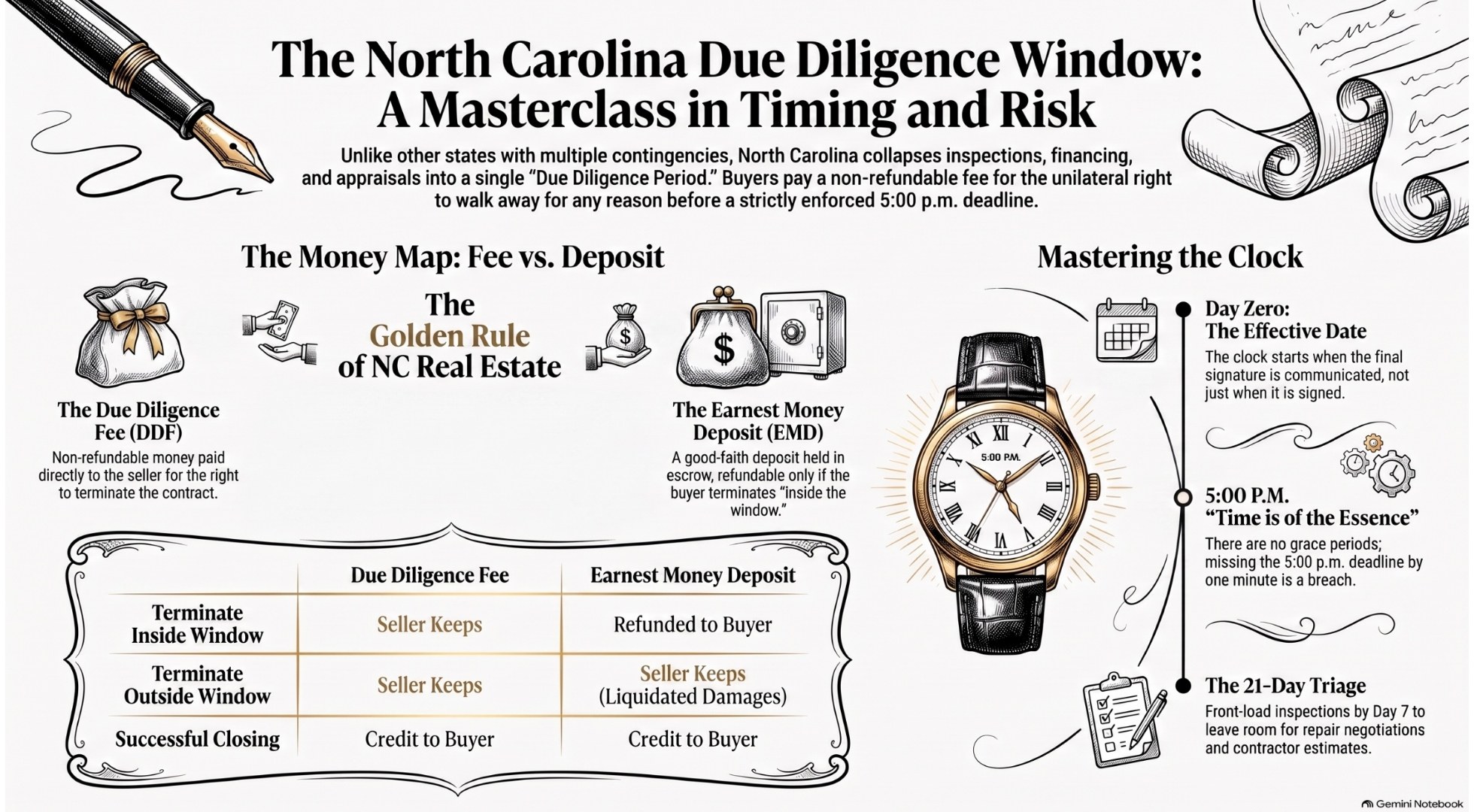
The due-diligence fee is paid directly to the seller, not held in trust, and it is non-refundable no matter what happens next. If you terminate during your NC due-diligence period for any reason, including a bad inspection or a denied loan, you keep your earnest money but the seller keeps the due-diligence fee. That fee compensates the seller for taking the home off the market while you complete your due diligence.
| Item | Who holds it | Refundable if buyer terminates in due-diligence period |
|---|---|---|
| Due-diligence fee | Paid directly to seller | No, never refundable |
| Earnest money | Held in trust account | Yes, refundable within the due-diligence period |
Buyers coming from contingency states almost always misunderstand this. The due-diligence fee is not a deposit, it is closer to an option payment that buys you the exclusive right to walk away.
NC Bar Association guidance on residential contract structure
How long is the NC due-diligence period itself
The due-diligence fee amount and the due-diligence period length are negotiated together but serve different purposes. The fee compensates the seller financially. The period gives the buyer time to inspect, secure financing, and order any needed specialist evaluations before the fee becomes final and earnest money exposure increases.
| Scenario | Typical due-diligence period length | Why |
|---|---|---|
| Standard Triad resale, financed | 14 - 21 days | Time for inspection, appraisal, and full underwriting |
| Cash purchase, standard condition | 7 - 14 days | No appraisal or lender underwriting required |
| Rural property with well and septic | 21 - 25 days | Extra time for specialist scheduling in Wilkes and Watauga counties |
| New construction, builder contract | Often waived or shortened | Builder warranty replaces buyer due-diligence leverage |
Shorter due-diligence periods paired with strong due-diligence fees are common competitive tactics in hot markets, since sellers value certainty and speed almost as much as price. However, a period that is too short to complete a well and septic evaluation, or too short for a lender to clear underwriting conditions, creates real risk of losing your due-diligence fee for reasons outside your control. Match the period length to the property type and your financing timeline, not just to what wins the most points against a competing offer.
How much is the average due diligence fee in NC, by market condition
Due-diligence fee size tracks market temperature more closely than any other single factor. In a hot market with multiple offers, buyers use a larger fee to signal seriousness. In a cooler market, fees shrink back toward a token amount.
| Market condition | Typical due-diligence fee | Buyer profile |
|---|---|---|
| Hot (multiple offers) | 0.5% - 2% of purchase price | Highly competitive, motivated buyers |
| Balanced | 0.25% - 0.5% of purchase price | Normal negotiating leverage |
| Cool | $500 - $2,000 flat | Buyer-favorable conditions |
The median Triad NC due-diligence fee in July 2026 was 7,700 dollars, based on Teresa Overcash Market Pulse data published August 1, 2026. That figure reflects a market still leaning competitive in well-priced neighborhoods, even as overall inventory has grown compared to 2023 and 2024.
Due diligence fee recommender
Enter your purchase price, current market temperature, and your buyer confidence level below. The recommender returns a suggested due-diligence fee range and the reasoning behind it.
Due diligence fee recommender
Estimate only. Every offer strategy should be tailored to the specific listing and competing offers.
Estimate only. Call 336-262-3111 to build your specific offer strategy before you submit.
The Ticking Clock System — NC due diligence, explained end to end.
North Carolinas Unforgiving Due Diligence Period
Full masterclass on the NC window. The Money Map, Mastering the Clock, the 21-Day Triage, and what changed with the July 1 2026 Form 2-T.
Negotiation strategy for the due-diligence fee
Your due-diligence fee amount is one of the few offer terms you fully control, alongside price and closing timeline. Use it deliberately rather than defaulting to whatever a template suggests.
- In a hot market, a larger due-diligence fee is one of the clearest ways to beat a higher-price competing offer without raising your own price.
- If your financing is tight or your down payment is minimal, keep the fee lower and protect your cash for closing costs and reserves.
- Pair a strong due-diligence fee with a shorter due-diligence period only if you are confident in the property and have your inspector ready to move fast.
- Sellers read the due-diligence fee as a signal of buyer seriousness. A fee under 500 dollars on a 400,000 dollar home can read as a weak offer even if your price is strong.
- Never offer a due-diligence fee larger than you can afford to lose. It is gone the moment the seller accepts your offer, regardless of what happens next.
The due-diligence fee is really a confidence signal wrapped in a dollar amount. Buyers who understand that spend it more strategically instead of just matching whatever the last buyer paid.
NC Association of Realtors guidance on offer structuring in competitive markets
Financing type also affects how you should think about the fee. Cash buyers and highly qualified conventional buyers with 20 percent or more down carry very little appraisal or financing risk, so they can safely offer a larger due-diligence fee to win a competitive listing. FHA, VA, and USDA buyers, along with any buyer putting down less than 10 percent, carry more appraisal and underwriting risk, so a smaller due-diligence fee protects them if the deal cannot close through no fault of the seller.
Build your NC offer strategy before you write it
The right due-diligence fee depends on the specific listing, how many offers are expected, and your financing profile. Call 336-262-3111 or email teresatedder@gmail.com and our team will help you set a fee that wins without overexposing you.
NC Due Diligence Mind Map
Explore the entire due diligence system as a clickable mind map. Click any branch (Money Map, Ticking Clock, 21-Day Triage, Form 2-T) to drill in.
Frequently asked questions
What is the average due diligence fee in NC in 2026?
The median Triad NC due-diligence fee in July 2026 was 7,700 dollars, according to Teresa Overcash Market Pulse data published August 1, 2026. Fees range from 500 dollars flat in a cool market up to 2 percent of purchase price in a hot, multiple-offer market.
Who keeps the due diligence fee in a NC real estate transaction?
The seller keeps the due-diligence fee regardless of whether the sale closes. It is paid directly to the seller, not held in escrow like earnest money, and it is non-refundable once paid, even if the buyer terminates during the NC due-diligence period.
Is the due diligence fee the same as earnest money in NC?
No. The due-diligence fee is paid directly to the seller and is never refundable. Earnest money is held in a trust account and is refundable to the buyer if they terminate during the NC due-diligence period, but forfeited to the seller if the buyer walks away after that period ends.
Can a buyer get the due diligence fee back if the deal falls through?
Almost never. The due-diligence fee is designed to be non-refundable to compensate the seller for taking the home off the market during the due-diligence period. The only common exception is if the seller breaches the contract or fails to deliver clear title.
How is the due diligence fee different from a contingency in other states?
North Carolina does not use the separate inspection, financing, and appraisal contract clauses common in many other states. Instead, buyers pay a due-diligence fee and earnest money, then can terminate for any reason during the single NC due-diligence period and keep their earnest money, though the due-diligence fee stays with the seller.
Should I offer a higher due diligence fee to win a multiple-offer situation in NC?
Often yes, if you are highly qualified and confident in the property. A stronger due-diligence fee signals seriousness to the seller in a hot market. Financing-contingent buyers with appraisal risk should be more cautious, since a large non-refundable fee raises their exposure if the appraisal comes in low.