In 30 years of Triad and High Country real estate, the buyers who follow some version of the 3-3-3 rule almost never lose sleep after closing. The ones who skip test three — walking three comparable homes before making an offer — are the ones who call me a year later wondering why their home is not appraising the way they expected. Reserves protect against life. Comparisons protect against overpaying. Both matter. And for sellers, the 3-day, 3-week, 3-month diagnostic is the cleanest way to hear what the market is telling you before your listing goes stale.
Teresa Overcash, Broker/Owner Realty ONE Group Results, on the 3-3-3 rule applied to Triad and High Country buyers and sellers, August 2026
Written by Teresa Overcash, a North Carolina broker since 1996. See full bio at the bottom of this page.
What the 3-3-3 Rule Means in NC Real Estate
Buyers hear the 3-3-3 rule a hundred different ways online, and half of the versions apply to markets that look nothing like North Carolina. Here is the version that actually works for Triad and High Country buyers in the current 2026 market, plus the sister frameworks worth knowing so you can spot which one an agent, lender, or blog post is using when they mention it.
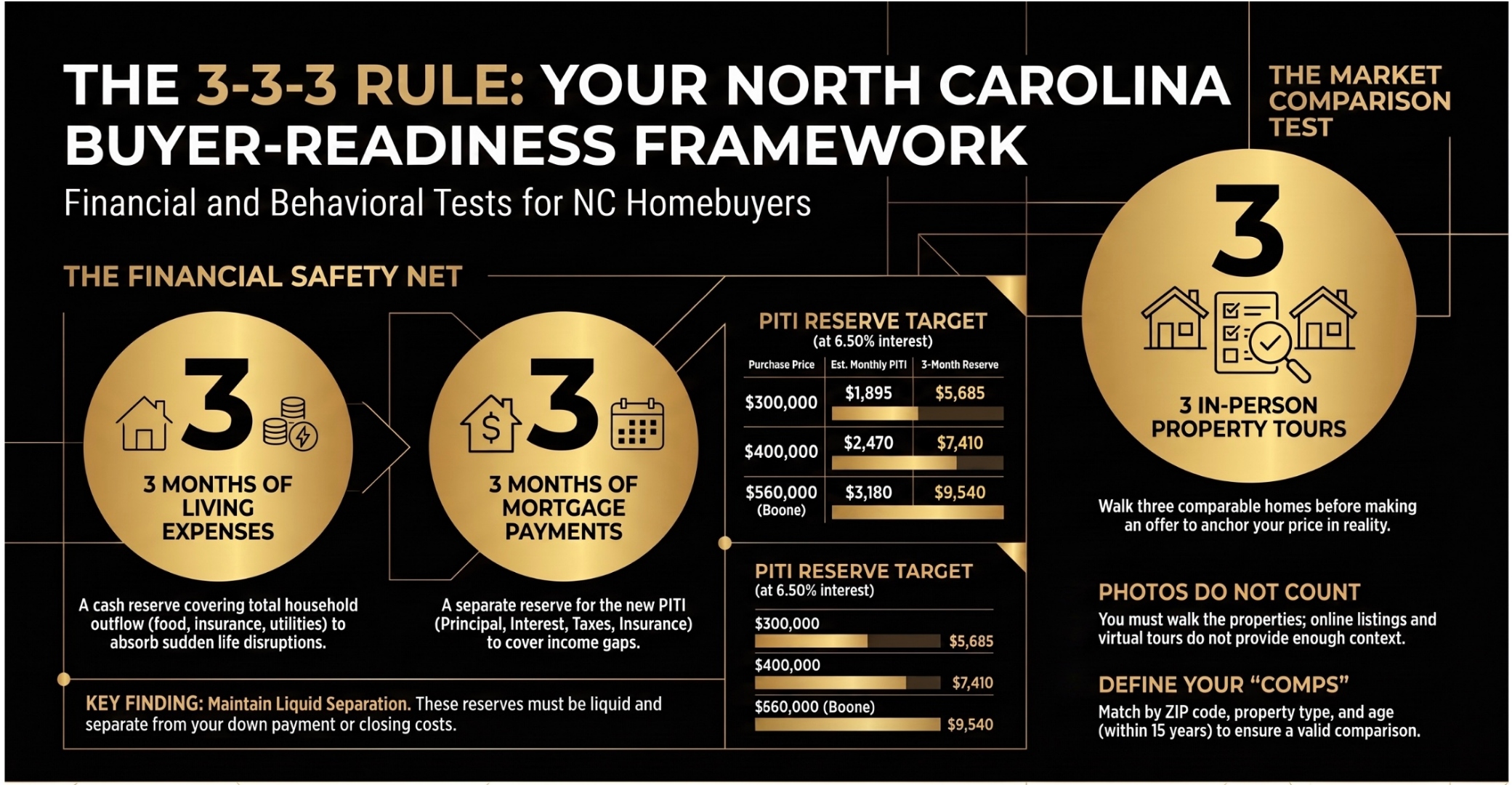
The core buyer-readiness 3-3-3 rule breaks into three tests you run before you write an offer. The first two are financial. The third is behavioral. If any one of them fails, the offer waits.
The three tests of the buyer-readiness 3-3-3 rule
| Test | What It Means | Why It Matters |
|---|---|---|
| 3 months of living expenses | Cash reserve equal to 3 months of your total household living expenses (rent or mortgage, food, transportation, insurance, utilities, minimum debt payments), untouched by the down payment or closing costs. | Handles a sudden income loss, a medical bill, or an early home repair without forcing a sale. |
| 3 months of mortgage payments | A separate reserve equal to 3 months of the new PITI (principal, interest, taxes, insurance) at the target purchase price. | Covers vacancy, slow business quarters, or an appraisal gap. Lenders on jumbo, second-home, and investor loans require this in writing. |
| 3 property comparisons | Tour at least 3 comparable homes in person before making an offer on any one of them. | Protects against overpaying by anchoring to a specific comp set, not to online photos or a listing agent narrative. |
The rule is informal. It is not an NCREC regulation, and no lender enforces the third test. But it maps closely to what serious lenders check on non-conforming loans, and it maps almost perfectly to how successful Triad buyers in the 2024 to 2026 cycle protected themselves during rate volatility, appraisal gaps, and repair-request season. Sources: FastExpert buyer-readiness explainer, and the buyer-readiness framing tracked in the 30/30/3 comparison guide.
Test 1: The 3 Months of Living Expenses Reserve
The first reserve exists to absorb life. Job disruption, car repair, an aging parent needing help, a health event. The number that matters is your household total monthly outflow, not just your future mortgage payment. Run a 90-day back-check on your checking account: everything that left, averaged, times three. That is the reserve minimum. Triad household examples below use median-income Triad homeowner budgets in Winston-Salem, Greensboro, and High Point.
Example: 3-month living-expense reserve by Triad city
| Household Type | Monthly Outflow (Est.) | 3-Month Reserve Target |
|---|---|---|
| Winston-Salem — single earner, no kids, $65K income | $3,600 | $10,800 |
| Greensboro — dual earner, 1 child, $110K income | $5,800 | $17,400 |
| High Point — retiree couple, no mortgage yet, $80K income | $4,200 | $12,600 |
| Boone — remote-work couple, $130K income, seasonal utility spike | $6,400 | $19,200 |
| West Jefferson — second-home owner, $180K income primary residence out of state | $8,200 (combined) | $24,600 |
This reserve stays in a high-yield savings or money market account. It is not the down payment. It is not the closing-cost budget. It is not the appliance-upgrade fund. It exists to keep the roof over your head when something you did not plan for happens in the first 12 months after closing.
Test 2: The 3 Months of Mortgage Payments Reserve
The second reserve is separate. It covers the new mortgage payment at the target price, taxes and insurance included, for three months. For most Triad buyers in the current 2026 rate environment, that number is bigger than they expect because taxes and insurance in North Carolina have been climbing.
Example: 3-month PITI reserve at Triad medians
Assumptions: 30-year fixed at 6.50 percent (NerdWallet North Carolina average August 28, 2026), 20 percent down, homeowners insurance $1,845 per year statewide NC average (BoringRate), county-level effective property tax rate.
| Market | Median Sale Price | Est. PITI (Monthly) | 3-Month PITI Reserve |
|---|---|---|---|
| Winston-Salem | $297,000 | $1,878 | $5,634 |
| Greensboro | $285,000 | $1,825 | $5,475 |
| High Point | $277,000 | $1,770 | $5,310 |
| Kernersville | $286,000 | $1,832 | $5,496 |
| Clemmons | $417,000 | $2,590 | $7,770 |
| Boone (Watauga) | $560,000 | $3,180 | $9,540 |
Note on the tax line: County effective property-tax rates blend municipal and unincorporated parcels. Watauga County-wide runs about 0.318 percent, but inside Boone or Blowing Rock town limits the combined county-plus-town rate is closer to 0.758 percent. Treat the PITI figures in this table as a floor for city-limits purchases. Confirm the exact combined rate with the town tax office or your closing attorney before setting your reserves target.
PITI is illustrative and rounded. Your actual monthly will move with your credit score, exact loan program, property-specific tax value, and the insurance quote for the actual address. Watauga carries the lowest effective property tax rate on the list at 0.43 percent per SmartAsset, which is why Boone PITI does not scale as steeply as raw price would suggest. Guilford at 0.92 percent effective and Forsyth at 0.90 percent are the higher-tax exposure ends of the Triad. Full Triad and High Country tax comparison at our NC Property Tax by County 2026 guide.
Why lenders read this reserve as a signal
Conforming Fannie and Freddie loans on a primary residence do not require the 3-month PITI reserve, but they read it as strength. On a second-home loan, most portfolio lenders require 2 to 6 months of PITI documented. On a jumbo loan above the conforming limit, 6 to 12 months of PITI is typical. On an investment property, 6 months of PITI per financed property is standard. The 3-3-3 rule tests you on the lower end of that reserve range regardless of loan type — because if you cannot document 3 months of the payment before you buy, you are one financial surprise away from selling in an emergency.
Test 3: The 3 Property Comparisons Walkthrough
The last test is behavioral and non-negotiable. Before making an offer on any Triad or High Country home, walk at least 3 comparable homes in person. Comparable means same rough price band, same submarket, same type (single-family, townhome, condo, cabin), and same age band. Photos on Zillow and Redfin do not count. Virtual tours do not count. Neither does driving by. You have to walk them.
Why this test exists
Buyers who have not walked 3 comps almost always anchor to the first home they toured. They defend a price the market does not defend. They miss condition issues the second comp would have exposed. They overpay by 3 to 8 percent, which on a $300,000 Triad home is $9,000 to $24,000. That is real money and it is hard to un-do after closing.
Buyers who have walked 3 comps show up to the offer conversation with specific, defensible reference points. They can say, "This one is $30,000 more than the Clemmons ranch, but the kitchen is already updated and the yard is flat." That is a defensible offer. That is also why sellers respond to it better than to a low-ball with no context.
What counts as a comparable in the Triad and High Country
| Attribute | Acceptable Range |
|---|---|
| Price band | Plus or minus 15 percent of your target |
| Location | Same ZIP code, or same school district if suburban |
| Property type | Match: single-family, townhome, condo, or cabin (High Country) |
| Living square footage | Plus or minus 20 percent |
| Age band | Within 15 years of build date, unless you are shopping historic districts (Buena Vista, West End, downtown Greensboro) where age is the point |
| Bedroom count | Match, or plus or minus 1 |
| Lot type | Match interior vs corner, flat vs sloped, wooded vs cleared |
Three good comps beat ten thin ones. The point is to arrive at your offer with three side-by-side reference points, not with a wall of listings.
Alternative 3-3-3 Framings (Do Not Confuse Them)
Because the label is informal, four different frameworks travel under similar names. Below is what each one means and when each one applies.
1. The buyer-readiness 3-3-3 (this article, primary)
3 months living reserve, 3 months PITI reserve, 3 comparable walkthroughs. Applies to every Triad or High Country residential buyer.
2. The holding-period 3-3-3
Some agents use 3-3-3 to describe a stability screen: plan to stay in the home at least 3 years, expect around 3 percent annual appreciation as a long-term average, and budget for roughly 3 percent in each of buying and selling transaction costs. Source: FastExpert holding-period framing.
The holding-period framing exists because homes are not liquid. If you buy today and sell in 18 months, the 3 percent buyer costs plus the 6 to 8 percent seller costs plus the modest 18-month appreciation almost always net you a loss. The 3-3-3 stability screen prevents that outcome. In the Triad in 2026, appreciation is running closer to 1.4 to 3.4 percent year over year across the anchor cities per our own Triad market reports, so the 3-year holding assumption is doing real work.
3. The 30/30/3 rule (adjacent, often confused)
Popularized by Financial Samurai in 2009, the 30/30/3 rule is a separate affordability screen. Total housing cost at 30 percent of gross monthly income, 30 percent of home price saved before buying (20 percent down plus 10 percent buffer), and a home price no more than 3 times gross annual household income. Source: 30/30/3 rule guide and MIDFLORIDA rule of 3 explainer.
Applied to a Triad household earning $110,000 gross (before the current NC flat state income tax of 3.99 percent for 2026 per NCDOR and federal withholding): max home price $330,000, target savings before buying $99,000 (thirty percent of the target purchase price), and monthly total housing under $2,750. That reaches comfortable Winston-Salem, Greensboro, High Point, and Kernersville purchases inside the 30/30/3 band as of late August 2026. It does not reach Clemmons or Boone, where median prices already sit above the $330,000 cap, so a $110,000 household would need to relax the 30-percent-saved test or extend timelines to buy in those submarkets.
4. The seller diagnostic 3-3-3
Not a buyer rule at all. A seller diagnostic based on how long a Triad or High Country listing has been active without a serious offer. First 3 days: exposure test. First 3 weeks: pricing verdict. First 3 months: reputational damage warning. Sources: iBuyer price-reduction 2026 guide, arthurzhao.realtor 21-day pricing framework, and Zillow when-to-lower guide.
Full breakdown of the seller diagnostic below.
The Seller Diagnostic 3-3-3: 3 Days, 3 Weeks, 3 Months
When a Triad or High Country home is on the market and not selling, the seller diagnostic 3-3-3 tells you what the market is signaling at each stage. The 2026 data points below come from Zillow research, RE/MAX November 2025 guidance, and expert commentary compiled by iBuyer and realtor.com.
The three stages
| Stage | What to Watch | What It Means |
|---|---|---|
| First 3 days: exposure test | 3 to 10 showings in the first three days per the Goodhart Group first-week volume benchmark; saved-search buyers should be showing up. Zero showings in three days is a red flag. | If nobody shows in the first 3 days, the listing photos, price band, or showing access is filtering buyers out at the search stage. This is a search-level problem, not a price-level problem yet. |
| First 3 weeks: pricing verdict | 10 to 15 showings by end of week 3 in a normal market. Consistent showings without offers by week 3 is the widely-cited pricing signal. Per iBuyer 2026, 14 to 21 days without offers is the standard reduction trigger in a balanced market. | If showings are happening but no offers land by day 21, buyers are comparing your home against comps and choosing not to bid. That is a price problem. A meaningful reduction of 3 to 5 percent is warranted, per iBuyer 2026 and Creekstone Real Estate. |
| First 3 months: reputational damage warning | Per Zillow research cited by arthurzhao.realtor, past 30 days without an offer buyer psychology shifts to "something must be wrong." At 90 days without a contract, reputational damage compounds and a larger reduction is typically required to reset perception. | By month 3 the market has moved on. Options: withdraw and relist after cosmetic changes, take a larger single reduction, or accept that current price and current condition together are outside the market. A relaunch with new photography, new copy, and a decisive single cut typically outperforms a series of small drops. |
Triad-specific seller reduction bands in 2026
In a balanced Triad market — which is what Winston-Salem, Greensboro, and High Point are running in August 2026 with 3.6 months of supply — first-reduction size lands at 3 to 4 percent per iBuyer 2026 guidance. That is $12,000 to $16,000 on a $400,000 Clemmons listing, or $9,000 to $12,000 on a $300,000 Winston-Salem listing. A single decisive cut in weeks 2 or 3 outperforms three or four small $2,000 cuts spread across three months.
How to Apply the 3-3-3 Rule Before Making a Triad or High Country Offer
Practical 3-step run through, in order.
Step 1: Do the reserve math
Print your last three months of checking-account activity. Total the outflow. Divide by 3. That is your monthly living-expense number. Multiply by 3 for your first reserve target. Then get a pre-approval at your target purchase price and ask your lender for a PITI estimate including your county property tax rate and a real homeowners insurance quote for the actual address you are considering. Multiply that PITI by 3 for your second reserve target. Both reserves stay separate from the down payment.
Step 2: Book 3 tours before making any offer
Ask your buyer agent to line up 3 comparable homes in the same ZIP code and price band. Walk all three within a two-week window so you can compare them fresh. Take one photograph of each kitchen, primary bedroom, and yard for reference. Skip the interior shots that show family photos or personal items — you are looking at the house, not the seller.
Step 3: Run the 30/30/3 sanity check
Before your offer is written, run the 30/30/3 numbers as a secondary check. Housing cost under 30 percent of gross monthly income, at least 30 percent of price saved between down payment and reserves, and price no more than 3x gross annual income. If the property fails 30/30/3 but passes 3-3-3, you probably can afford it, but the margin is thinner than the traditional target. If it fails both, wait or lower the target price.
Reserve sanity table by purchase price
| Purchase Price | Est. PITI at 6.50 percent NC 30-yr, 20 pct down | Total 3-3-3 Reserve Target (Living plus PITI) |
|---|---|---|
| $250,000 | $1,620 | Living reserve plus $4,860 |
| $300,000 | $1,895 | Living reserve plus $5,685 |
| $400,000 | $2,470 | Living reserve plus $7,410 |
| $500,000 | $3,040 | Living reserve plus $9,120 |
| $700,000 | $4,180 | Living reserve plus $12,540 |
| $1,000,000 | $5,895 | Living reserve plus $17,685 |
Add your household 3-month living-expense number on top of the PITI reserve column. That combined total is the minimum liquid cash beyond down payment and closing costs that the 3-3-3 rule asks you to hold on closing day.
Take the full briefing with you
The 3-3-3 Rule — NC Buyer Readiness 2026, the companion PDF. Ten pages, brand designed, with the Triad and Boone reserve tables at 6.5 percent, the seller diagnostic 3-3-3, and the 30/30/3 sanity check. Save it offline for the pre-approval conversation and the drive to your first three tours.
Frequently Asked Questions
Is the 3-3-3 rule required by North Carolina law or the NCREC?
No. The 3-3-3 rule is not an NCREC regulation and no NC lender enforces the property-comparison test. It is an informal buyer-readiness framework recommended by financial-education sources including FastExpert and mirrored inside the lender reserves that apply to jumbo and second-home loans. Following it is optional but protective.
Do the two cash reserves have to be separate?
Yes. That is the point. If both reserves live in the same account and you dip into one for the other, you no longer have a buffer against life plus a buffer against slow income. You have one buffer that has to cover both risks. Keep the living-expense reserve in one high-yield savings account and the mortgage-payment reserve in another, or at minimum earmark them separately on paper.
How does the 3-3-3 rule interact with the NC due-diligence period?
The 3-3-3 test is a pre-offer readiness check. The NC due-diligence period is a post-offer inspection window during which you can walk away and lose only the negotiated fee. They complement each other. Do 3-3-3 before you write. Do due diligence after you sign. Neither replaces the other.
Does the 3-3-3 rule apply to cash buyers?
Yes, differently. Cash buyers do not need the second reserve to cover mortgage payments because there is no monthly payment. They still need the first reserve (3 months of living expenses) and the third test (3 comparable walkthroughs). The comparison test is arguably more important for cash buyers because there is no lender-ordered appraisal to catch overpaying.
What is the difference between the 3-3-3 rule and the 30/30/3 rule?
The 3-3-3 rule tests readiness at the moment of purchase (3 months of each of two reserves plus 3 property comparisons). The 30/30/3 rule tests affordability across the ownership window (30 percent housing cost cap, 30 percent saved before buying, 3x income max price). They answer different questions. Sophisticated Triad buyers run both.
Should sellers use the 3-3-3 diagnostic instead of a formal price-reduction schedule?
The 3-day, 3-week, 3-month diagnostic is a market-reading tool, not a schedule. It tells you which signal to weight (search-level exposure, pricing verdict, or reputational damage). Your actual reduction schedule should follow the diagnostic outcome, not a calendar. Zero showings in 3 days: fix photos or price band. Showings but no offers by day 21: cut 3 to 5 percent decisively. Stale at 90 days: withdraw, refresh, relaunch with new pricing.
How many homes should Triad and High Country buyers see before making an offer?
At minimum 3, per the third test. Most Triad buyers who close successfully tour 8 to 15 homes in total, per iBuyer showings-before-offer 2026 guidance. The 3-3-3 rule is a floor, not a ceiling. If your third comparable feels like the right one, do not tour more just because. But do not tour fewer either.
Ready to Apply the 3-3-3 Rule to Your Triad or High Country Purchase?
The 3-3-3 rule is not complicated. It is a discipline. Reserve, reserve, compare. Two financial buffers, one behavioral check. If you are within 6 to 12 months of a Triad or High Country purchase, run the math this week, book comparable-home tours as soon as your search area is locked in, and get a lender pre-approval that includes a real PITI at your target address.
Call 336-262-3111 · Text 336-262-3111 · Email teresatedder@gmail.com
Author: Teresa Overcash, Broker-in-Charge and Owner of Realty ONE Group Results. 30 years of active North Carolina real estate production and over a billion in personal career sales. Licensed NCREC Instructor. CLHMS certified. Top 1 percent nationally ranked producer serving Triad, Wilkes County, and High Country NC. Every buyer we work with runs the 3-3-3 test before writing an offer, and every listing we take gets read against the 3-day, 3-week, 3-month diagnostic. Questions? Call or text 336-262-3111 or email teresatedder@gmail.com.