Boone NC Real Estate: How to Find Mountain Properties with No HOA Restrictions
By Teresa Overcash, Broker-in-Charge · September 3, 2026
14 min read
Quick answer: The best no-HOA homes for sale in Boone NC sit in unincorporated Watauga County — Junaluska Road, Vilas and Sugar Grove, Deep Gap, and Valle Crucis. Boone’s July 2026 median sold price was $485,000 with 42 days on market. No-HOA means more freedom but Town of Boone STR and zoning rules still apply.
Updated September 3, 2026 · Teresa Overcash, Broker-in-Charge, Realty ONE Group Results
Watch: Teresa walks the four Boone corridors where no-HOA homes still exist and the five due-diligence items every mountain buyer should verify before writing an offer.
Read the full video transcript
This is Teresa Overcash, Broker in Charge at Realty ONE Group Results. This video uses AI-generated narration of a script I wrote and reviewed. We’re talking about buying no-HOA property in Boone and Watauga County, the four corridors where the unrestricted inventory actually lives, and the mountain-specific homework every buyer needs to do before waiving due diligence.
Let’s start with why buyers filter for no HOA. Three reasons, and all three are legitimate. First, the dues you keep. Boone-area associations typically run three hundred to twenty-four hundred dollars a year, which is twenty-five to two hundred dollars a month you don’t send anywhere. Second, the architectural review committee. Metal roof for snow load, a workshop, an accessory dwelling, a gravel drive wide enough for the truck and a trailer. Nobody votes on it but you. Third, rental flexibility. Many Boone-area associations have adopted short-term rental bans or thirty-day minimums over the last several years. Without an HOA, that option stays open, subject to town or county rules, which we’ll get to.
Here’s what most buyers don’t hear until they close. What disappears is only half the story. What arrives in its place is your road, your snow removal, your well, your septic, your drainage. Every service an HOA quietly performs becomes a line item you own personally. No HOA is beautiful in July on the deck. It gets expensive in January if you skipped the winter homework.
Now let’s walk the four corridors where inventory turns up consistently. Junaluska Road, about ten minutes from King Street, three-bedroom homes on one to two acres in the five-sixty to six-sixty range. Long-range views common. Most parcels sit on county roads or shared private drives, so check the deed for a recorded road maintenance agreement. That’s an entirely separate instrument from an HOA covenant. Vilas and Sugar Grove, fifteen to twenty-five minutes west on Highway 194, where the terrain opens into Watauga’s traditional agricultural corridor. Bigger acreage, thinner restrictions, and the widest price spread of the four. Deep Gap, east on US 421 between Boone and Wilkesboro, where the Blue Ridge Parkway crosses. This is where full-time residents land when they want mountain life without the steep-slope winter commute. Prices run ten to twenty percent below Boone-proper comps for comparable acreage, and the unrestricted inventory is deeper because most of it was never platted as subdivision in the first place. And Valle Crucis, the historic community along the Watauga River, home to the original Mast General Store. A few small associations and some conservation-easement land, but the majority are unrestricted individual parcels. River frontage and the school district carry the premium.
Now here’s the trap. No HOA does not mean no rules. Inside Town of Boone limits, short-term rentals require an annual permit, the zoning code defines homestay versus vacation rental, the Unified Development Ordinance governs by district, and steep-slope review triggers at thirty percent grade with heavy restrictions above fifty. In unincorporated Watauga there is currently no countywide STR permit, no countywide zoning code, but state stormwater rules apply and occupancy and sales tax are owed either way. The line that decides everything is whether the parcel sits inside or outside Boone town limits. Verify the parcel, not the mailing address.
Before you underwrite any rental income, call Town of Boone Planning and Inspections and confirm the current permit fee, the rental category your plan falls into, and whether your zoning district allows it. Then confirm the current combined sales and occupancy tax rate with the county. Getting this wrong doesn’t reduce your return. It eliminates it. A property that cannot legally be rented earns nothing.
Here’s the seven-item checklist we run before any client removes a due diligence contingency. Road maintenance agreement, a recorded document at the Register of Deeds. Winter plowing plan. Well flow test in gallons per minute. Water quality panel for bacteria, nitrates, lead, and VOCs. Septic inspection of tank and drainfield. Permitted septic capacity from the county, which matters for an ADU. Insurance quote on the specific address. If the parcel is inside town limits, add a steep-slope determination. None of these are optional on a mountain property.
The item to act on before you write an offer is the road maintenance agreement. When a property fronts a private road or shared drive, most conventional lenders, and FHA and VA programs, require a recorded agreement. Without one the loan may not close. Buyers discover this during underwriting, weeks in, with a closing date already booked. Get a copy from the seller or pull it at the Register of Deeds before you go under contract. If it doesn’t exist, creating one means getting every owner on the road to sign, which is a negotiation with neighbors you haven’t met yet.
And confirm legal access. Deeded, recorded access, not the family has always driven across the neighbor’s land. Historical use is not an easement, and a property without legal access is close to unfinanceable and very difficult to resell.
On the well, order a flow test in gallons per minute, not a listing note that says the well is good. Run a full quality panel. On the septic, ask the county what bedroom capacity the system is actually permitted for. A four-bedroom house on a three-bedroom permit is a problem you inherit at closing, and it forecloses the ADU that may have been the whole reason you wanted an unrestricted parcel. On insurance, mountain carriers ask about roof material, heat source, driveway grade, and elevation. Metal roofing is preferred at altitude. Some carriers decline gravel-access properties above certain elevations outright. Get a real quote on the specific address from a local independent agent before your due diligence window closes.
Here’s the market context. Boone-area single-family homes are moving in roughly six weeks at close to asking price. Well-priced unrestricted property is not sitting around waiting for you to finish your research, which is exactly why the research happens before you find the house.
If you’re serious about a no-HOA property, don’t rely on the big portals. The no-HOA checkbox misses listings where the agent never coded the field, which happens constantly in rural mountain markets. Call or text me at 336-262-3111, tell me the corridor, and we’ll pull the Watauga MLS directly and flag the properties that actually clear the checklist. That’s the whole video. Thanks for watching.
{"__asi_start__": {"model": "gemini_3_1_pro"}}
{"__asi_media__": {"type": "text", "path": "/home/user/workspace/c_00_evaluation.txt", "mime_type": "text/plain"}}
All right, let’s dive right into this explainer and unpack a truly massive trend happening right now in the Boone, North Carolina mountain real estate market. We are looking at this fascinating shift where buyers are just aggressively targeting properties that don’t have homeowners associations. It’s a dynamic that is completely reshaping property values and honestly just fundamentally changing how people buy in the high country.
So I want to pose this question directly to you right out of the gate. Why are buyers actually paying a premium to avoid HOA rules? Because you know, skipping the HOA isn’t really about just saving a few bucks on your monthly dues. What this is really about is buying freedom, pure and simple. Buyers are actively seeking out total autonomy over their land. And as you’ll see, they are more than willing to pay top dollar for it.
Here is our road map for today. One, the appeal of no HOA. Two, top unrestricted Boone corridors. Three, the short-term rental reality. Four, understanding local zoning rules. Five, the maintenance checklist. And six, the true cost of freedom.
Okay, jumping right into section one, the appeal of no HOA. The whole appeal of avoiding an HOA really boils down to three core freedoms. First, and absolutely foremost, it’s about preserving your short-term rental income. I mean, strict Airbnb bans have spread like wildfire through a lot of Boone area HOAs recently. Second is property modifications. Without an HOA, you don’t have to go begging some
{"__asi_start__": {"model": "gemini_3_1_pro"}}
{"__asi_media__": {"type": "text", "path": "/home/user/workspace/c_01_evaluation.txt", "mime_type": "text/plain"}}
some architectural committee just to put up a heavy-duty metal roof for the snow load or, you know, just to park your RV in your own driveway. And finally, yeah, there’s the monthly carrying cost. You’re saving anywhere from $600 to $2,400 a year. But make no mistake here, those lower dues are really just a bonus. The main driver? Buyers are running from HOAs to fiercely protect their autonomy and their rental income potential.
To put that into perspective, local broker in charge Teresa Overcash sees this on the ground every single day. She notes that buyers will quite literally walk away from absolutely beautiful homes simply because an HOA banned short-term rentals. And get this, when a no HOA property hits the market in that exact same price range, the offers usually come together in under a week. That freedom literally translates into real tangible dollar value and massive buyer urgency.
Moving on to section two, top unrestricted boon corridors. Think of this next part as your personal treasure map. These four corridors are all located in unincorporated Watauga County, which is exactly why HOAs never really took root there. First up, you have the Junaluska Road area. This is kind of the sweet spot. It’s about 10 minutes from downtown and a solid three-bedroom home on one to two acres is going to run you between $560,000 and $660,000. Then heading west, there’s Vilas and Sugar Grove. This is the agricultural corridor, perfect for cabin sites or large acreage. Prices here are super wide-ranging, from 45 grand for a small plot all the way to nearly 600,000.
{"__asi_start__": {"model": "gemini_3_1_pro"}}
{"__asi_media__": {"type": "text", "path": "/home/user/workspace/c_02_evaluation.txt", "mime_type": "text/plain"}}
thousand dollars for massive 57 acre homestead. Over to the east, Deep Gap is fantastic for full-time residents who need an easier winter commute off those steep mountain slopes. Plus, prices there actually run about 10 to 20% below Boone proper. Finally, Valle Crucis commands premium pricing, and that’s thanks to its historic community vibe, great schools, and that gorgeous Watauga River frontage.
Next up, section three, the short-term rental reality. Now, here is where things get a little tricky, because no HOA absolutely does not mean zero rules. The municipal lines completely dictate your reality here. If you buy inside the town of Boone, you’re subject to their Unified Development Ordinance. You’re going to need an annual permit, and they strictly define your rental. It’s either a homestay, meaning you live there and rent out two bedrooms or less, or a vacation rental. Contrast that with unincorporated Watauga County. Out there, well, there’s currently no countywide STR permit required, and no countywide zoning codes, which means a much, much lighter regulatory burden. It’s exactly why investors flock to places like Vilas and Deep Gap. But here is the biggest takeaway, so listen closely. You might escape the HOA, but you cannot escape the taxman. State and county occupancy taxes still apply across the board.
Which brings us nicely to section four, understanding local zoning rules. Basically, municipal zoning steps in where private HOAs left off. Inside the town of Boone, the zoning is incredibly strict. I mean, get this. A slope over 50% is considered very
{"__asi_start__": {"model": "gemini_3_1_pro"}}
{"__asi_media__": {"type": "text", "path": "/home/user/workspace/c_03_evaluation.txt", "mime_type": "text/plain"}}
Steep by the town and is practically unbuildable. No way around it. They also enforce strict stream buffers and complex storm water controls. But out in Wataga county there is no countywide zoning code. You’re primarily regulated by state septic rules and county subdivision regulations and those steep slope rules, they’re enforced far less aggressively. So the general rule of thumb is, the further you get from downtown Boone, the fewer public rules you have stacking on top of your no HOA deed.
All right, section five, the maintenance checklist. Having no HOA means you are dealing with private infrastructure, which is really just a polite way of saying you are entirely on your own. If you’re on a private road, nobody is sending a community snow plow for you. You have to figure out winter plowing yourself. That means either shelling out up to $2,000 for a seasonal contract or buying your own plow and freezing at 5:00 a.m. in January to do it yourself. You’ve also got to manage your own water and waste. You need a well flow test, a water quality panel to check for things like bacteria and lead, and a full blown septic inspection. Actually don’t forget the county septic permit either. You have to pull that to confirm how many bedrooms you are legally allowed to claim. And finally the whole insurance situation. You have to verify carrier acceptance because a lot of carriers won’t even write policies for homes with ultra steep gravel access or certain types of heat sources. It’s the whole shebang.
And speaking of those private roads, we really need to talk about the road maintenance agreement. This is a recorded legal document that literally outlines how neighbors sharing a private road are going to split the cost for plowing, fresh gravel and road repairs. Now I want to emphasize
{"__asi_start__": {"model": "gemini_3_1_pro"}}
{"__asi_media__": {"type": "text", "path": "/home/user/workspace/c_04_evaluation.txt", "mime_type": "text/plain"}}
This is entirely separate from an HOA covenant. There are no monthly dues going to some management company. But here is the major catch. Most conventional, FHA, and VA lenders absolutely require this document in order to close your loan. If you don’t have it, the deal often dies right there.
Finally, section six, the true cost of freedom. Just take a look at this number for a second, $485,000. That was the median sold price for a single family home in Boone as of July 2026. And the market urgency, it’s wild. Properties are moving in just 42 days with a staggering 99.1% sold to list ratio.
So what does that tell us? It tells us buyers are not getting discounts right now. Well-priced no HOA properties are just flying off the market, and anyone sitting around waiting for a price drop is completely losing out.
Theresa Overcash gives buyers some phenomenal advice on this front. She says don’t chase the cheapest listing, chase the property where the fundamentals actually add up. Think about it. A no HOA cabin that already has clean water, a legit road maintenance agreement on file, and a fully working septic system, that is easily worth $30,000 more than some restricted HOA property that just appears to be $30,000 cheaper on paper.
Freedom definitely compounds over time, but honestly so does the massive headache if you buy a place with broken fundamentals. Which brings us to our final thought today, is the freedom of having no HOA...
{"__asi_start__": {"model": "gemini_3_1_pro"}}
{"__asi_media__": {"type": "text", "path": "/home/user/workspace/c_05_evaluation.txt", "mime_type": "text/plain"}}
Really worth all that winter homework? On one hand, you get to run your short-term rentals, build whatever you want and live completely independently. It’s an absolutely beautiful kind of freedom in the middle of July. But on the other hand, you have to weigh that against the very expensive, very cold realities of managing your own private road in the dead of January. That is the real trade-off in the Boone Mountains. Thanks for joining me on this explainer, and I’ll catch you on the next one.
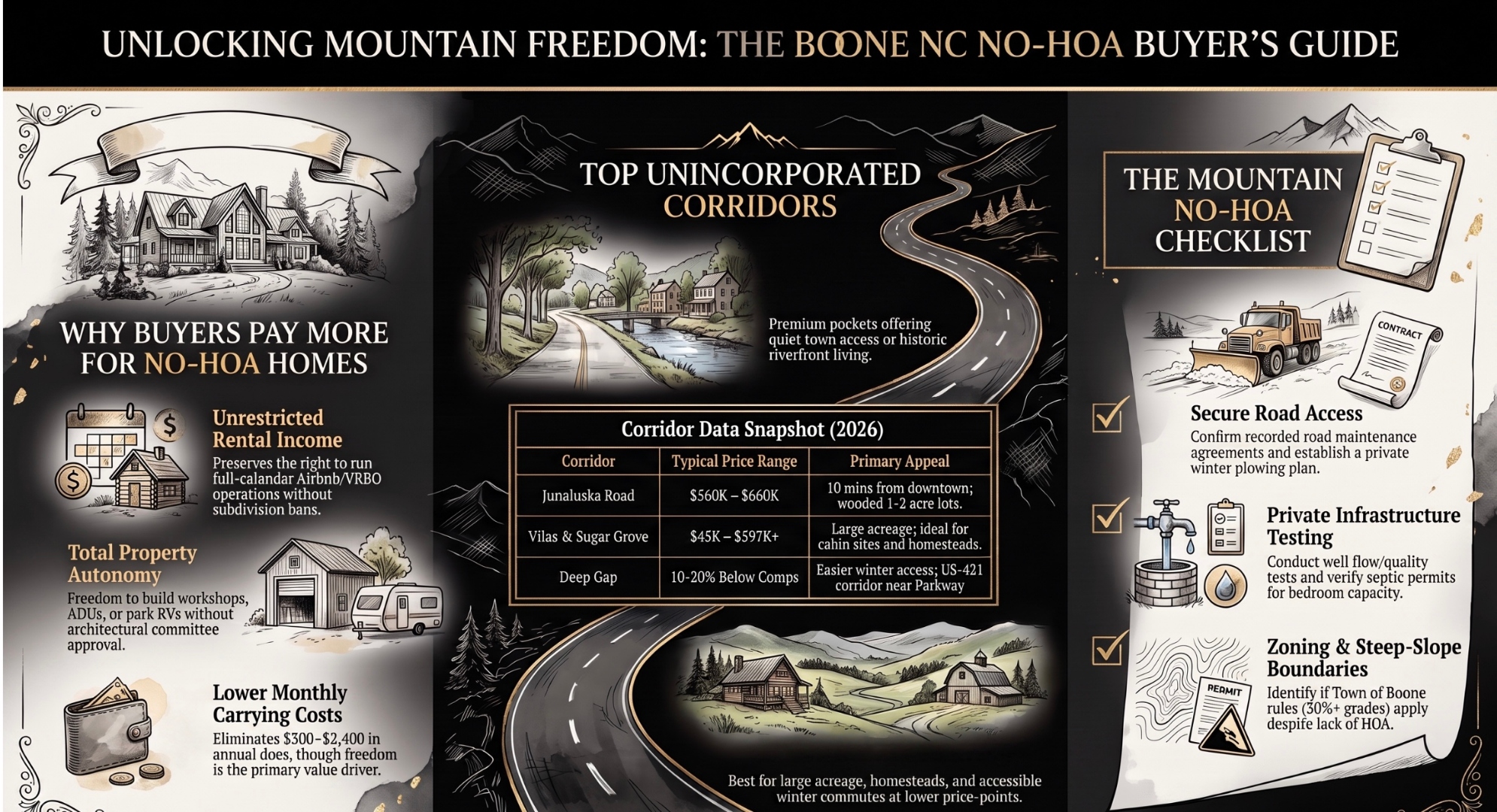
The Boone no-HOA buyer’s field map: four unincorporated corridors, five due-diligence items, and the STR rule that still applies without an HOA. Download the full field guide (PDF).
Why Buyers Pay More for No-HOA Homes in Boone
An HOA in a Boone-area subdivision runs $300 to $2,400 a year in dues, and the rulebook often bans the three things mountain buyers want most: short-term rentals, detached garages or workshops, and the freedom to park an RV or camper in the driveway. When those restrictions disappear, so does a big chunk of the buyer pool that filters listings looking for “no HOA fees” on Zillow and Realtor.com.
That premium shows up in three ways.
Short-term rental income stays on the table. Many Boone-area HOAs adopted STR bans or minimum-30-day rental rules between 2018 and 2024. A no-HOA property preserves the option to run a full Airbnb or VRBO calendar — subject to Boone town rules or Watauga County rules, which we’ll cover below.
Property modifications are yours to make. Want a metal roof for snow load? A 400 square foot ADU for a grown kid or rental income? A gravel driveway wide enough for your F-250 and a boat trailer? No architectural review committee gets a vote.
Monthly carrying cost stays lower. A typical Boone-area HOA runs $600 to $2,400 a year in dues. That’s real money you’re not sending to a management company every month. Just don’t let anyone tell you the dues savings changes your affordability math — on a real Boone-priced loan, $50 a month is roughly a fifth of a point of rate, not a quarter point, and it won’t move your DTI or your pre-approval ceiling. Buy no-HOA for the freedom and the rental option. The lower dues are a bonus, not the reason.
“I’ve had buyers walk away from beautiful Boone homes because the HOA banned short-term rentals. When we find a no-HOA property in the same price range, the offer usually comes together within a week. That freedom has real dollar value in this market.”
— Teresa Overcash, Broker-in-Charge, Realty ONE Group Results
Top Boone Pockets With No-HOA Properties
These are the corridors where our team consistently finds unrestricted listings. Every one of them is unincorporated Watauga County or a mixed-zoning stretch, which is exactly why HOAs never got established there.
Top Boone Pockets With No-HOA Properties
Corridor
Location relative to Boone
Typical price range (2026)
Best for
Junaluska Road
10 min from downtown, county
$560K – $660K (3BR homes, 1-2 ac)
Buyers who want quiet with easy town access
Vilas & Sugar Grove
West on Hwy 194, 15-25 min
$45K/2.5ac to $597K/57ac (land + homes)
Cabin sites, homesteads, larger acreage
Deep Gap
East on US-421, 15 min
10-20% below Boone-proper comps
Full-time residents needing winter access
Valle Crucis
Southwest on Hwy 194, 15 min
Premium (river frontage, school district)
Buyers wanting historic community + river
Junaluska Road area
The sweet spot for buyers who want quiet mountain living without a long drive. Junaluska sits about 10 minutes from downtown King Street and Appalachian State University. Recent Zillow and MLS activity puts three-bedroom homes on 1-acre wooded lots in the $560K to $660K range, with long-range views common. Most parcels are on unrestricted county roads or shared private drives — you’ll need to check the deed for a road maintenance agreement, which is a separate document from an HOA.
Vilas and Sugar Grove
Head west from Boone on Highway 194 and the terrain opens up. Vilas and Sugar Grove are the traditional agricultural corridor of Watauga County, which is why acreage is bigger and restrictions are thinner. LandSearch and public listings currently show parcels from $45,000 for 2.5 acres up to $597,800 for 57 acres in this stretch. Buyers here are typically looking for cabin sites, working homesteads, or family compounds — not tract homes.
Deep Gap
Deep Gap sits along US-421 between Boone and Wilkesboro, right where the Blue Ridge Parkway sweeps through on its way south from the Virginia line. It’s where full-time residents go when they want mountain life but need an easier winter commute off the steep slopes. Doc Watson lived here. Prices tend to run 10 to 20 percent below Boone proper for comparable acreage, and the no-HOA inventory is deeper because most of Deep Gap was never platted as a subdivision in the first place.
Valle Crucis
Historic community along the Watauga River, home to the original Mast General Store. Valle Crucis has some conservation-easement land and a few small HOA subdivisions, but the vast majority of properties are unrestricted individual parcels. Prices run higher here than Vilas or Deep Gap because of the river frontage and the school district.
Short-Term Rental Rules Still Apply (With or Without HOA)
This is the trap I watch buyers fall into every season: they close on a no-HOA property assuming they can list it on Airbnb the next day, and then they find out the town or county has its own STR ordinance.
Here’s the two-tier reality for Boone-area STRs in 2026:
Short-Term Rental Rules Still Apply (With or Without HOA)
Rule
Inside Town of Boone
Unincorporated Watauga County
Permit required?
Yes — annual fee (confirm current amount with Town of Boone)
No countywide STR permit currently
STR categories
Homestay (owner-occ, ≤2BR) or Vacation Rental
None defined countywide
Zoning restrictions
Yes, per UDO district
No countywide zoning code
Total tax stack
State sales + county local sales + county occupancy — confirm current rates with Watauga County Tax
State + county occupancy tax only — confirm current rates
Ordinance date
Dec 8, 2021 UDO amendment
N/A
Enforcement authority
Boone Planning & Inspections
State + county tax authorities
Inside Town of Boone limits: The Town of Boone amended its Unified Development Ordinance on December 8, 2021, and now runs a dual-category system. A “homestay” is an owner-occupied rental of two bedrooms or fewer for less than 30 days. A “vacation rental” is anything else — a whole-house rental with no owner on-site. Both require an annual permit, must meet specific zoning-district rules, and are subject to a combined tax load that includes state sales tax, the Watauga County local sales tax, and the county room-occupancy tax. Permit fees and tax rates get updated on a regular basis, so before you list on Airbnb or VRBO, call Town of Boone Planning & Inspections at (828) 268-6960 for the current permit amount, and Watauga County Tax Administration at (828) 265-8036 for the current combined tax rate. Don’t trust an old blog post — not even this one two years from now.
Unincorporated Watauga County: Outside town limits, Watauga County does not currently have a countywide STR permitting ordinance. You still owe state and county occupancy taxes and any applicable business licenses, but the regulatory burden is lighter. This is the primary reason the STR-investor demand for unincorporated Vilas, Deep Gap, and Sugar Grove properties has stayed so strong.
Bottom line: no-HOA does not equal no-rules. It means fewer private layers of rules on top of the public ones.
The Mountain No-HOA Checklist
Here’s what our team walks through with every no-HOA buyer in Boone. Miss one of these and you can turn a dream cabin into a five-figure headache within the first winter.
The Mountain No-HOA Checklist
Item
What to check
Typical cost
Road maintenance agreement
Recorded document at county register of deeds
$0 if it exists; $500-$2K to create
Winter road plowing
Contract or DIY plan for private drives
$500-$2,000/season
Well flow test
Gallons-per-minute measurement
$300-$500
Water quality panel
Bacteria, nitrates, lead, VOCs
$150-$300
Septic inspection
Tank condition + drainfield perc
$400-$700
Watauga County septic permit
Confirm bedroom capacity (call 828-264-4995)
Free lookup
Steep-slope review (if in town)
30%+ grade triggers ordinance
$0 to confirm
Insurance carrier acceptance
Local independent agent, roof + heat source
Quote-only
Winter road maintenance
No HOA means no community snowplow contract. If your driveway or access road is private, you’re on the hook for plowing — either a $500 to $2,000-per-season contract with a local operator, or the equipment and time to do it yourself. Homes on NCDOT-maintained state roads get plowed for free; homes on private easements or gravel drives do not. Ask for the maintenance history in seller disclosures.
Road maintenance agreements
Most conventional lenders, and all FHA and VA lenders, require a recorded road maintenance agreement when a property fronts a private road. This is a separate legal instrument from an HOA covenant. Without one, your loan may not close. Get a copy from the seller or the county register of deeds before you go under contract.
Well and septic due diligence
No-HOA typically means private infrastructure. Order a well flow test (measured in gallons per minute), water quality panel (bacteria, nitrates, lead, VOCs), and a septic inspection (tank condition and drainfield percolation). Watauga County Environmental Health can confirm the permitted septic capacity, which matters if you plan to add bedrooms or an ADU.
Town of Boone vs Watauga County zoning
Even without an HOA, properties inside Boone town limits still fall under the Boone Unified Development Ordinance. That includes steep-slope rules (any slope 30 percent or greater triggers the ordinance; 50 percent or greater is “very steep” and highly restricted), stormwater controls, and stream-buffer setbacks. County properties fall under Watauga County subdivision regulations and state septic rules but have fewer municipal overlays.
Insurance and access
Confirm the property has legal, deeded access — not just historical use. Insurance carriers will ask about roof material (metal is preferred for snow), heating system (wood stoves must be certified), and driveway grade. Some carriers won’t write policies on gravel-access properties above a certain elevation. Talk to a local independent agent before removing your due diligence contingency.
What No-HOA Homes Are Selling For Right Now
Here’s the current Boone-area market context from our July 2026 Watauga County MLS data, cross-checked against Realtor.com and Zillow snapshots.
What No-HOA Homes Are Selling For Right Now
Boone-area metric
July 2026 value
Source
Median sold price (single-family)
$485,000
Watauga County MLS via Realty ONE Group Results
Median days on market
42 days
Same
Sold-to-list price ratio
99.1%
Same
Realtor.com citywide median (wider band)
$396,500
Realtor.com Boone market page
Watauga County unemployment (Jan 2026)
3.8%
NC Department of Commerce
Typical Boone-area HOA dues
$300 – $2,400/yr
Composite of Watauga MLS listings
The $485,000 Boone median from July 2026 comes with 42 days on market and a 99.1 percent sold-to-list ratio — the tightest ratio we’ve seen since spring 2024. That means well-priced no-HOA properties are still moving under contract quickly, and buyers who wait for a price drop are usually competing against a second offer by the time one arrives.
Realtor.com’s citywide Boone snapshot shows a lower median ($396,500) that reflects a wider geographic band including smaller condos and older homes; our $485K number is the single-family sold-price median from Watauga County MLS, which is the more useful benchmark for a no-HOA house shopper.
“I tell every buyer the same thing: don’t chase the cheapest listing. Chase the property whose story adds up. A no-HOA cabin with clean water, a real road maintenance agreement, and a working septic is worth $30,000 more than an HOA property that’s $30,000 cheaper. The freedom compounds. So does the headache if the fundamentals are wrong.”
— Teresa Overcash, Broker-in-Charge, Realty ONE Group Results
Town of Boone vs Watauga County — The Zoning Difference
Where the property sits determines what rules apply on top of the deed. Here’s the practical breakdown.
Inside Town of Boone (roughly 6.5 square miles surrounding Appalachian State University): Boone Unified Development Ordinance applies. STR permits required. Steep-slope ordinance for grades 30 percent and above. Stormwater controls. Stream buffers (100 feet for Type I streams, 50 feet for Type II, 30 feet for Type III). Building permits reviewed by the town Planning and Inspections Department at 1510 Blowing Rock Road.
Unincorporated Watauga County (everything outside Boone, Blowing Rock, and Beech Mountain limits): Watauga County subdivision regulations apply, but there’s no countywide zoning code. Septic and well permits go through Watauga County Environmental Health. State building code applies for construction. Steep-slope rules exist under state stormwater law but are enforced less aggressively than inside Boone town limits.
In short: the further you get from downtown Boone, the fewer public rules stack on top of your no-HOA deed. That’s the trade-off. More freedom, more responsibility, longer winter commute.
“I always tell out-of-state buyers to spend a February weekend in Boone before they sign anything. Drive the road you’d be driving. Watch how the snow plow schedule works. Ask the neighbors how the gravel holds up after a freeze-thaw week. No-HOA freedom is beautiful in July and expensive in January if you skipped the winter homework.”
— Teresa Overcash, Broker-in-Charge, Realty ONE Group Results
Want a curated list of active no-HOA properties in Watauga County?
Skip the automated filters. Our team pulls the Watauga County MLS twice a week and flags the properties that actually clear the checklist above — road agreement in place, septic permitted, well documented, and priced against real comps. Text or call Teresa directly.
Listen: The hidden traps of no-HOA mountain homes — private roads, well and septic, STR rules, and the difference between unrestricted and restrictionless land.
This is Teresa Overcash, Broker in Charge at Realty ONE Group Results, and this episode uses AI-generated narration of a script I wrote and reviewed. Today we’re talking about the hidden traps of no-HOA mountain homes in Boone and Watauga County. This is one of the most common searches we see, and one of the least understood corners of the market.
Let’s start with what you’re actually buying. Buyers filter for no HOA for three reasons, and all three are legitimate. First, the dues you keep. Boone-area associations typically run three hundred to twenty-four hundred dollars a year, which is twenty-five to two hundred dollars a month you don’t send anywhere. Luxury and amenity communities run well past that. Second, the architectural review committee. Metal roof for snow load, a workshop, an accessory dwelling for a grown kid, a gravel drive wide enough for the truck and a trailer. Nobody votes on it but you. Third, rental flexibility. Many Boone-area associations adopted short-term rental bans or thirty-day minimums over the last several years. Without an HOA, that option stays open, subject to town or county rules, and we’ll get to those rules in a minute.
Here’s the part most buyers don’t hear until they close. What disappears is only half the story. What arrives in its place is your road, your snow removal, your well, your septic, your drainage. There is no association budget, no reserve fund, and no board to call when the gravel washes out in a freeze-thaw week. Every service an HOA quietly performs becomes a line item you own personally. No HOA is beautiful in July on the deck. It gets expensive in January if you skipped the winter homework.
Now let’s talk about where the unrestricted inventory actually lives. Four corridors turn up consistently. Junaluska Road, about ten minutes from King Street, three-bedroom homes on one to two acres in the five-sixty to six-sixty range. Vilas and Sugar Grove, fifteen to twenty-five minutes west on Highway 194, where the terrain opens into Watauga’s traditional agricultural corridor. That’s the widest price spread of the four, forty-five thousand for two and a half acres up to five ninety-eight for fifty-seven acres. Deep Gap, east on US 421 toward Wilkesboro, where full-time residents land when they want mountain life without the steep-slope winter commute. Prices there run ten to twenty percent below Boone-proper comps for comparable acreage. And Valle Crucis, southwest on 194, the historic community along the Watauga River, home of the original Mast General Store. River frontage and the school district carry the premium.
Now the trap. This is the misunderstanding that costs people the most. No HOA does not mean no rules. A buyer closes on an unrestricted property assuming they can list it on Airbnb the next morning, and discovers the town or the county has its own ordinance. Removing the private layer of rules does not remove the public one. Inside Town of Boone limits, short-term rentals require an annual permit, the zoning code defines homestay versus vacation rental categories, the Unified Development Ordinance controls what you can and cannot do by district, and steep-slope review triggers at thirty percent grade with heavy restrictions above fifty. In unincorporated Watauga there is currently no countywide STR permit, no countywide zoning code, and lighter enforcement, but state stormwater rules still apply, and occupancy and sales tax are owed either way. The line that decides everything is whether the actual parcel sits inside or outside Boone town limits. Verify the parcel, not the mailing address. Plenty of properties with a Boone address are in unincorporated Watauga, and a few that feel rural are inside the line.
Before you underwrite any rental income, call the Town of Boone Planning and Inspections office and confirm the current permit fee, the rental category your plan falls into, and whether your zoning district actually allows it. Then confirm the current combined sales and occupancy tax rate with the county. These figures change and ordinances get amended, including in neighboring mountain towns right now. Getting this wrong doesn’t reduce your return. It eliminates it. A property that cannot legally be rented earns nothing at any occupancy rate.
Here’s the checklist we run before any client removes a due diligence contingency on a mountain property. Seven items and none of them are optional. One, road maintenance agreement, a recorded document at the Register of Deeds, not a handshake. Two, winter plowing plan, who clears the drive, at what price, on what priority. Three, well flow test, gallons per minute, measured. Four, water quality panel, bacteria, nitrates, lead, and volatile organic compounds. Five, septic inspection, tank condition plus drainfield performance. Six, permitted septic capacity, the county record of bedroom count, which matters for an ADU. Seven, insurance quote, roof material, heat source, driveway grade, elevation. If the parcel is inside town limits, add a steep-slope determination.
If there’s one item to act on before you write an offer, it’s the road maintenance agreement. When a property fronts a private road or shared drive, most conventional lenders, and FHA and VA programs, require a recorded road maintenance agreement. Without one the loan may not close. Buyers discover this during underwriting, weeks in, with a closing date already booked and a due diligence fee already paid. Get a copy from the seller or pull it at the Register of Deeds before you go under contract. If it doesn’t exist, creating one means getting every owner on that road to sign, which is a negotiation with neighbors you haven’t met yet, on a timeline you don’t control.
The agreement needs to answer three questions. Who is bound, every parcel using the road or only some of them. How are costs split and how are they collected. And what standard is being maintained, because passable and plowed by seven a.m. are very different commitments and only one of them gets you to work. And confirm legal access, deeded recorded access, not the family has always driven across the Miller place. Historical use is not an easement, and a property without legal access is close to unfinanceable and very difficult to resell.
On the well, order a flow test in gallons per minute, not a note in the listing saying the well is good. Run the full quality panel. A low-producing well is not always fatal, but it changes how you can use the property, and you want to know before closing rather than during a dry September.
On the septic, inspect the tank and evaluate the drainfield, then do the step most buyers skip. Ask the county what bedroom capacity the system is actually permitted for. That number governs what you can legally do with the house. A four-bedroom home on a three-bedroom permit is a problem you inherit at closing, and it forecloses the accessory dwelling or added bedroom that may have been the whole reason you wanted an unrestricted parcel.
On insurance, mountain carriers ask about roof material, heating system, driveway grade, and elevation. Metal roofing is preferred at altitude. Wood stoves need to be certified and properly installed. Some carriers decline gravel-access properties above certain elevations outright. Get a real quote on the specific address from a local independent agent before your due diligence window closes. An uninsurable property is an unfinanceable one.
Here’s the market context. Boone-area single-family homes have been moving in roughly six weeks at close to asking price. Well-priced unrestricted property is not sitting around waiting for you to finish your research, which is exactly why the research happens before you find the house. Median sold price is around four hundred eighty-five thousand, median days on market about forty-two, sold-to-list around ninety-nine percent. And a note on which median you’ll see quoted. Single-family sold, citywide including condos, and countywide Watauga are three different numbers, and all three get published as Boone. The county figure runs materially higher because it includes Blowing Rock. For a no-HOA house hunt, the single-family sold median is the useful benchmark.
Here’s what I want you to take from this. Don’t chase the cheapest listing. Chase the property whose story adds up. A no-HOA cabin with clean water, a recorded road agreement, and a working septic is worth more than an HOA property thirty thousand dollars cheaper. The freedom compounds, and so does the headache if the fundamentals are wrong.
The big portals miss listings where the agent never coded the no-HOA field. Call or text me at 336-262-3111 and tell me the corridor. We’ll pull the Watauga MLS directly and flag the properties that actually clear the checklist. That’s the whole episode. Thanks for listening.
Take the whole no-HOA field guide with you
Nine pages: the four Boone corridors, the five-item due-diligence checklist, private-road maintenance agreement red flags, and the STR permit and tax reality every mountain buyer needs before an offer.
Prefer to read it in the browser? Open the HTML version — same content, fully searchable.
Frequently Asked Questions
What is the median home price in Boone NC in 2026?
Boone’s median sold price in July 2026 was $485,000 with 42 days on market and a 99.1 percent sold-to-list ratio, based on Watauga County MLS data. Realtor.com’s wider citywide snapshot shows $396,500, which includes condos and smaller units below the single-family median.
Can I run an Airbnb on a no-HOA property in Boone?
Yes, but the town and county rules still apply. Inside Town of Boone limits, you need an annual STR permit and must comply with the Unified Development Ordinance categories (homestay or vacation rental). State sales tax, county local sales tax, and county room-occupancy tax all apply to short-term stays. Permit fees and tax rates change on a regular basis, so confirm the current numbers with Town of Boone Planning & Inspections at (828) 268-6960 and Watauga County Tax Administration at (828) 265-8036 before you commit. Outside town limits in unincorporated Watauga County, there is currently no countywide STR permitting ordinance, though state and county occupancy taxes still apply.
What is the difference between no-HOA and no road maintenance agreement?
Different documents. An HOA is a private community association with dues, rules, and enforcement power. A road maintenance agreement is a separate recorded document that spells out how neighbors on a private road split plowing, gravel, and repair costs. Most lenders require the road agreement even when no HOA exists. A no-HOA property can still have a required road maintenance agreement — and usually should.
Which Boone-area corridors have the most no-HOA homes for sale?
Junaluska Road (10 minutes from downtown, mountain views, county-maintained), Vilas and Sugar Grove (west of Boone, larger acreage, most rural), Deep Gap (US-421 corridor, easier winter commute, Blue Ridge Parkway access), and Valle Crucis (historic community, river frontage). Every one of these is unincorporated Watauga County or a mixed-zoning stretch where HOAs never took hold.
Do no-HOA properties in Boone still have to follow zoning rules?
Yes. Inside Town of Boone limits, the Unified Development Ordinance still applies, including steep-slope rules (30 percent grade triggers restrictions; 50 percent or above is “very steep”), stormwater controls, and stream buffers. In unincorporated Watauga County, there is no countywide zoning code, but state building codes, septic permits, and subdivision regulations apply. No HOA means fewer private rules — not zero rules.
Is a no-HOA home in Boone harder to finance?
Not inherently. Financing works the same way as any other Watauga County home purchase. The wrinkle is private roads: if the property fronts a private road or shared driveway, most conventional lenders and all FHA and VA lenders require a recorded road maintenance agreement. Get a copy of that document from the seller or county register of deeds before the appraisal orders.
How much are HOA dues in Boone subdivisions?
Boone-area HOA dues typically run $300 to $2,400 per year, though luxury developments (Reserve at Deer Ridge, Jefferson Landing, some Blowing Rock and Beech Mountain communities) can run $5,000-plus annually including road, water, and amenity assessments. Skipping HOA dues saves anywhere from $25 to $200 a month on carrying cost.
Should I inspect the well and septic on a no-HOA property?
Always. Order a well flow test (gallons per minute), water quality panel (bacteria, nitrates, lead, VOCs), and a septic tank and drainfield inspection. Watauga County Environmental Health at 828-264-4995 can confirm permitted septic capacity, which matters if you plan to add bedrooms or an accessory dwelling unit. These inspections are separate from the standard home inspection and are not optional in the mountains.
What is Boone’s steep-slope ordinance?
Under the Town of Boone Unified Development Ordinance, any lot with a slope of 30 percent or greater triggers steep-slope review, which restricts grading, foundation type, and stormwater controls. Slopes of 50 percent or greater are classified as “very steep” and are highly restricted for new construction. This is a public rule and applies whether or not the property has an HOA.
How do I get a list of no-HOA homes for sale in Watauga County?
Realtor.com and Zillow both have “no HOA fees” filters, but those miss listings where the agent didn’t code the field correctly, which is common in rural mountain markets. The reliable way is to pull directly from Watauga County MLS with an experienced local broker. Call or text Teresa Overcash at 336-262-3111 for a curated list refreshed twice a week.
About the Author
Teresa Overcash is Broker-in-Charge and Owner of Realty ONE Group Results, a Realty ONE Group brokerage with 8 offices and 280 agents across North Carolina. She has 30 years of active production, over 10,000 NC closings, over $1 billion in personal career sales, and ranks in the top 1 percent of North Carolina brokers. She is an NCREC Licensed Instructor and holds CLHMS, CRS, ABR, ALHS, CNHS, and ONE LUXE certifications. Realty ONE Group Results has sold over $3 billion in NC real estate in the last 8 years and closed over 1,500 transactions in 2025.