Quick answer: Senate Bill 889 froze the 2026 Guilford County reappraisal. Your 2026 tax bill uses your 2025 assessed value at a new 78.95-cent rate — up 5.9 cents. On a $171,600 median home that is about $8.44 more per month. The 2026 reappraisal values apply to your 2027 bill. Next full reappraisal: 2032.
Teresa Overcash, a 30-year top 1 percent NC agent and Broker/Owner of Realty ONE Group Results, walks buyers, sellers, and homeowners through the SB 889 math on every Guilford County transaction. Here is what you need to know before you write an offer, list a home, or open your August reappraisal notice.
- What SB 889 actually does
- The new Guilford County tax math
- Video walkthrough (6:38)
- Interactive mind map
- Greensboro and High Point city rates
- Interactive tax worksheet
- If you are buying in Guilford County right now
- If you are selling in Guilford County right now
- Should you still appeal your 2026 value?
- The 2027 tax bill — the one nobody is talking about
- Frequently asked questions
What SB 889 actually does — and why Guilford was caught in the middle
North Carolina Senate Bill 889, titled the Property Tax Reappraisal Moratorium, was filed April 28, 2026 by Senate Leader Phil Berger (R-Rockingham, Guilford), Sen. Brent Jackson (R-District 9: Bladen, Duplin, Jones, Pender, Sampson), and Sen. Steve Jarvis (R-District 30: Davidson, Davie). The bill originally would have affected 20 counties; the Senate narrowed it to 12, and the House narrowed it further to eight. The Senate approved the final version 35-8 on May 6, 2026, and the House passed it 69-43 on June 10 (final third reading). Governor Josh Stein signed it into law on Friday, June 19, 2026, and it took effect as Session Law 2026-8. The House then took a separate Senate bill (SB 474) and rewrote it to further adjust exemption criteria; that became Session Law 2026-47, signed July 7, 2026.
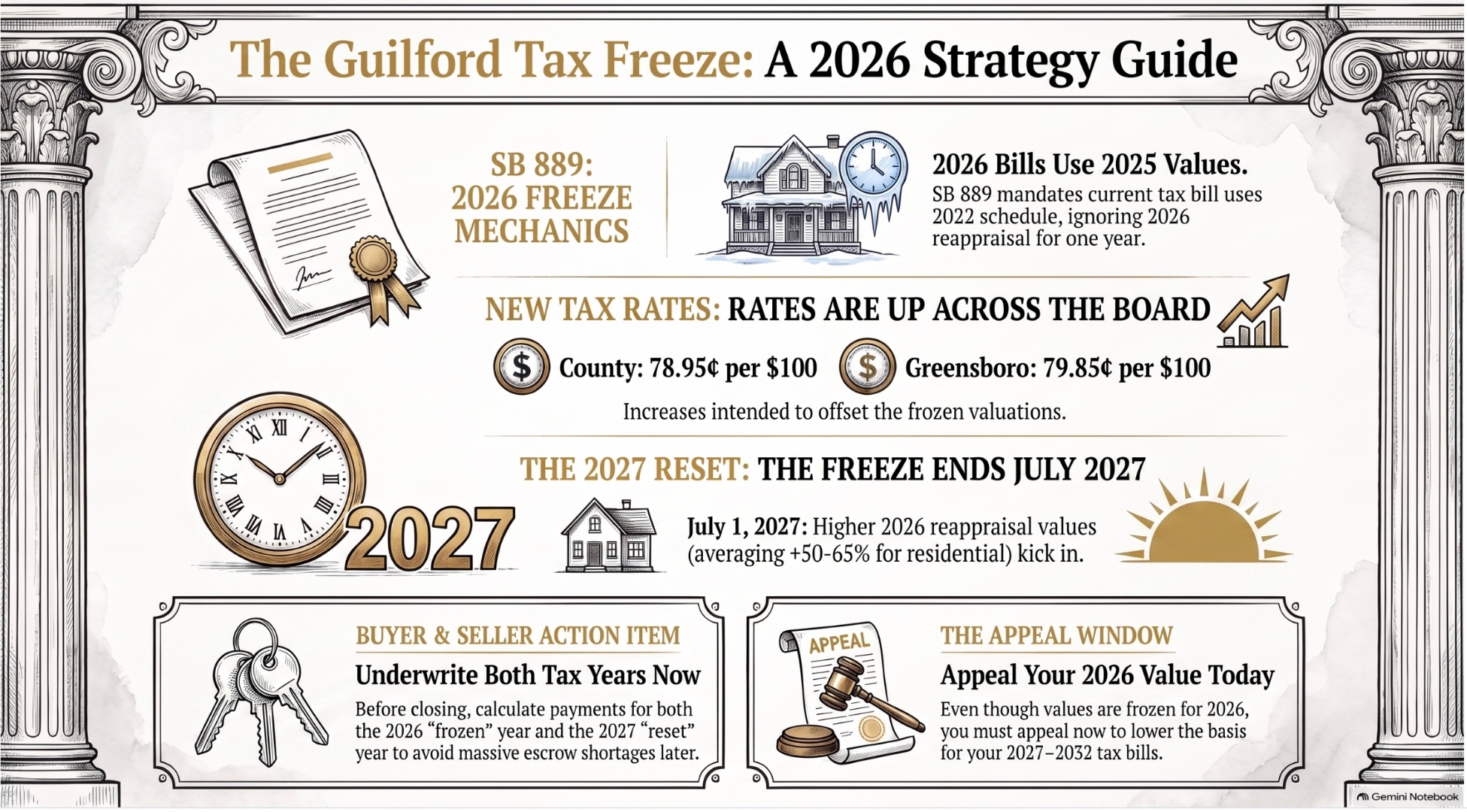
Here is what the law does in plain English. For every county that ran a countywide property reappraisal effective January 1, 2026 and is not exempted under the amended criteria, the county cannot use those new 2026 values on your July 1, 2026 through June 30, 2027 tax bill. Instead, the county must use the schedule of values from its most recent PRIOR reappraisal — for Guilford, that means the 2022 values that produced your 2025 tax bill. The 2026 values then kick in for the following tax year (July 1, 2027 forward) and stay in place until the next full reappraisal, which for Guilford is now scheduled for 2032.
Guilford County was pulled into an early 2026 reappraisal for a specific reason. Under NCGS 105-286(a)(2), counties with populations of 75,000 or greater must reappraise early if their NCDOR sales-assessment ratio falls below 0.85 or rises above 1.15. According to Guilford County Tax Director Ben Chavis, the county's post-2022 sales-assessment ratio came in at 0.8495 — just below the 0.85 threshold — which triggered a mandatory advancement. That is why Guilford went to reappraisal in 2026 instead of waiting for its normal cycle. And that is why Guilford homeowners were staring at reappraisal notices projecting average residential increases above 50 percent, with the countywide median residential value rising to roughly $283,700 from $171,600 — an increase of about 65 percent — before SB 889 froze those numbers.
Twelve NC counties completed reappraisals effective January 1, 2026. The original SB 889 covered counties with populations of 15,000 or greater, but the amendment (SL 2026-47) replaced that population threshold with a new set of exemption criteria. The UNC School of Government summary of the enrolled law lays out the final result: eight counties are bound by the moratorium, three are exempt, and one is conditional.
| County | Region | Status under final law | Why |
|---|---|---|---|
| Anson | Southern Piedmont | Bound — must postpone | Completed 2026 reappraisal; not exempt under SL 2026-47 |
| Bladen | Southeastern NC | Bound — must postpone | Completed 2026 reappraisal; not exempt under SL 2026-47 |
| Chowan | Northeastern NC | Bound — must postpone | Under original SB 889 was exempt (population under 15,000); SL 2026-47 removed that threshold |
| Davidson | Piedmont Triad (borders Forsyth) | Bound — must postpone | Completed 2026 reappraisal; not exempt under SL 2026-47 |
| Guilford | Piedmont Triad | Bound — must postpone | Completed 2026 reappraisal; sales-ratio-triggered early advancement |
| Onslow | Coastal (Jacksonville) | Bound — must postpone | Completed 2026 reappraisal; not exempt under SL 2026-47 |
| Pamlico | Coastal (Pamlico Sound) | Bound — must postpone | Under original SB 889 was exempt (population under 15,000); SL 2026-47 removed that threshold |
| Pender | Coastal (Wilmington metro) | Bound — must postpone | Completed 2026 reappraisal; not exempt under SL 2026-47 |
| Clay | Western NC | Exempt | Population under 12,000 (SL 2026-47 criterion 1) |
| Harnett | Central NC | Exempt | In G.S. 105-286(a)(2)a. designated year and population under 150,000 (SL 2026-47 criterion 2) |
| Scotland | Southern NC | Exempt | Levied a property tax rate above 95¢/$100 within the prior four years (SL 2026-47 criterion 3) |
| Buncombe | Western NC (Helene area) | Conditional | Exempt if it adopts a revenue-neutral or lower rate for FY2027; otherwise bound |
Forsyth, Watauga, Wilkes, and every other Triad and High Country county are NOT on this list because their most recent reappraisals fell outside the 2026 calendar year. If you own property in one of those counties, SB 889 does not change your bill — but the debate it started about revenue-neutral rates and reappraisal sticker shock absolutely will shape how your county sets rates in its next cycle. Davidson County matters most for Triad readers because it borders Forsyth and shares housing markets around Lexington, Thomasville, and Welcome.
The new Guilford County tax math — line by line
On June 25, 2026, the Guilford County Board of Commissioners voted 7-2 to adopt an $889.2 million FY2027 General Fund budget with a property tax rate of 78.95 cents per $100 of assessed valuation — a 5.9-cent increase from the previous 73.05-cent rate. On the county's median home value of $171,600, that translates to roughly $8.44 more per month in county property tax. All seven Democratic commissioners voted for the budget; Republican commissioners Alan Perdue and Pat Tillman voted against it.
Here is what your Guilford County tax bill looks like this year and next, side by side.
| Item | FY2026 (last year) | FY2027 (this year, under SB 889) |
|---|---|---|
| Assessed value used | 2022 reappraisal values | 2022 reappraisal values (SB 889 forces this) |
| Guilford County rate per $100 | $0.7305 | $0.7895 (+5.9 cents) |
| Median home value | $171,600 | $171,600 |
| Estimated county tax on median home | $1,253 | $1,354 (+$101/yr, +$8.44/mo) |
| Reappraisal notice mailed | N/A | August 15, 2026 (delayed from July 10) |
| 1 percent early-payment discount deadline | Aug 31, 2025 | Monday, August 31, 2026 |
| Bill becomes delinquent | Jan 5, 2026 | Jan 5, 2027 |
The number that surprises most Guilford homeowners: the county manager's ORIGINAL FY2027 recommendation, before SB 889 became law, was a tax rate CUT to 61.90 cents per $100 — 11.15 cents lower than the prior year. That recommendation was built on the new, higher 2026 reappraisal values, where the revenue-neutral rate under NCGS 159-11 calculated out to 53.26 cents. Once SB 889 froze those higher values, the revenue-neutral rate had to be recalculated against the older 2022 values, and the county's June 25 adopted-budget release listed it at 58.54 cents. Commissioners had two options: cut the budget deeply or raise the rate on the older 2022 values. They raised the rate. That is the story of the 5.9-cent hike — and it is why some homeowners are seeing a HIGHER bill than they would have gotten under the new values with a lower rate.
SB 889's revenue impact on Guilford County gets reported at three very different scales, and it matters which one you are reading. The narrowest number is roughly $4.3 million under public service equalization (state-appraised utility property) plus about $0.3 million for rural fire districts, per the county's own June 17 update. The broadest number is roughly $92.7 million in projected FY2027 property tax revenue that Guilford lost when SB 889 forced the county off its manager's original $935.5 million recommendation, per WFMY News 2's June 25 budget coverage carried by Yahoo News/AP. And the gap that county staff walked commissioners through in a June 19 no-tax-increase scenario was roughly $83.7 million — the amount the county would have had to cut to hold the tax rate flat at 73.05 cents under the frozen 2022 values. Board Chair Skip Alston publicly described the hit as "about $83 million." The freeze protected homeowners from a big one-year assessed-value jump, but it also produced a rate hike on OLDER values and reduced funding for schools, public safety, and county services during a year the county was already planning to invest more.
Video: The 2027 timebomb — why Guilford County must appeal now
Guilford County SB 889 infographic — visual reference
Interactive mind map — click every branch
Guilford County SB 889 Mind Map
Explore the full SB 889 decision framework as a clickable mind map. Click any branch (the sales-ratio trigger, county and city rate math, the 2027 reset, the appeal window, buyer/seller action items) to drill into the tactic and the source citations.
Greensboro and High Point — city rates on the SAME frozen values
SB 889 did not just affect the county rate. Every city, town, and fire district in Guilford County that funds itself with property taxes had to redo its own FY2027 budget on the older 2022 values. That means the moratorium ripples through the tax bill for every property owner in Greensboro, High Point, Jamestown, Pleasant Garden, Summerfield, Oak Ridge, Stokesdale, Sedalia, Whitsett, and Gibsonville — plus the fire districts that surround them.
The clearest example is Greensboro. The City Council adopted a FY2027 property tax rate of 79.85 cents per $100 of assessed valuation — a 12.6-cent increase — and the city said in plain language on its own website that the rate was set on 2025 property values rather than the 2026 reappraisal values because of SB 889. High Point set its own rate against the older values on the same schedule. The combined city-plus-county rate is what shows up on your tax bill.
| Municipality | FY2027 rate per $100 | Combined with county (78.95 cents) | Notes |
|---|---|---|---|
| Unincorporated Guilford (county only) | — | $0.7895 | No city tax |
| Greensboro | $0.7985 | $1.5880 | +12.6-cent city increase cited SB 889 directly |
| High Point | varies by district | Verify with High Point tax office | City rate set on 2025 values per SB 889 |
| Jamestown, Summerfield, Oak Ridge, Stokesdale | varies | Verify with your town office | All Guilford municipalities affected by moratorium |
If you are buying, selling, or refinancing in Greensboro or High Point right now, do not use last year's tax number in your monthly-payment math. Pull the FY2027 combined rate for the specific address and apply it to the 2025 assessed value. That is the number that hits your bill this year.
Run the numbers on your own parcel — interactive worksheet
Enter your 2025 assessed value, your projected 2026 reappraisal value, and your municipality. The worksheet returns your FY2027 bill (frozen values, new rates) alongside three FY2028 scenarios for the 2027 tax bill — revenue-neutral, mid-range, and current rates held flat against your reappraisal value. Every rate comes directly from adopted FY2027 budget documents and the Guilford County revenue-neutral filings.
If you are buying in Guilford County right now
The freeze is genuinely helpful for buyers on the closing math for this tax year. The 2026 tax bill on the home you are buying uses the 2025 assessed value at the new 78.95-cent county rate plus whatever city rate applies. That is a knowable number — you can pull it from the Guilford County Property Tax Moratorium Information Hub for the specific parcel before you go under contract.
Two things every Guilford buyer needs to do differently right now:
First, ask your lender to escrow the new number. A lot of pre-approval letters and monthly-payment estimates are still using pre-SB-889 tax figures. If your lender quotes you a payment based on the 73.05-cent rate, your monthly principal-interest-taxes-insurance number is under-cooked by roughly $8 to $12 on a median-priced home — and more on a larger one. Get the FY2027 escrow line right BEFORE you close, not after your first shortage notice.
Second, ask the seller to give you the reappraisal notice. When the reappraisal notice went out August 15, 2026, every Guilford property owner received a new 2026 assessed value that is FROZEN for tax purposes this year but becomes the basis for the 2027 tax bill and every bill after that until 2032. You want to see that number BEFORE you go under contract. If the seller's 2026 value is up 50 percent from their 2022 value (roughly the residential average), the 2027 tax bill on the home you are about to own is going to reset dramatically — and you need to know that during your due diligence period, not on your 2027 escrow shortage notice.
North Carolina's due diligence period is short and the due diligence fee is non-refundable — you will spend $500 to $3,000 up front on a typical Guilford home before the seller even accepts your inspection findings. Use that window wisely. Pull the reappraisal notice, model the 2027 tax bill at three reasonable rate scenarios, and decide whether the number still works. That is one of the specific pieces we walk every Guilford buyer through before they sign the offer.
If you are selling in Guilford County right now
The freeze is neutral to positive for you as a seller. Buyers writing offers on Guilford homes right now are seeing a lower-than-expected 2026 tax bill on your home, which reduces one of the most common sources of buyer sticker shock — the "did you know the tax is going up 45 percent" conversation that torpedoes deals in reappraisal years. Because the 2026 values are frozen, your buyer's 2026 tax bill is knowable and predictable, and you have a genuine story to tell about affordability.
What sellers need to be honest about is the 2027 reset. Buyers who understand this law are going to ask what the 2026 reappraisal notice says about your specific property. Have it ready. Show it to them. If your assessed value went up 40 or 50 percent, tell them why (Guilford as a whole ran hot, your neighborhood ran hotter, your renovations added value) and walk them through what the 2027 bill looks like at a reasonable rate scenario. Sellers who front-load that conversation close cleanly. Sellers who hide the reappraisal notice get called out during due diligence and lose the deal or renegotiate hard.
The other seller move that matters right now: run a real home valuation against current market data, not against your 2022 assessed value. Guilford saw genuine appreciation between 2022 and 2026 — that is why the reappraisal came in high. If you priced your home off the old assessment, you are almost certainly under-pricing. A real CMA that uses closed comps from the last 90 days is the number that matters, and the reappraisal is just one input.
Should you still appeal your 2026 reappraisal value?
Yes, if the number on your notice looks off — and Guilford County has confirmed appeals are still being processed even though those values do not affect your 2026 tax bill. Here is why the appeal still matters. The 2026 value becomes the basis for your 2027 tax bill AND every tax bill after that until the next reappraisal in 2032. Six tax years. If your 2026 assessed value is $50,000 too high, that error compounds across six bills at whatever rate commissioners set each year.
The appeal window is short. You have limited time from the date of the reappraisal notice (mailed August 15, 2026) to file an informal appeal with the Guilford County Tax Department. Wait too long and your only option is a formal Board of Equalization and Review appeal with a much higher evidentiary bar. If you are close to the deadline and unsure, file the informal appeal to protect your rights — you can withdraw it later.
The strongest appeals in a reappraisal year come with three things: a recent appraisal (order one during your due diligence period if you are buying, or after your notice arrives if you are already an owner), a set of three to five closed comparable sales from the last six months in your neighborhood, and photos documenting any deferred maintenance or condition issues the county's mass-appraisal model missed. For the fuller playbook, see our NC property tax appeal guide.
Download the Guilford SB 889 buyer and appeal guide (PDF)
Eight pages you can print, mark up, and take into your due diligence conversation or your appeal filing. Covers the FY2027 rate math, the 2027 reset, the appeal window, and the exact underwriting questions to ask your lender before you sign. Written for Guilford buyers, sellers, and current homeowners staring at an August 2026 reappraisal notice.
The 2027 tax bill — the piece almost nobody is talking about
Here is what worries us more than the FY2027 hike: the FY2028 bill. Starting July 1, 2027, the frozen 2026 reappraisal values kick in for Guilford tax bills. Commissioners will need to set a new rate against those higher values. Under NCGS 159-11, the county has to publish a revenue-neutral rate calculation — but they are not required to adopt it, and they historically have not. So the question becomes: what rate will commissioners choose against values that just jumped roughly 50 percent for residential?
Nobody knows the answer yet. But here is a reasonable scenario. If commissioners aim to keep the tax bill roughly flat year-over-year on the median home, they would need a rate around 53 cents (the estimated revenue-neutral rate on new values). If they aim to match the FY2027 hike in percentage terms, the rate would land higher. And if the state legislature does what Sen. Berger has signaled — using the SB 889 pause to enact broader property tax reform — the rules could change again before FY2028 bills are set.
What we tell every Guilford buyer and seller working this fall: underwrite BOTH tax years. Model the FY2027 bill (the one under SB 889 you can see right now) AND a reasonable FY2028 scenario using your 2026 reappraisal value at three rate assumptions (revenue-neutral, mid-range, current 78.95 cents held flat). If the FY2028 number breaks your budget, that is the conversation to have now — not in June 2027 when your escrow shortage notice arrives. A good NC agent should be running these numbers on your specific parcel before you sign anything.
Frequently asked questions
What is Senate Bill 889 and how does it affect Guilford County property taxes?
Senate Bill 889 (Session Law 2026-8), signed by Governor Josh Stein on June 19, 2026, froze the 2026 property tax reappraisal in eight NC counties including Guilford. Your 2026 tax bill is calculated on the 2025 assessed value, not the new value from your February 2026 reappraisal notice. The 2026 reappraisal values will apply to your 2027 tax bill, and the next full countywide reappraisal is not until 2032.
What is the new Guilford County property tax rate for 2026-2027?
The Guilford County Board of Commissioners adopted a FY2027 tax rate of 78.95 cents per $100 of assessed valuation on June 25, 2026 — an increase of 5.9 cents from the previous 73.05-cent rate. On a median Guilford County home valued at $171,600, that works out to roughly $8.44 more per month. The board voted 7-2 to approve the budget.
Why did commissioners raise the tax rate if property values are frozen?
SB 889 forced Guilford to use the same value from the 2025 tax bill (which derives from the 2022 reappraisal) instead of the higher 2026 reappraisal values. The revenue impact gets reported at three different scales. The narrowest is roughly $4.3 million under public service equalization plus $0.3 million for rural fire districts (Guilford County's own June 17 update). County staff walked commissioners through a $83.7 million gap between the manager's plan and a no-tax-increase scenario on the 2022-based values, and Board Chair Skip Alston publicly described the hit as "about $83 million." The broadest figure is roughly $92.7 million in projected FY2027 property tax revenue lost against the manager's original $935.5 million recommendation (WFMY News 2 via Yahoo News/AP, June 25). The manager's original May 2026 recommendation — before SB 889 became law — was actually a rate CUT to 61.90 cents (11.15 cents lower than the prior year), based on the new 2026 values. When SB 889 stripped away those values, commissioners raised the rate on the older 2022-based values to fund schools, public safety, and county services.
How does SB 889 affect city taxes in Greensboro and High Point?
Greensboro adopted a new city property tax rate of 79.85 cents per $100 — a 12.6-cent increase from 67.25 cents — specifically because SB 889 forced the city to build its budget on the same values that produced 2025 tax bills (from the 2022 reappraisal) instead of the higher 2026 reappraisal values. High Point and the other Guilford municipalities faced the same math and set their own rates against the older 2022-based values. Your total tax bill combines the county rate plus your city or town rate.
Do I still need to appeal my 2026 reappraisal notice?
Yes, if the number on your notice looks off. Even though the 2026 value does not apply to your 2026 tax bill, it becomes the basis for your 2027 tax bill and every bill after that until the next reappraisal in 2032. Guilford County confirmed appeals filed against 2026 values are still being processed. Reappraisal notices went out August 15, 2026 (delayed from July 10 because of the moratorium). Your appeal window is short — start now, do not wait.
Should I still buy or sell in Guilford County with all this tax uncertainty?
Yes, and in most cases the freeze is neutral to positive for the transaction itself. Buyers benefit from a lower-than-anticipated 2026 tax bill and a clearer picture of the 2027 bill before they close. Sellers benefit because buyer sticker-shock over the reappraisal is reduced for the current tax year. The bigger issue is the 2027 bill — that is when the frozen 2026 values kick in — so any buyer or seller working today needs to underwrite BOTH the 2026 bill (2025 values, new higher rate) and the 2027 bill (2026 values, whatever rate commissioners set for FY2028). We run both scenarios on every Guilford transaction.
When is the FY2027 Guilford property tax bill due, and is there a discount?
FY2027 tax bills went out based on August 2026 notices. Guilford County offers a 1 percent discount for payment received by Monday, August 31, 2026. Under current NC General Statutes, the Board of Commissioners cannot adjust that early-payment discount date even during the moratorium year. Bills become delinquent on January 5, 2027. If your lender escrows taxes, they will pay on your behalf — but confirm the escrow amount reflects the new 78.95-cent rate.
Which other NC counties are affected by SB 889?
Eight counties are bound by the final law: Anson, Bladen, Chowan, Davidson, Guilford, Onslow, Pamlico, and Pender. SB 889 originally would have affected 20 counties, the Senate narrowed it to 12, and the House narrowed it to eight in a series of amendments. A separate bill (SB 474) was then rewritten by the House to further adjust exemption criteria; it became Session Law 2026-47, signed July 7, 2026. Under that amended framework, three counties are exempt: population under 12,000 (Clay), certain designated reappraisal years plus population under 150,000 (Harnett), and having levied a rate above 95 cents per $100 in the prior four years (Scotland). Buncombe County is conditionally exempt if it adopts a revenue-neutral or lower rate. Davidson County matters most for Triad readers because it borders Forsyth and shares housing markets around Lexington, Thomasville, and Welcome.
Talk to someone who has run the numbers on your specific parcel
Every Guilford County client we work with in 2026 gets a two-year tax projection: FY2027 (frozen values, new 78.95-cent rate) AND a FY2028 scenario using their 2026 reappraisal value at three reasonable rate assumptions. If you are buying, we build that into your monthly payment math BEFORE you sign the offer. If you are selling, we build it into the buyer conversation so you close cleanly. If you are just a homeowner trying to decide whether to appeal, we will look at your reappraisal notice with you.
Text or call 336-262-3111 to start a conversation. Email teresatedder@gmail.com with your Guilford address, whether you are buying, selling, or holding, and a screenshot of your August 2026 reappraisal notice if you have it. We will run the numbers and send back a real answer before you spend another dollar on a decision that depends on them.