Teresa Overcash, a 30-year top 1 percent NC agent, Broker/Owner of Realty ONE Group Results, and NCREC Licensed Instructor, has walked buyers through their first Boone winter, their first Beech Mountain summer thunderstorm, and their first Helene-scale reality check. This is the conversation she has with every High Country buyer before they write an offer.
Jump to a section:
The elevation truth most buyer guides skip
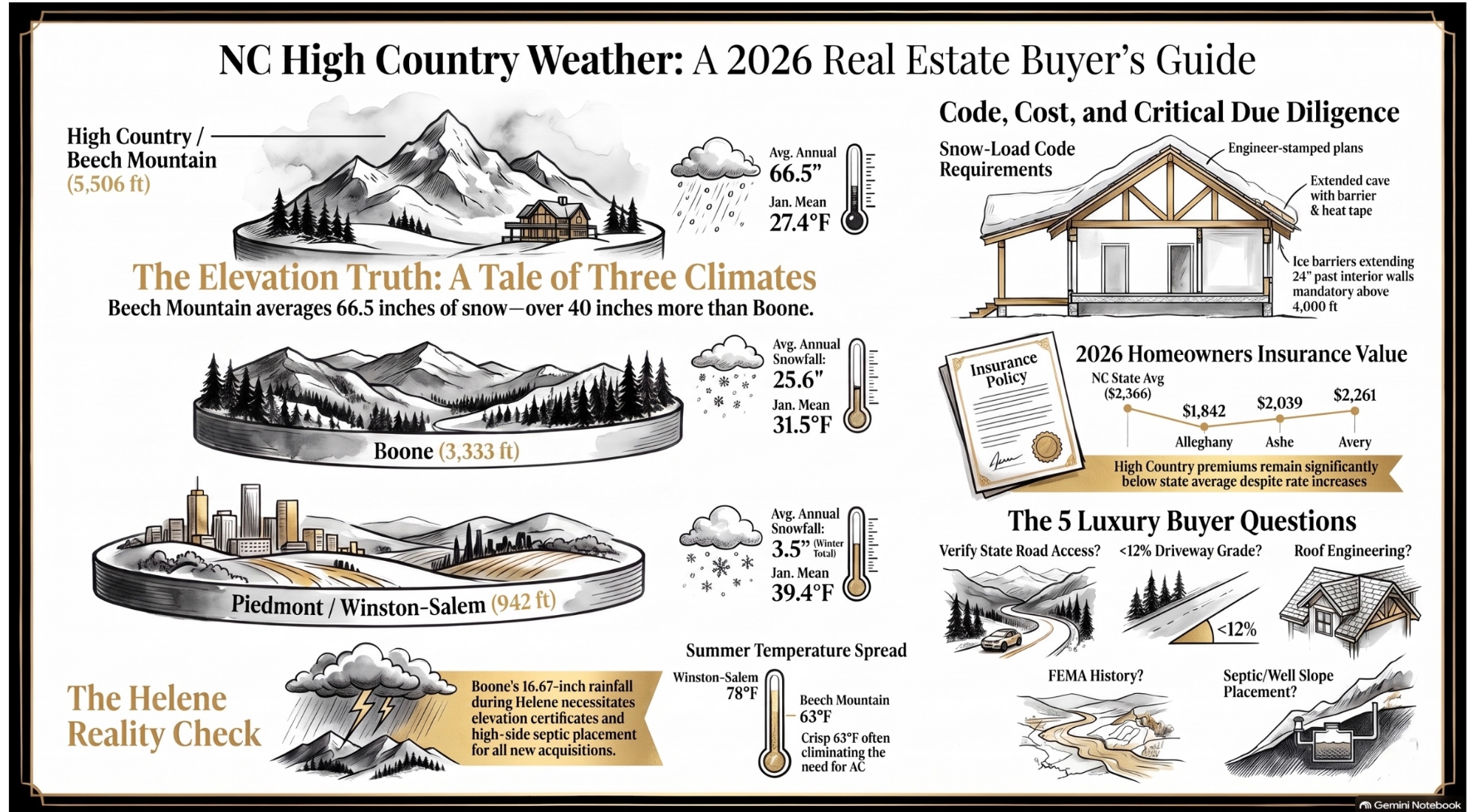
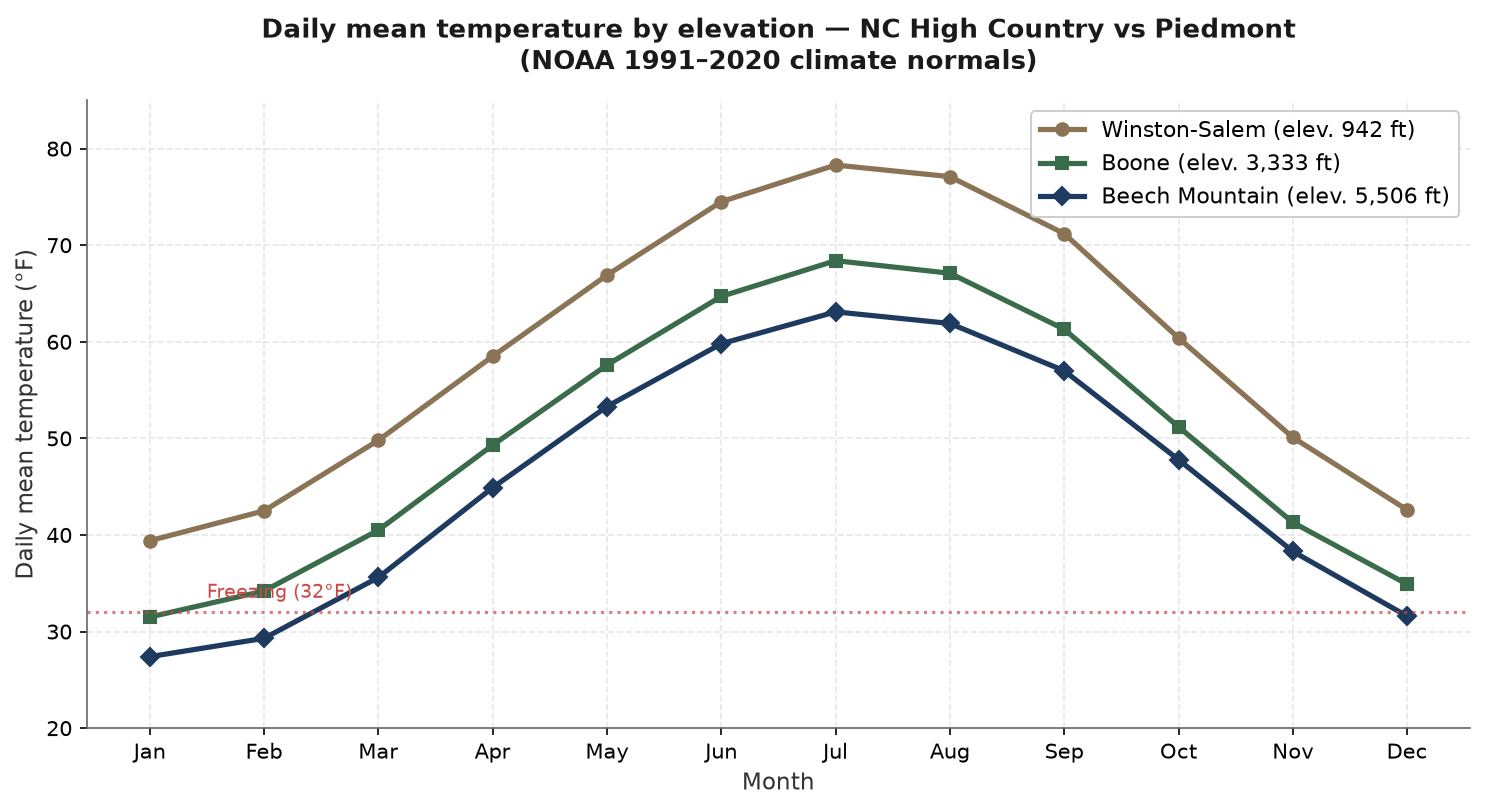
You cannot talk about weather in the NC High Country without talking about elevation. On any given day in July, Winston-Salem sits at a daily mean of 78°F. Boone, one hundred miles up US 421, sits at 68°F. Beech Mountain, another 2,000 vertical feet above Boone, sits at 63°F. That 15-degree spread — on the same day, in the same state — drives everything: HVAC size, insulation R-value, how your driveway freezes, and the premium on your homeowners policy.
The NC High Country is not one climate. It is a stack of climates. The buyer who understands that walks into a Boone showing asking the right questions. The buyer who does not buys the house at 4,600 feet in July, moves in November, and discovers three things at once: the driveway is a skating rink, the HVAC never shuts off, and the propane bill is triple what the listing agent hinted at.
Every buyer coming out of Charlotte, Atlanta, or Florida thinks they know cold. They do not. Cold at 4,500 feet with a wet wind pushing across a north-facing lot is a different animal. I have watched a lot of new mountain owners heat their house through the ceiling for the first four winters until they finally seal the attic.
Teresa Overcash, Broker/Owner Realty ONE Group Results, on relocating buyers into the High Country
Winter in the NC High Country (December–February)
Winter is what makes the High Country the High Country. It is the reason ski season exists at Beech, Sugar, App Ski, and Hound Ears. It is also the season that separates the buyer who did their homework from the one who did not.
Boone at 3,333 feet
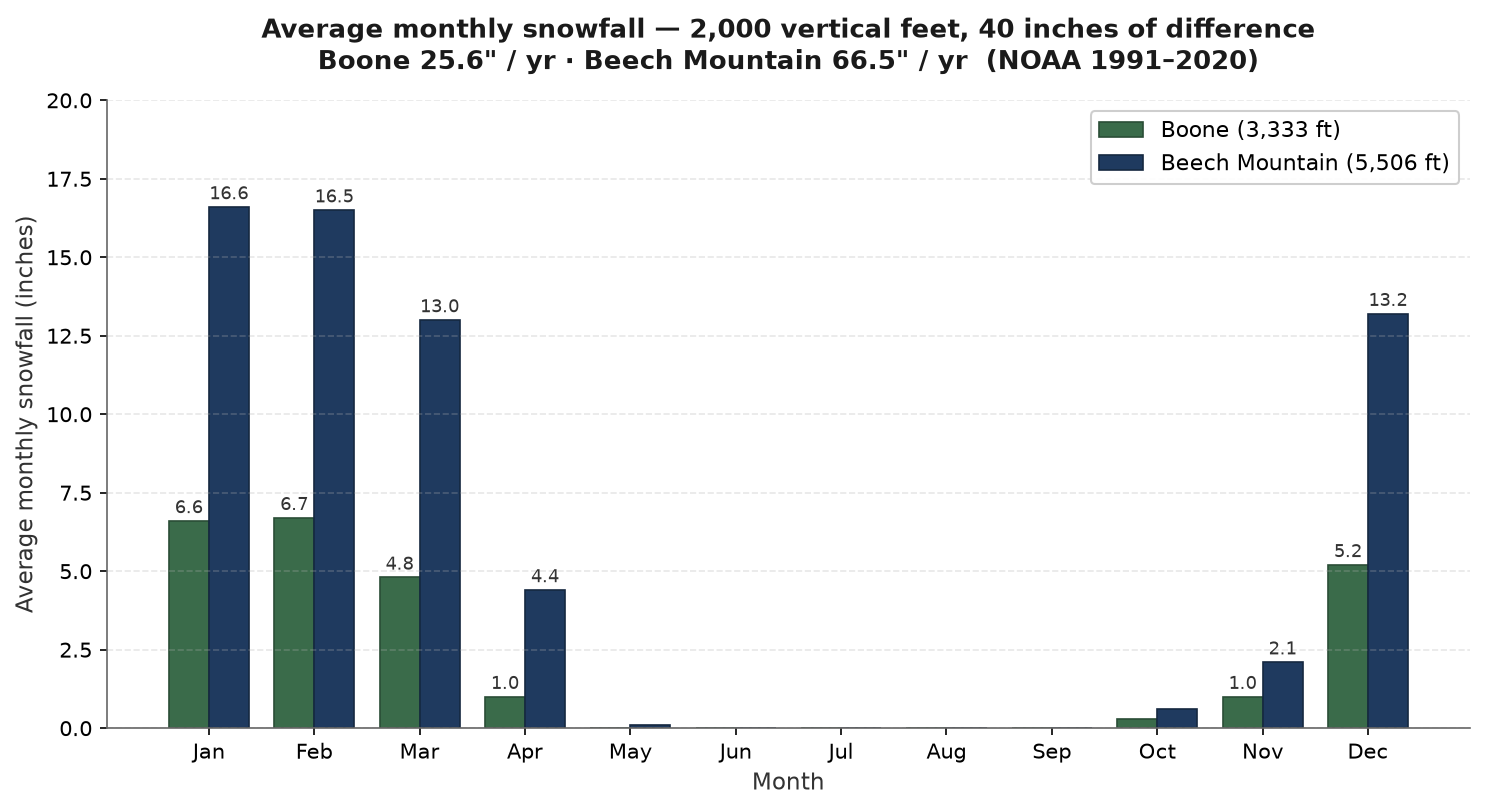
Boone’s January daily mean is 31.5°F, February 34.2°F. The record low, set January 21, 1985, is −24°F (per NOAA’s 1991–2020 climate normals for Boone). Snow arrives roughly six days a month in January and February, averaging 6.6 and 6.7 inches. Those averages hide what actually happens: six 40-degree afternoons followed by a single 14-inch storm that shuts everything for three days.
USDA hardiness zone in Boone is 6B, with 7A pockets on south-facing slopes. That matters if you plan to garden. It matters more if you plan to leave a pipe uninsulated over a January long weekend in Fort Lauderdale.
Beech Mountain at 5,506 feet
Beech is the highest incorporated town east of the Rockies — the nearest higher municipality is Des Moines, New Mexico, 1,220 miles away (Beech Mountain, NC, NOAA normals). January daily mean is 27.4°F, with 16.6 inches of snow in January and another 16.5 in February. The town averages 37.9 snowy days a year and runs 20 to 25 degrees colder than Charlotte, Raleigh, and Atlanta on any given day (Beech Mountain Visitor Center).
What that means as a homeowner: you will heat your house from mid-October through mid-May. You will not use central air. Your roof will hold snow for weeks at a time. And your driveway, if it is not south-facing and paved, will not clear on its own until March.
Table 1 — Winter climate normals: Boone vs. Beech Mountain vs. Winston-Salem
| Metric | Winston-Salem 942 ft |
Boone 3,333 ft |
Beech Mountain 5,506 ft |
|---|---|---|---|
| January daily mean (°F) | 39.4 | 31.5 | 27.4 |
| February daily mean (°F) | 42.5 | 34.2 | 29.3 |
| December daily mean (°F) | 42.6 | 34.9 | 31.6 |
| Winter snowfall (Dec+Jan+Feb, inches) | 3.5 | 18.5 | 46.3 |
| Record low (°F) | −6 | −24 | −18 |
| USDA hardiness zone | 7B | 6B / 7A | 5B / 6A |
Sources: NOAA 1991–2020 climate normals (Boone); NOAA 1991–2020 climate normals (Beech Mountain).
The snow-load code that changes what you can build
North Carolina’s building code takes mountain snow seriously. Ground snow load reaches 40 psf or more at Beech Mountain and across the higher-elevation areas of Watauga and Avery Counties (NC Roof Authority). Where roof snow load exceeds 20 psf, Watauga and Avery require engineer-stamped structural plans. New construction above 3,000 feet must use ASCE 7 for site-specific values under 2018 NCRC section R301.1.3 (NC Office of State Fire Marshal formal interpretation).
Table 2 — Mountain snow-load & roofing code requirements by elevation
| Elevation band | Ground snow load | Structural design requirement |
|---|---|---|
| Below 3,000 ft | 10–20 psf | Standard NCRC prescriptive tables |
| 3,000–4,000 ft (much of Watauga/Ashe) | 20–30 psf | ASCE 7 site-specific analysis under R301.1.3 |
| Above 4,000 ft (Watauga/Avery highlands) | 30–40+ psf | Engineer-stamped plans; ice-barrier ≥24" past interior wall line |
| Beech Mountain (5,506 ft) | 40+ psf | Full engineered design; metal roofing preferred (1:12 min slope) |
Sources: NC Roof Authority; NC OSFM formal interpretation of NCRC R301.1.3.
What that means in practice: the stock ranch plan your builder uses in Kernersville does not drop onto a lot in Beech Mountain without a redesign. Metal roofing is preferred over asphalt at these elevations because it sheds snow better and the fasteners hold under repeated freeze-thaw. An ice-barrier membrane must extend at least 24 inches inside the interior wall line at the eave. These are not upgrades. They are code.
Spring in the NC High Country (March–May)
Spring in the mountains is a negotiation. March still averages 4.8 inches of snow in Boone and 13 inches at Beech (NOAA 1991–2020 normals). April drops to about 1 inch in Boone and 4.4 at Beech. May is essentially snow-free, but a freak overnight freeze can hit into mid-May at 4,500+ feet — exactly why Beech’s frost-free growing season is 30 days shorter than Boone’s.
Mud season is real. Between snowmelt runoff and the spring rains, gravel driveways above 3,500 feet can be soft for weeks. Ashe County alone got 17.01 inches of rain in three days during Helene (NC State Climate Office) — a September event, but a reminder this landscape can absorb enormous water and still saturate.
Spring is when the Blue Ridge Parkway begins reopening in stages. NPS opens sections as ice clears and Helene-damaged segments get repaired. Do not buy a home assuming the Parkway is your daily route to Blowing Rock in April.
Spring is also when the buying market wakes up. The four-county High Country region closed 90 sales in January 2026, 97 in February, 113 in March, and 118 in April — and by May we hit 152 closings (High Country Association of Realtors).
Summer in the NC High Country (June–August)
Summer is the reason retirees leave Florida and Georgia for the mountains. Winston-Salem’s July daily mean is 78.3°F. Boone’s is 68.4°F. Beech Mountain’s is 63.1°F (NOAA 1991–2020 normals). Nighttime lows at 4,500+ feet routinely drop into the low 50s in July — which is why the majority of homes built at that elevation before 2005 do not have central air.
Humidity is the second gift. Boone’s summer dew points sit in the mid to upper 50s while the Triad pushes 70+. That is the difference between a shirt that dries on the porch and one that does not. It is also why the Florida-to-Boone retirees tell me they had forgotten what a summer evening was supposed to feel like.
The one summer feature buyers underestimate is the afternoon thunderstorm. The southern Appalachians manufacture them almost daily in July and August as warm valley air rises against cold ridge air. These storms can drop half an inch of rain in twenty minutes, take out power for two hours, and be over before the coffee is cold. Ask about propane backup, generator readiness, and how the house drains during a storm.
Half the folks buying up here in June never come back in February. That is the honest truth. I ask every High Country buyer to spend one full winter in a rental — Beech, Boone, Sugar Mountain, doesn’t matter which — before they close on the primary residence. Not the second home. The primary residence. Weather is not just a comfort question. It is a lifestyle question. And you cannot answer it in July.
Teresa Overcash, Broker/Owner Realty ONE Group Results, on choosing where to live in the High Country
Run the numbers on a High Country home
The median June 2026 High Country sale was $520,000 across the four-county region, and Watauga alone came in at $614,250 ([HCAR June 2026 report](https://www.wataugademocrat.com/news/regional/hcar-report-high-country-home-sales-climb-in-june-as-median-price-hits-520k/article_cf2bdc39-e6be-475b-b352-a75444ff81ff.html)). Use the calculator to model your down payment, rate, and monthly with real 2026 numbers before you tour.
Or get a personalized High Country buyer briefing: call or text 336-262-3111.
Fall in the NC High Country (September–November)
Fall is what the High Country sells itself on. Color arrives in stages — Beech Mountain and Grandfather peaks turn first in the second week of October, Boone by the third, and Blowing Rock and Banner Elk by the last. Peak color is a genuine economic engine: weekly rental rates on Airbnbs in Boone and Blowing Rock double for those three weekends, and US 321 can back up ninety minutes.
The weather itself is arguably the best of the year: September daily means run in the low 60s in Boone, upper 50s at Beech. First frost typically hits Beech in mid-September and Boone in early October. October is when your propane refill guy starts scheduling tank fills — book yours before Halloween.
September is also when the honest reality check has to happen — because September 2024 brought Hurricane Helene.
Storm risk: the Helene reality check
On September 25–27, 2024, Hurricane Helene stalled over the Southern Appalachians and produced catastrophic flooding across the High Country. The Boone 1 SE station recorded 16.67 inches of rain in three days (NC State Climate Office rapid reaction). Ashe County’s Laurel Springs station recorded 17.01 inches. Downtown Boone flooded to several feet. A tornado — the first in Watauga County since 1998 — touched down near Blowing Rock the evening of September 25. Governor Roy Cooper called it "one of the worst storms in modern history for parts of Western North Carolina" (Appalachian State University).
Table 3 — Hurricane Helene rainfall totals, September 25–27, 2024
| Station | County | 3-day rainfall (in) |
|---|---|---|
| Boone 1 SE | Watauga | 16.67 |
| Laurel Springs ECONet | Ashe | 17.01 |
| Grandfather Mtn area | Avery | 14–18 (est.) |
Source: NC State Climate Office rapid reaction, September 30, 2024.
"The historic rainfall totals across western North Carolina from Helene rank among the worst weather-related events in state history. Any home built or renovated in the region now needs to reckon with what a 100-year rainfall event actually does to soil, septic, and access."
— NC State Climate Office, rapid-reaction analysis, September 2024
The buyer response is not to avoid the High Country. It is to buy smarter. FEMA flood zones, elevation certificates on any home near a creek or river bottom, septic on the high side of the property, and Helene damage disclosure on affected parcels are the new normal. The full Florida-to-High-Country relocation guide covers how retirees work storm risk into year-one budgets.
What this weather means for your High Country home purchase
Insurance premiums
NC High Country insurance is still among the cheapest in the state. Alleghany County averages $1,842 a year — the lowest in North Carolina. Ashe runs $2,039, Watauga $2,040, Avery $2,261. Statewide average is $2,366 (Teresa Overcash: NC Homeowners Insurance 2026).
Rates are climbing. The Watauga/Ashe territory saw approved increases of 4.4% in 2025 and 4.5% in 2026; Avery/Mitchell 0.7% and 0.9% (Brandi Rininger — Mountain Home Insurance After Helene). Statewide, a 7.5% base-rate increase took effect June 1, 2026. Second-home and rental policies face 5% increases in October 2026 and October 2027, negotiated down from the NCRB’s original 42.2% ask.
Table 4 — 2026 Homeowners Insurance Rates: NC High Country Counties
| County | 2026 average annual premium | 2026 approved rate change | vs. NC state avg ($2,366) |
|---|---|---|---|
| Alleghany | $1,842 | +4.5% | 22% below state avg (cheapest in NC) |
| Ashe | $2,039 | +4.5% | 14% below state avg |
| Watauga | $2,040 | +4.5% | 14% below state avg |
| Avery | $2,261 | +0.9% | 4% below state avg |
Sources: NC Homeowners Insurance 2026; Mountain Home Insurance After Helene. Second-home policies face additional 5% increases Oct 2026 and Oct 2027.
Insurance estimator: your High Country county
Pick your county, occupancy type, and target purchase month, and this tool returns the estimated 2026 annual premium, second-home surcharge if applicable, elevation-band code requirements, and how you compare to the North Carolina state average. Numbers reflect NC Rate Bureau approved 2026 rates and NCRC ground-snow-load thresholds. Not a binding quote — carrier premiums vary by roof age, distance-to-hydrant, credit, and construction class.
Estimated 2026 total premium
$2,040
$170.00 per month
| Base county premium | $2,040 |
| 2026 approved rate change | +4.5% |
| Typical elevation band | 3,000–4,000 ft |
| Ground snow load (NCRC) | 25 psf |
| Structural code requirement | ASCE 7 site-specific analysis (R301.1.3) |
| Annual snowfall (est.) | 25.6 in (Boone) |
| Helene 3-day rainfall risk | 16.67 in (Boone 1 SE) |
Want a real quote paired with a High Country tour? Call or text Teresa at 336-262-3111.
Prefer the workbook version? Download the Excel estimator ↓
HVAC and utility sizing
Piedmont HVAC contractors habitually undersize heat and oversize cooling. In the High Country you want the opposite. A properly sized system for a 2,500-square-foot Boone home is roughly 90,000 BTU heat, 24,000–30,000 BTU cooling. At Beech, heat capacity climbs and cooling can disappear entirely. Propane, not natural gas, runs most homes above 3,000 feet — a 500-gallon tank at $3.50/gal fills to roughly $1,750 and lasts one heating cycle in a well-insulated home or two months in a poorly insulated one.
Real estate seasonality
Table 5 — 2026 High Country Home Sales by Month (Alleghany + Ashe + Avery + Watauga)
| Month (2026) | Closed sales | Median sale price | Buyer takeaway |
|---|---|---|---|
| January | 90 | $502,500 | Softest prices; fewest choices |
| February | 97 | $460,000 | Motivated sellers; inspection risk |
| March | 113 | $450,000 | Inventory begins climbing |
| April | 118 | $512,500 | Best inspection weather |
| May | 152 | $482,500 | Full selection returns |
| June | 171 | $520,000 | Peak median; strong competition |
| July | 209 | $470,000 | Highest closing volume of the year |
Sources: High Country Association of Realtors monthly market data; Watauga Democrat, HCAR June 2026 report.
If you want the widest inventory in the High Country, tour in April through July. If you want the best price leverage, tour in December through February when there are fewer buyers and sellers have carried the property through a winter. That is real advice, not sales copy. I have closed both sides of it many times.
Teresa Overcash, Broker/Owner Realty ONE Group Results, on High Country buyer timing
The five questions to ask before you buy
- State road access to the driveway. DOT plows state roads. Nobody plows private roads for you.
- Driveway grade and exposure. Anything over 12% grade or north-facing needs to be paved or you accept two-to-five days of no access per storm.
- Roof age, material, and snow-load rating. Ask for the engineer’s stamp if the home is above 3,000 feet.
- FEMA flood zone and Helene damage history. Full stop. Get the elevation certificate.
- Well and septic locations relative to slope. Water always wins. High-side septic drains, low-side wells are contamination risk.
Take the full guide with you
Four Seasons, Four Elevations — the companion PDF to this article. Winter through fall by elevation band, the five questions to ask before you write, and the elevation-vs-driveway checklist buyers keep going back to. 11 pages, saves offline for showings.
Frequently asked questions
How much snow does Boone NC actually get in a year?
Boone averages 25.6 inches of snow per year according to NOAA’s 1991–2020 climate normals, but the number varies dramatically by elevation inside the town limits. Neighborhoods above 3,500 feet routinely see 40 to 50 inches, and Beech Mountain, at 5,506 feet, averages 66.5 inches. Snowfall is not evenly distributed either. January and February each drop about 6.5 inches, and a single storm can deliver more than the monthly average.
Is the NC High Country really 20 degrees cooler than the Piedmont?
In July, yes. Winston-Salem’s daily mean is 78.3°F. Boone’s is 68.4°F. Beech Mountain’s is 63.1°F. That is a 15-degree spread from the Triad to the top of the mountain, on the same day. In January that spread widens: Winston-Salem averages 39.4°F, Boone 31.5°F, Beech 27.4°F. This is why buyers moving up from the Piedmont undersize their summer AC and oversize their winter heat.
What are homeowners insurance rates in the NC High Country in 2026?
Alleghany County averages $1,842 a year, Ashe $2,039, Watauga $2,040, and Avery $2,261 in 2026. The state average is $2,366. Rates in the Watauga and Ashe territory were approved at a 4.5% increase for 2026, and second-home policies statewide face 5% increases in October 2026 and October 2027 as part of the NCDOI settlement.
Do I need special roof engineering for a High Country home?
Above 3,000 feet you should assume yes, and above 4,000 feet in Watauga and Avery counties you should assume absolutely. The NC Building Code requires engineer-stamped structural plans wherever roof snow load exceeds 20 psf, and ground snow load at Beech Mountain reaches 40 psf or more. New construction above 3,000 feet must use ASCE 7 for site-specific values. This is why a stock Piedmont builder plan cannot be dropped onto a lot at 4,500 feet without a redesign.
Does Hurricane Helene mean the High Country is now a flood risk?
Helene dumped 16.67 inches of rain on Boone in three days in September 2024, and 17.01 inches on Ashe County. Downtown Boone flooded to several feet. That was a genuine once-in-a-century event, but insurance markets and lenders now underwrite the possibility. Buyers should check FEMA flood zones, get elevation certificates on any home near a creek or river bottom, and confirm septic and well are on the high side of the property before writing the offer.
Can you get to your High Country house in the winter?
Yes, most days, if you buy the right house. State-maintained roads in Watauga, Avery, and Ashe get plowed and salted after storms. Private gravel driveways above 3,500 feet, especially north-facing driveways with grades over 12%, can be impassable for two to five days after a heavy snow. Buyers who want winter reliability should ask three questions: state road access to the driveway, driveway grade, and driveway exposure.
When does the Blue Ridge Parkway close in the winter?
The Parkway is open year-round in principle, but the National Park Service closes sections preemptively for winter storms and reactively for ice, wind, and Helene-related repairs. In January 2026 the NPS preemptively closed the entire Parkway for a single winter storm. Sections around Grandfather Mountain and Rough Ridge can remain closed for weeks after an event. Do not buy a High Country home assuming the Parkway is a daily commute.
What is the busiest month for High Country home sales?
July 2026 recorded 209 closings across Alleghany, Ashe, Avery, and Watauga counties, the peak of the year. June had 171 closings at a median of $520,000. January and February are the slow months at 90 to 97 closings each. If you want the widest selection, tour April through September. If you want the softest prices, tour December through February.
How humid does it actually feel in the High Country in summer?
Considerably less humid than the Piedmont. Boone summer dew points typically run in the mid to upper 50s when Winston-Salem’s are pushing 70. That is the difference between a shirt that stays dry on a July hike and one that does not. Many High Country homes above 3,500 feet do not have central air conditioning and do not need it. Ceiling fans and cross-ventilation carry the summer.
Is fall foliage worth timing my move around?
If you plan to Airbnb the property, absolutely. Peak color in the High Country runs from the second week of October through the third week, higher elevations first. Weekly rental rates in Boone and Blowing Rock double for those three weekends. If you are moving in, book the move for late September before the leaf-peepers arrive. Traffic on US 321 and US 421 into Boone can add ninety minutes to a normal drive in mid-October.
Ready to buy a High Country home with weather in the plan, not the surprise?
Weather is not a marketing objection. It is a design brief. The right elevation, the right exposure, the right driveway, and the right insurance carrier turn a mountain home into a lifestyle. The wrong ones turn it into a project. Get the pre-showing weather-and-elevation briefing before you tour.
Call or text: 336-262-3111
Email: teresatedder@gmail.com
Teresa Overcash, Broker/Owner, Realty ONE Group Results. 30 years in North Carolina real estate. 10,000+ NC closings. Serving the Triad, Wilkes County, and the NC High Country with access to 4 MLS systems and a national network of 22,000+ agents.
About the author. Teresa Overcash is Broker in Charge and Owner of Realty ONE Group Results, an NCREC Licensed Instructor, and CLHMS certified luxury broker with 30 years in North Carolina real estate and over 10,000 NC closings. Realty ONE Group Results serves the Triad, Wilkes County, and the NC High Country with access to 4 MLS systems and a network of over 22,000 agents nationwide. She still sells, still coaches, and still answers her phone at 336-262-3111.
Sources. All climate data from NOAA 1991–2020 climate normals as published in the Wikipedia climate tables for Boone and Beech Mountain. Helene rainfall data from the NC State Climate Office and Appalachian State University. Snow-load code interpretation from the NC Office of State Fire Marshal and NC Roof Authority. Insurance rates from the 2026 NC Homeowners Insurance guide and Brandi Rininger’s WNC insurance analysis. Real estate closings from the High Country Association of Realtors and Watauga Democrat. Blue Ridge Parkway conditions from the Blue Ridge Parkway Foundation. NC State Climate Office institutional analysis via climate.ncsu.edu. App State climate research via today.appstate.edu.