NC High Country Real Estate Market Fall 2026: The $470K Median Is Not the Whole Story
Published · Updated · 16 min read
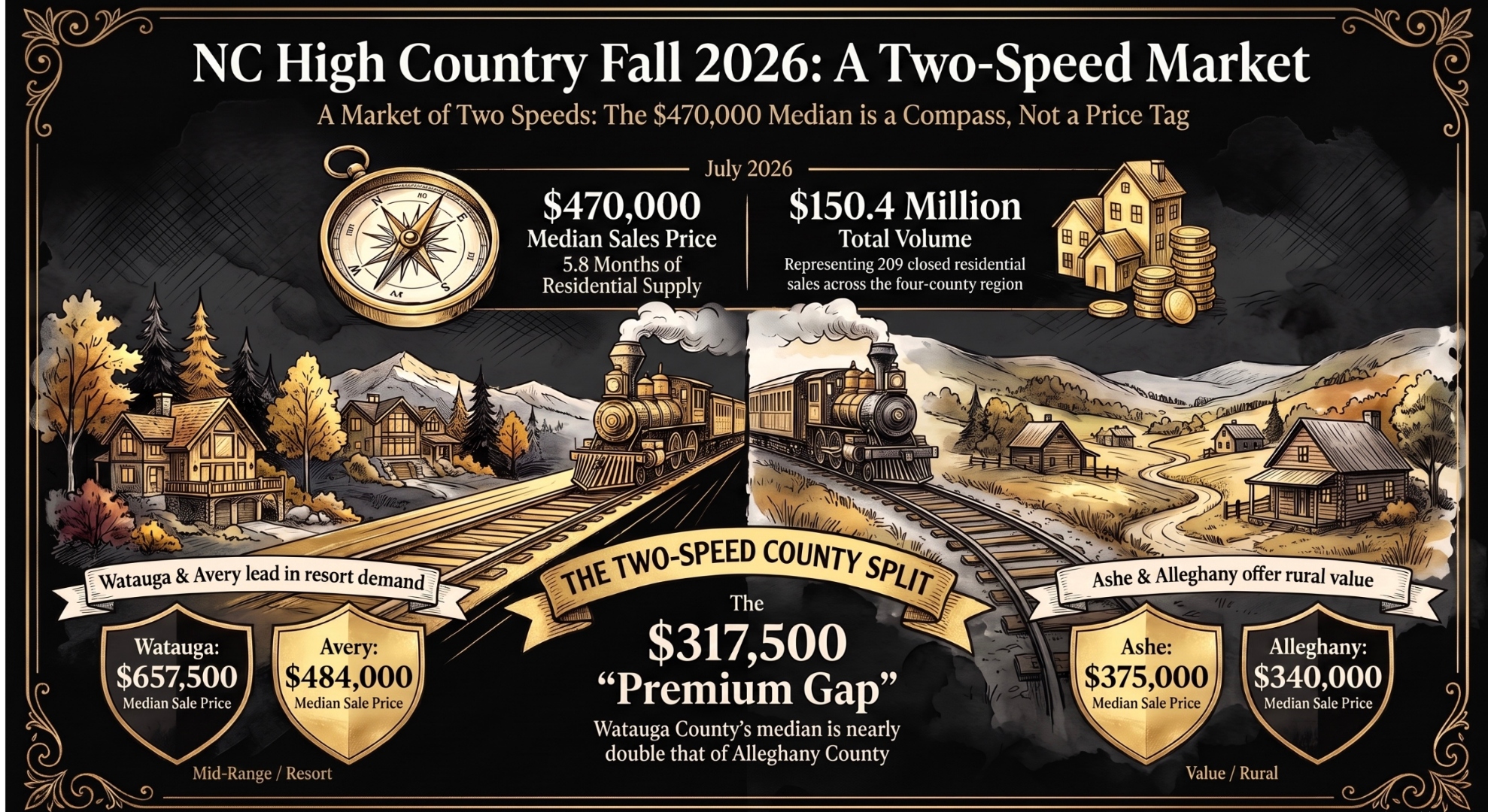
Quick answer: The July 2026 High Country MLS median was $470,000, but that number hides two different buyer experiences. Watauga sat at $657,500 while Alleghany was $340,000. With 5.8 months of residential supply, buyers have time in many pockets, but quality homes still reward preparation.
By Teresa Overcash, Broker/Owner, Realty ONE Group Results — NCREC Licensed Instructor. Sources verified September 2026.
Watch: A plain-English deconstruction of misleading mountain real estate stats — the $470,000 regional median, the four-county split, and what buyers should actually be reading. 8:28 with Teresa Overcash.
Read the full video transcript
Hey everyone, welcome to the explainer. I’m so pumped you’re here because today we’re putting a magnifying glass to a really fascinating topic. We’re deconstructing misleading mountain real estate stats. Look, if you’ve been eying the North Carolina High Country market for Fall 2026, you’ve probably seen it right? That single, flashy, headline grabbing median price. But as we’re going to see, taking that number at face value is a massive mistake. We’re going to break down exactly why the $470,000 regional average is totally deceiving and uncover what the data actually tells us when we look a little closer.
Okay, let’s dive into this. We’re taking a macro to micro funnel approach today. We’ll start by looking at that 470K headline illusion. Then we’ll break down the four county split, untangle all that noise you get from housing portals, map out where you actually have buyer leverage and finally, we’ll wrap up with mastering mountain due diligence. Let’s get right into it.
Alright, setting the stage, let’s look at the July 2026 high country MLS report. $470,000, that is the recorded regional median sale price across the four counties for that month. It represents 209 closed residential sales totaling over $150 million in volume. Now sure, it’s a healthy regional pulse, absolutely. But here’s the illusion. This single number hides two vastly different buyer experiences. Think of it as just a ma-
mathematical middle, you know, it’s definitely not a promise of what you’re actually going to pay in your target town. I absolutely love this analogy from broker and owner Teresa Overcash. She says you should use the regional median as a compass to get your general bearings, not as a specific GPS pin for your offer price. The data shows us that there were over 1200 active residential listings that month, but only 209 closed sales. That gives buyers about 5.8 months of supply. So you’ve got options, but, and this is absolutely crucial, those options are not interchangeable. A property with a flat driveway and lightning-fast internet just doesn’t sit on the market the same way a steep lot with zero view does.
Moving on to section two, the four-county split. Now, to truly understand why that median deceives us, we need to look at the macro-level breakdown and see exactly where the data fractures. What’s really interesting here is the sheer contrast between these areas. Take Watauga County for example, which includes Boone and Blowing Rock. It boasted 96 closed sales at a massive premium median of $657,500. That’s largely driven by college town demand and resort proximity. Now, juxtapose that directly against Alleghany, only 15 sales but at a median of $340,000. I mean, that’s the value lane right there. If you average Watauga and Alleghany together, well, you get that misleading $470,000 number. But nobody is buying an average of two different counties, right? You’re buying in one or the other.
All right, section two, the problem with averages. Why average price is meaningless. And this is exactly why trying to find the truth about this region. The high country is not one giant unified market. It’s actually several small markets stacked right on top of one another. Think about it, a full-time buyer looking for a cute bungalow in Boone and a buyer looking for raw acreage in Ashe County, they aren’t competing in the same market whatsoever. So trying to apply a regional average to your specific budget is quite frankly, practically useless. You’ve got to isolate the data for your specific use case.
All right, section three, why housing portals disagree. So when you’re actually trying to look up these towns, you inevitably run into this wall of digital noise. It brilliantly illustrates the confusion out there. If you open three different browser tabs to research the area, you are going to get three totally different numbers. And it’s so easy to just assume the biggest one is the truth. But they’re measuring completely different things. For instance, Zillow reports Blowing Rock’s typical home value as just under $750,000, but keep in mind that is a modeled value based on listings. Meanwhile, Redfin reported Boone’s median at about $380,000 because they’re looking at recent closed sales and actual negotiations. Modeled list values versus actual closed sales. If you don’t know which metric you’re looking at, you’re literally flying blind.
And you also really have to watch out for sample sizes. Redfin showed Banner Elk having this highly intimidating median sale price of $1.04 million sitting on the market for 94 days. I mean, that sounds like a stagnant ultra-luxury market, right? Well, actually, scratch...
That median was based on a sample size of exactly three sales in that reference period. Just three. A tiny group of luxury closings can dramatically distort a median. Consider this a massive caution flag. You should always pull current property-level comparables rather than just trusting a town-wide portal median.
Let’s move to section four, where buyers actually have leverage. Shifting our focus to the pragmatic reality of making an offer, now that we know the headline numbers are illusions, where do you as a buyer actually have power in the fall of 2026? This leverage matrix is everything. Your power depends entirely on time, condition, and alternatives. If a home has been sitting for 60-plus days or, hey, maybe it’s already taken a price cut, use the clock. You have the negotiation room to ask for repair credits or maybe a rate buy-down. However, if a pristine home with a killer view, flat road access, and strong internet just hit the market 10 days ago, you have got to respect that scarcity. In that scenario, you compete on certainty, think clean timelines and rock-solid pre-approvals. Having 5.8 months of regional supply is a great chance to compare and inspect, but it is definitely not an excuse to lowball a perfect property.
Let’s pivot for a second and see how this leverage changes when we look at the realities of acreage. Look at the massive difference in supply here. While residential sits at a pretty balanced 5.8 months, land supply is sitting at 24.3.
Three months. That is over two years of inventory. It is a completely different, much, much slower market.
So why is land sitting for so long? Because raw mountain land looks incredibly cheap, right up until you price the work required to actually make it livable. A so-called bargain parcel requires serious capital. You’re going to need soil evaluations, you’ve got to cut driveways into steep slopes, you need well drilling, power line extensions, erosion management, the whole shebang. When you’re buying land you absolutely must compare the cost of a buildable lot plus all those infrastructure improvements against the cost of a finished home on a total project basis.
Finally, section 5, mastering mountain due diligence.
This brings us right down to the micro level, the actionable reality of the buyer’s journey on the mountain. How do you protect yourself once you’ve found the property? You do it with ruthless due diligence. A mountain inspection is a sequence of intense questions, not just a casual walk-through. You’ve got to verify road ownership. If it’s a private road, who exactly is plowing it in the winter? Test the internet speed at the actual physical address. Don’t just rely on the provider’s generic coverage map. Pull those septic permits to ensure they actually match your intended occupancy. Check the integrity of retaining walls on those steep driveway grades, and get an insurance quote immediately to check for wildfire or landslide exclusions. Let me tell you, a forty thousand dollar discount on the purchase price disappears almost instantly if the road can’t be plowed in January or if the home is flat-out uninsurable.
So the really crucial...
So the point here is this: a mountain inspection is about meticulously verifying systems. It’s not just about standing on the back deck admiring a beautiful view. Certainty is incredibly valuable. You want to be the buyer who used their time wisely to confirm the road access, review the HOA documents, and really understand the property’s operating budget way before that due diligence deadline expires.
I want to leave you with this final provocative question: When you look past the illusion of the regional average and you look past those portal estimates, and you look really closely at the driveway, the well, and the retaining walls, are you buying a home or are you accidentally buying a very expensive maintenance plan?
If you properly apply the local data and verify the systems, I promise you’ll find exactly what you’re looking for up in the high country. Thanks so much for joining me for this explainer and keep learning.
{"__asi_start__": {"model": "gemini_3_1_pro"}}
{"__asi_media__": {"type": "text", "path": "/home/user/workspace/c_00_evaluation.txt", "mime_type": "text/plain"}}
Hey everyone, welcome to the explainer. I’m so pumped you’re here because today we’re putting a magnifying glass to a really fascinating topic. We’re deconstructing misleading mountain real estate stats. Look, if you’ve been eyeing the North Carolina high country market for fall 2026, you’ve probably seen it, right? That single, flashy, headline-grabbing median price. But as we’re gonna see, taking that number at face value is a massive mistake. We’re gonna break down exactly why the $470,000 regional average is totally deceiving and uncover what the at data actually tells us when we look a little closer.
Okay, let’s dive into this. We’re taking a macro to micro funnel approach today. We’ll start by looking at that 470k headline illusion. Then we’ll break down the four-county split, untangle all that noise you get from housing portals, map out where you actually have buyer leverage, and finally, we’ll wrap up with mastering mountain due diligence. Let’s get right into it.
Section one, the $470,000 headline illusion.
Alright, setting the stage, let’s look at the July 2026 High Country MLS report. $470,000, that is the recorded regional median sale price across the four counties for that month. It represents 209 closed residential sales totaling over $150 million in volume. Now sure, it’s a healthy regional pulse, absolutely. But here’s the illusion. This single number hides two vastly different buyer experiences. Think of it as just a m
{"__asi_start__": {"model": "gemini_3_1_pro"}}
{"__asi_media__": {"type": "text", "path": "/home/user/workspace/c_01_evaluation.txt", "mime_type": "text/plain"}}
mathematical middle, you know? It’s definitely not a promise of what you’re actually going to pay in your target town. I absolutely love this analogy from broker and owner Teresa Overcash. She says you should use the regional median as a compass to get your general bearings, not as a specific GPS pin for your offer price. The data shows us that there were over 1200 active residential listings that month, but only 209 closed sales. That gives buyers about 5.8 months of supply. So you’ve got options. But, and this is absolutely crucial, those options are not interchangeable. A property with a flat driveway and lightning fast internet just doesn’t sit on the market the same way a steep lot with zero view does.
Moving on to section two, the four county split.
Now, to truly understand why that median deceives us, we need to look at the macro level breakdown and see exactly where the data fractures. What’s really interesting here is the sheer contrast between these areas. Take Watauga County for example, which includes Boone and Blowing Rock. It boasted 96 closed sales at a massive premium median of $657,500. That’s largely driven by college town demand and resort proximity. Now, juxtapose that directly against Alleghany, only 15 sales but at a median of $340,000. I mean that’s the value lane right there. If you average Watauga and Alleghany together, well, you get that misleading $470,000 number. But, nobody is buying an average of two different counties, right? You’re buying in one or the other. And this brings us to a really fundamental tr
{"__asi_start__": {"model": "gemini_3_1_pro"}}
{"__asi_media__": {"type": "text", "path": "/home/user/workspace/c_02_evaluation.txt", "mime_type": "text/plain"}}
truth about this region. The high country is not one giant unified market. It’s actually several small markets stacked right on top of one another. Think about it, a full-time buyer looking for a cute bungalow in Boone and a buyer looking for raw acreage in Ashe County, they aren’t competing in the same market whatsoever. So trying to apply a regional average to your specific budget is quite frankly, practically useless. You’ve got to isolate the data for your specific use case.
All right. Section three: Why housing portals disagree. So when you’re actually trying to look up these towns, you inevitably run into this wall of digital noise. It brilliantly illustrates the confusion out there. If you open three different browser tabs to research the area, you are going to get three totally different numbers. And it’s so easy to just assume the biggest one is the truth. But they’re measuring completely different things. For instance, Zillow reports Blowing Rock’s typical home value as just under $750,000. But keep in mind, that is a modeled value based on listings.
Meanwhile, Redfin reported Boone’s median at about $380,000 because they’re looking at recent closed sales and actual negotiations. Modeled list values versus actual closed sales. If you don’t know which metric you’re looking at, you’re literally flying blind. And you also really have to watch out for sample sizes. Redfin showed Banner Elk having this highly intimidating median sale price of $1.04 million, sitting on the market for 94 days. I mean, that sounds like a stagnant, ultra-luxury market, right? Well, actually, scratch that.
{"__asi_start__": {"model": "gemini_3_1_pro"}}
{"__asi_media__": {"type": "text", "path": "/home/user/workspace/c_03_evaluation.txt", "mime_type": "text/plain"}}
Ax that. That median was based on a sample size of exactly three sales in that reference period. Just three. A tiny group of luxury closings can dramatically distort a median. Consider this a massive caution flag. You should always pull current property-level comparables rather than just trusting a town-wide portal median.
Let’s move to section four where buyers actually have leverage.
Shifting our focus to the pragmatic reality of making an offer. Now that we know the headline numbers are illusions, where do you as a buyer actually have power in the fall of 2026? This leverage matrix is everything. Your power depends entirely on time, condition, and alternatives. If a home has been sitting for 60 plus days or, hey, maybe it’s already taken a price cut, use the clock. You have the negotiation room to ask for repair credits or maybe a rate buy down. However, if a pristine home with a killer view, flat road access, and strong internet just hit the market ten days ago, you have got to respect that scarcity. In that scenario, you compete on certainty, think clean timelines and rock-solid pre-approvals. Having 5.8 months of regional supply is a great chance to compare and inspect, but it is definitely not an excuse to lowball a perfect property.
Let’s pivot for a second and see how this leverage changes when we look at the realities of acreage. Look at the massive difference in supply here. While residential sits at a pretty balanced 5.8 months, land supply is sitting at 24.3.
{"__asi_start__": {"model": "gemini_3_1_pro"}}
{"__asi_media__": {"type": "text", "path": "/home/user/workspace/c_04_evaluation.txt", "mime_type": "text/plain"}}
Three months, that is over two years of inventory. It is a completely different, much, much slower market. So why is land sitting for so long? Because raw mountain land looks incredibly cheap, right up until you price the work required to actually make it livable. A so-called bargain parcel requires serious capital. You’re going to need soil evaluations, you’ve got to cut driveways into steep slopes, you need well drilling, power line extensions, erosion management, the whole shebang. When you’re buying land, you absolutely must compare the cost of a buildable lot plus all those infrastructure improvements against the cost of a finished home on a total project basis.
Finally, section five, mastering mountain due diligence. This brings us right down to the micro level, the actionable reality of the buyer’s journey on the mountain. How do you protect yourself once you’ve found the property? You do it with ruthless due diligence. A mountain inspection is a sequence of intense questions, not just a casual walk-through.
You’ve got to verify road ownership. If it’s a private road, who exactly is plowing it in the winter? Test the internet speed at the actual physical address. Don’t just rely on the provider’s generic coverage map. Pull those septic permits to ensure they actually match your intended occupancy. Check the integrity of retaining walls on those steep driveway grades, and get an insurance quote immediately to check for wildfire or landslide exclusions.
Let me tell you, a forty thousand dollar discount on the purchase price disappears almost instantly if the road can’t be plowed in January or if the home is flat out uninsurable. So the really crucial
{"__asi_start__": {"model": "gemini_3_1_pro"}}
{"__asi_media__": {"type": "text", "path": "/home/user/workspace/c_05_evaluation.txt", "mime_type": "text/plain"}}
The point here is this. A mountain inspection is about meticulously verifying systems. It’s not just about standing on the back deck admiring a beautiful view. Certainty is incredibly valuable. You want to be the buyer who used their time wisely to confirm the road access, review the HOA documents, and really understand the property’s operating budget way before that due diligence deadline expires.
I want to leave you with this final provocative question. When you look past the illusion of the regional average and you look past those portal estimates and you look really closely at the driveway, the well, and the retaining walls, are you buying a home or are you accidentally buying a very expensive maintenance plan? If you properly apply the local data and verify the systems, I promise you’ll find exactly what you’re looking for up in the high country. Thanks so much for joining me for this explainer and keep learning.
High Country fall 2026 market snapshot: $470,000 regional median, county split, and the buyer measures that matter. Download the full field guide (PDF).
The $470,000 headline is true, and still not enough
The High Country is not one market. It is four counties, several resort economies, a college town, rural communities, second-home corridors, and mountain roads that can turn a ten-minute map trip into a winter-weather question. A regional median is useful for orientation, but it is not a substitute for deciding whether a Boone bungalow, an Avery cabin, or an Ashe County acreage parcel is priced correctly.
The primary July 2026 High Country MLS report from the High Country Association of REALTORS® recorded 209 closed residential sales and $150.4 million in combined closings. The median sale price was $470,000 across Alleghany, Ashe, Avery, and Watauga counties. That is a healthy regional pulse, not a promise that your target town will land near $470,000.
July 2026 regional snapshot — High-Country MLS
July 2026 regional snapshot
Metric
July 2026
What it means
Closed residential sales
209
A monthly sample, not every active listing
Combined closing total
$150.4 million
Total closed residential volume
Median sale price
$470,000
Half sold above; half below
Active residential listings
1,214
Inventory down 0.3% from June
Months of supply
5.8 months
More choice and time than a tight seller market
Notice the distinction: 1,214 homes were active while 209 closed in the month. Buyers have options, but the options are not interchangeable. A view lot, a flat driveway, an address with dependable internet, or a cabin inside a well-run community can still command attention while a less convenient listing sits.
“The High Country is not one market; it is several small markets stacked on top of one another. When you hear the regional median, use it as a compass, not as your offer price.”
— Teresa Overcash, Broker/Owner, Realty ONE Group Results
The four-county split is the real buyer story
The public county breakout explains why buyers get conflicting answers. Watauga County closed 96 residential sales at a $657,500 median in July, while Alleghany closed 15 at $340,000. Ashe landed at $375,000 and Avery at $484,000. All four figures are valid within their own samples, and none should be stretched into a countywide forecast.
County-by-county July 2026 comparison
County-by-county July 2026 comparison
County
Closed sales
Median sale
Buyer read
Alleghany
15
$340,000
Value lane; verify rural systems and roads
Ashe
51
$375,000
More space; commute and internet matter
Avery
47
$484,000
Resort demand; condition and access split outcomes
Watauga
96
$657,500
Premium college and resort corridors
The best question is not “Is the High Country up or down?” The better question is “Which county, property type, and use case am I buying?” A full-time Boone buyer, a Banner Elk second-home buyer, and an Ashe County land buyer are not competing in the same market, even when they share a regional MLS report.
A second source helps frame the trend. The January through June 2026 MLS compilation showed a three-county median of $510,000, 75 median days on market, and 691 closings. Watauga median was $560,000, down 6.7 percent year over year, while Ashe and Avery medians rose 18.9 percent and 22.7 percent. That is the two-speed market in one table: a softer premium county alongside stronger value counties.
Town portals disagree because they measure different things
Buyers often open Zillow, Redfin, and Realtor.com in three browser tabs and assume the largest number must be the truth. The truth is more useful: each portal is answering a different question. Redfin reports closed-sale activity from MLS and public records. Zillow Home Value Index is a modeled value. Realtor.com may show active inventory and list data with a different refresh cycle.
Town-level signals — read the measure before the number
Town-level signals
Town
Public signal
Use it for
Boone
Redfin median sale $379,810; down 8.8% YoY; 55 DOM
Negotiation and recent closed-sale direction
Blowing Rock
Zillow typical value $749,720; up 3.0% through April
Modeled value context, not a comp
Banner Elk
Redfin $1.04M; 94 DOM; only 3 sales in reference period
Directional luxury signal; sample is tiny
Beech Mountain
Zillow typical value $455,619; down 2.0% through May
Modeled value and inventory context
Boone is the clearest example of buyer room: Redfin showed a 95.6 percent sale-to-list ratio, roughly 4 percent below list on average, and 52 days to pending. But the hot-home subset moved in about 31 days and sold closer to list. In plain English, buyers have leverage when the property has a reason to wait; they still need to move when the home is scarce and correctly priced.
Blowing Rock requires a different reading. Zillow reported a typical value of $749,720 and a $784,650 median list price through April 30, 2026. That is not a contradiction with the regional HCAR median. It reflects a higher-priced town and a modeled/list measure rather than a July closed-sale median.
Banner Elk is the caution flag. A $1.04 million median from only three reported sales is not a reliable market forecast. It may reflect the particular mix of homes that closed. Use it to ask better questions, then pull a current comparable set for the property you want.
“In a mountain market, the driveway can matter as much as the kitchen. I want buyers to know the road, the slope, the water, the internet, and the insurance plan before we celebrate a view.”
— Teresa Overcash, Broker/Owner, Realty ONE Group Results
Where the fall 2026 buyer leverage is strongest
The 5.8-month regional supply number is a useful signal, but it does not tell you how to write every offer. Leverage comes from time, condition, and alternatives. A property with 70 days on market and a recent price reduction gives you a different opening than a clean cabin that just hit the market near Appalachian State.
Do not confuse negotiating room with permission to skip due diligence. A lower price does not fix a failing retaining wall, an uninsurable roof, a driveway the plow cannot reach, or a septic field that does not support your intended use. The best offer is the one that protects your future monthly budget and your ability to enjoy the property.
Buyers also need to separate list price from total housing cost. Mountain homes can carry higher insurance, longer commutes, private-road obligations, propane, generators, and maintenance for steep terrain. A $40,000 discount can disappear quickly if the operating plan is thin.
Land is not the same market as homes
If you are shopping acreage, the residential 5.8 months of supply is the wrong benchmark. The July 2026 report showed 1,314 active land listings and 24.3 months of land supply across the four counties. That is a much slower market, with more time to verify access, soil, slope, utilities, survey boundaries, and development restrictions.
Residential versus land — July 2026
Residential versus land
Measure
Residential
Land
Active listings
1,214
1,314
Months of supply
5.8
24.3
New listings
294, down 9.8% from June
155, up 25.0% from June
Median closed price
$470,000
$108,750
Land looks cheaper until you price the work. A soil evaluation, survey, driveway cut, culvert, well, septic system, power extension, grading, and erosion control can turn a bargain parcel into a serious capital plan. If you want a mountain home, compare a buildable lot with a finished home on a total project basis.
Mountain due diligence before you write
A mountain inspection is not a single appointment. It is a sequence of questions that protects you from buying a beautiful photograph with an expensive maintenance plan. Start early enough that your inspection and document review fit inside the North Carolina due diligence period.
Access and slope: Identify who owns the road, who maintains it, how snow and ice are handled, whether emergency vehicles can reach the home, and whether the driveway or retaining walls show movement. Ask for easements and road-maintenance agreements in writing.
Water and waste: Review septic permits and field locations, test well yield and water quality, and confirm that the system supports the home size and intended occupancy. Public water and sewer are not universal once you leave town centers.
Insurance and hazards: Obtain an insurance quote before you fall in love with the monthly payment. Ask about roof age, tree risk, wildfire exposure, flood mapping, landslide indicators, and any exclusions or deductibles that could change your reserve plan.
Connectivity: Test internet at the actual address, not just the provider map. A remote worker needs an installation confirmation, realistic upload speeds, and a backup plan before treating a mountain home as a full-time office.
Use and community rules: Read town regulations, county zoning, HOA covenants, road documents, and any rental restrictions. A property can be legally beautiful and still be a poor fit for your intended use.
“The happiest mountain buyers are not the ones who found the prettiest listing. They are the ones who knew exactly what they were buying before the due diligence deadline ran out.”
— Teresa Overcash, Broker/Owner, Realty ONE Group Results
The fall 2026 High Country buyer playbook
Here is the boot camp with a hug. Use the regional data to get oriented, then make the property prove itself.
1. Pick your lane before you pick your town. Decide whether you need a full-time home, a second home, a future retirement base, or land for a build. Your use case determines which roads, services, taxes, insurance, and resale risks matter most.
2. Build a county-level shortlist. Start with Watauga, Avery, Ashe, or Alleghany, then narrow to a town and ZIP. Do not compare a $657,500 Watauga median to a $340,000 Alleghany median without adjusting for location, property type, and services.
3. Ask for the closed comps, not just the portal estimate. A modeled value is useful context. It is not a valuation opinion for a steep lot, a view corridor, a cabin with deferred maintenance, or a property with an unusual access agreement.
4. Use time intelligently. With 5.8 months of residential supply and Boone sales averaging below list, you may have room to negotiate. Use that time to compare insurance, inspect the systems, and confirm the road rather than simply waiting for a lower number.
5. Keep a repair and operating reserve. Mountain ownership is a lifestyle, but it is still ownership. Budget for roof, HVAC, driveway, trees, septic, well, generator, snow, insurance, and the little surprises that come with elevation and weather.
6. Write a clean offer that protects the right risks. Certainty is valuable, but speed without evidence is not strategy. Let your agent help you keep the offer competitive while preserving the inspections and document reviews that protect your long-term plan.
Want the High Country numbers in one place?
Bring your county, town, budget, and intended use. We will match the market measure to the decision instead of letting one headline make it for you.
The High Country $470K Median Is Not the Whole Story
A 5-minute survival guide for buyers navigating the fall 2026 High Country market: how to read the $470,000 regional median, why portals disagree, where leverage actually lives, and the mountain due diligence sequence.
Welcome to today’s deep dive. We are looking at a stack of Fall 2026 real estate reports from North Carolina’s High Country. And uh, our mission for you today is to build a practical six-step survival guide for buyers navigating this unique terrain.
Yeah, you really need a guide out there right now because if you just glance at the regional headlines, they are shouting about this um $470,000 median home price.
Right, which is a total illusion. I mean, that single number is hiding a completely two-speed market.
Exactly. And that brings us to step one of the playbook. You know, before you even look at a price tag, you have to pick your lane before your town. You need to decide exactly what kind of mountain life you’re actually signing up for.
So like are we talking a full-time residence or just a weekend getaway?
Right, or even just raw land, because your specific use case totally dictates what services and road access actually matter.
Spot on, and that leads right into step two, which is building a county-level shortlist. You know, the region is just vastly different depending on the county.
It really is.
Okay, let’s unpack this. Because treating the whole high country as one uniform market is basically like checking the average temperature of the entire US to figure out what to pack for Alaska.
That is a great way to put it. I mean, if you want that college or resort town lifestyle in say Watauga County, you are
Are definitely not paying that four hundred and seventy thousand average. Over there the median is actually pushing six hundred and fifty-seven thousand five hundred.
Wow, that is quite a premium.
It is. But then meanwhile, if you drive maybe forty minutes out into rural Allegheny County, that median drops all the way down to three hundred and forty thousand. So, you know, you are dealing with entirely different economic realities.
Right, so once you actually find a house in one of those lanes, how do you figure out what it’s worth? Because step three is all about asking for close comps and, uh, not trusting portal estimates. But aren’t those Zillow or Redfin algorithms pretty accurate everywhere else?
Usually, yes. But what’s fascinating here is how geography physically breaks the math. You know, an algorithm just assumes flat grids and standard cookie-cutter subdivisions.
It basically can’t see the mountain.
Exactly. It cannot factor in the value of a multi-million-dollar view corridor or the huge liability of a steep, icy driveway, or a failing cliffside retaining wall for that matter.
So it just guesses based on whatever happens to be nearby.
Right. And the data gets severely skewed by tiny sample sizes too. Like, one portal showed the town of Banner Elk with a median over a million dollars. But that was literally driven by a mere three home sales during that whole period.
Oh wow. You cannot base a half m
Million dollar mortgage on a sample size of three. No, you really can’t. Which is why you need actual recent sales, manually verified by a local broker. And gathering that localized data brings us to step four, which is to use time intelligently.
Because the market is actually giving buyers time right now with um, what is it a 5.8 month supply of residential inventory?
Yeah, exactly. Houses are sitting a bit longer. So instead of just passively waiting for a price drop, buyers need to use that six-month breathing room to aggressively vet the property.
Which is the perfect pivot to step five, right? Keeping a repair and operating reserve. Because finding a good purchase price is totally useless if the house becomes a financial sinkhole on day one.
Oh, absolutely. You have to budget for mountain realities. We are talking about the heavy costs of maintaining private septic systems or, you know, drilling deeper when a well suddenly dries up.
And tree removal, right.
Oh, yeah. Removing hazardous dead trees is a big one, plus paying for private snow plowing on steep inclines and running whole-home generators, it all adds up fast.
So what does this all mean for you listening? Basically, buying a mountain home is less about the floor plan and more about conducting a massive systems review.
That is exactly it. And that leads to step six. You have to write a clean offer that protects the right risks. You cannot just skip your due diligence to
to look like an easy buyer. Right, because a discount on the front end vanishes overnight if your driveway washes out every spring. Yep, if we connect this to the bigger picture, you have to verify who actually owns the road, who plows it in February, and importantly, whether you can actually pull a reliable internet connection out there. Which is the ultimate takeaway for you today. You aren’t just buying a pretty postcard view, you are buying the infrastructure required to actually survive and enjoy it. Yeah, and speaking of infrastructure, looking at those rural, affordable counties raises a massive question about where this whole market goes next. Right, and here is a provocative thought to leave you with. Remote work and standard broadband already changed mountain real estate once. But with emerging tech like satellite internet delivering gigabit speeds to the most isolated valleys, how long until that completely reshapes the map? It is going to be fascinating to watch. Truly. I mean, which of today’s affordable off-the-grid counties is going to be the next premium market in just five years? Definitely something to think about next time you check the forecast.
Take the High Country playbook with you
A printable field guide with the July 2026 regional snapshot, county and town comparisons, buyer leverage framework, land-versus-residential supply, and mountain due diligence checklist.
Prefer to read it in the browser? Open the HTML version — same content, fully searchable.
Frequently asked questions
Is the High Country NC housing market a buyers market in fall 2026?
It is a mixed market rather than one clean buyers or sellers label. The July 2026 High Country MLS report showed 5.8 months of residential supply across Alleghany, Ashe, Avery, and Watauga counties, while Redfin showed Boone sales about 4 percent below list and 55 days on market. Well-priced homes in tight pockets can still move quickly, but buyers have more room to inspect, compare, and negotiate than the 2021 market allowed.
What was the High Country median home price in July 2026?
The four-county High Country MLS median sales price was $470,000 in July 2026, across 209 closed residential sales and $150.4 million in combined closings. That figure covers Alleghany, Ashe, Avery, and Watauga counties, so it is a regional orientation number rather than a price prediction for a specific town or neighborhood.
Which High Country county is the most expensive in 2026?
Watauga County recorded the highest July 2026 county median in the public HCAR breakout at $657,500. Watauga includes Boone and Blowing Rock, where proximity to Appalachian State, downtown amenities, and resort access can create a premium. Zillow also placed Blowing Rock typical home value at $749,720 through April 2026, but that is a modeled value and not the same measure as a closed-sale median.
Are home prices falling in Boone NC in 2026?
Redfin reported a Boone median sale price of $379,810 for the three months ending July 2026, down 8.8 percent year over year, with sales about 4 percent below list on average. Other sources measure different geographies and property mixes, so a Boone buyer should use current closed comparables for the specific ZIP and property type rather than treating one portal median as the whole town.
How much negotiation room do buyers have in the High Country?
Negotiation room depends on the town, price band, condition, and days on market. Boone Redfin data showed an average sale-to-list ratio of 95.6 percent and about 4 percent below list, while a hot home averaged about 2 percent below list. That does not mean every buyer should start 4 percent low; it means the strongest leverage is on listings with time, a price adjustment, or a repair story.
Is Banner Elk a good place to buy in fall 2026?
Banner Elk can be a good fit when the buyer understands its small-sample, resort-oriented market. Redfin described the market as not very competitive, with 94 days on market and multiple offers rare, but the latest page also showed only three homes sold in its reference period. Treat the $1.04 million median as directional, verify current comparable sales, and underwrite taxes, insurance, roads, and any community rules separately.
What is the most affordable High Country county?
Alleghany had the lowest July 2026 county median in the HCAR breakout at $340,000, followed by Ashe at $375,000. These counties can offer more house or land for the money than resort-centered Watauga and Avery, but buyers should budget for drive times, broadband verification, well and septic diligence, steep-road maintenance, and winter access.
How much inventory is for sale in the High Country?
The July 2026 HCAR report summarized 1,214 active residential listings across the four-county High Country market, down 0.3 percent from June, with 5.8 months of supply. The land market was much looser, with 1,314 active land listings and 24.3 months of supply. Residential and land buyers should not use one inventory number for the other.
What should I inspect before buying a mountain home?
Start with the site, not the countertops. Confirm road ownership and winter maintenance, driveway grade, drainage, retaining walls, crawlspace moisture, roof condition, septic permit and field location, well yield and water quality, internet service at the address, flood and landslide exposure, insurance availability, and any HOA or town rental rules. A mountain inspection is a systems review.
Should I wait to buy a High Country home?
Waiting can make sense if your cash reserves, financing, or inspection plan are not ready. If you are financially prepared and find a home that fits your location, condition, and long-term use, the fall 2026 market gives you something valuable: time to compare and negotiate. Do not wait for a perfect regional headline; decide using property-level evidence and a payment you can carry comfortably.
About Teresa Overcash
Teresa Overcash is the Broker/Owner of Realty ONE Group Results and an NCREC Licensed Instructor. She leads 280 agents across 8 North Carolina offices, has personally guided over 10,000 NC closings across 30 years, and holds the CLHMS (Certified Luxury Home Marketing Specialist) designation.