The right list price in the Triad is not the highest number a comp supports. It is the number that produces 3 to 5 competing offers inside your first 10 days. That is where sellers actually maximize net proceeds.
Teresa Overcash, Broker/Owner Realty ONE Group Results, on Triad seller pricing
Jump to: Fall vs spring data · Who is buying in fall · Pricing math · Prep timeline · Fall staging · Mistakes to avoid · FAQs
Most sellers assume the housing market goes quiet after Labor Day. It does not close, it changes shape. Family buyers with a school-year deadline are largely done shopping by September, but that leaves a smaller, more serious buyer pool behind: job relocations, empty nesters downsizing before the holidays, and investors closing out fourth-quarter purchases. If you understand who is left in the market and price for that pool instead of the spring pool, a fall listing in Winston-Salem, Greensboro, or High Point can move faster than sellers expect.
Fall vs spring in the Triad: what the data actually shows
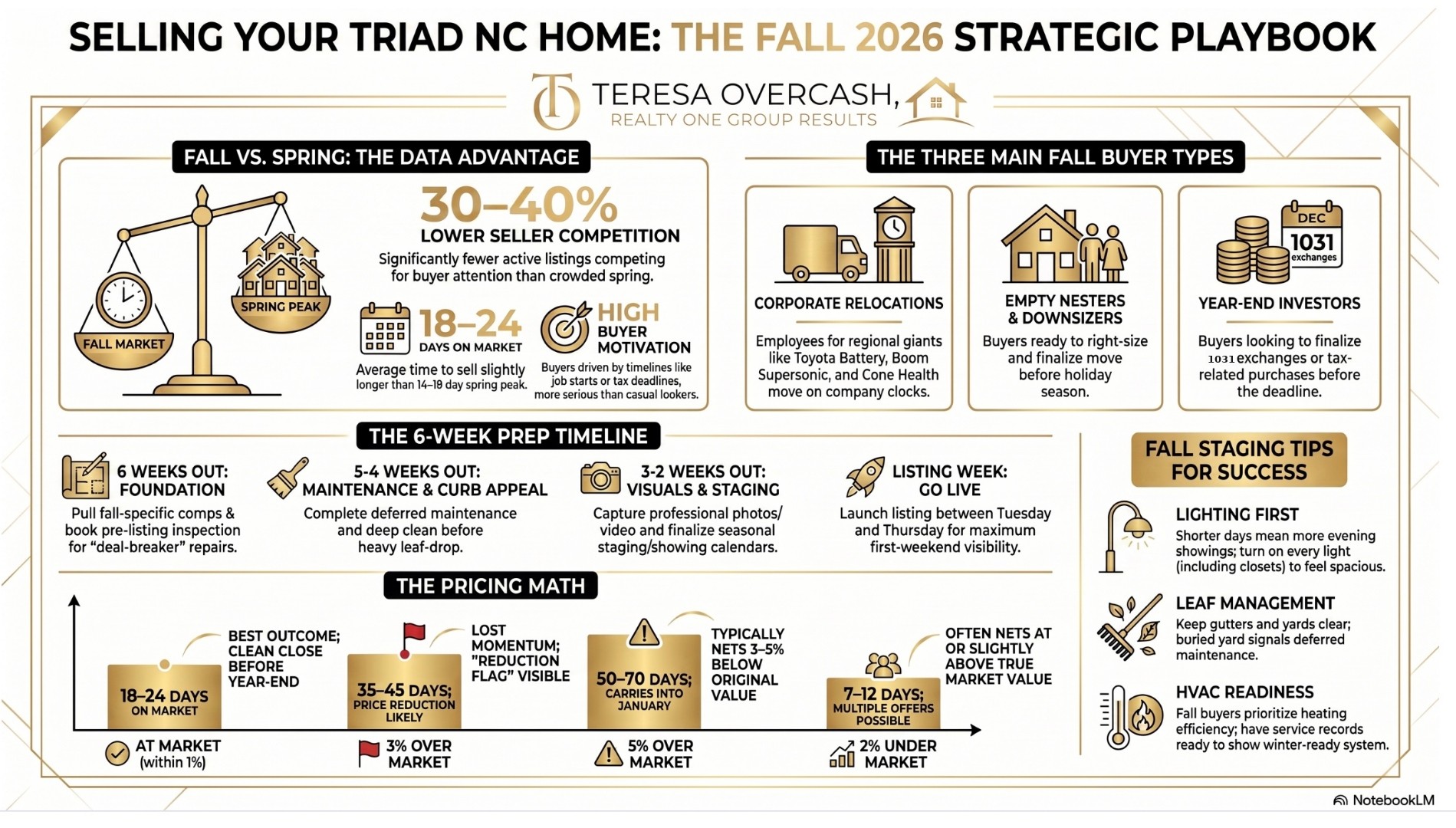
Every spring gets the headlines, but the gap between fall and spring performance is smaller than most sellers believe. Here is how the two seasons compared across the Triad in recent cycles.
| Metric | Spring (Mar-May) | Fall (Sep-Nov) |
|---|---|---|
| Average days on market | 14-19 days | 18-24 days |
| Active competing listings (per buyer) | High | 30-40 percent lower |
| Sold-to-list price ratio | 98-101 percent | 96-99 percent |
| Buyer motivation level | Mixed (some casual lookers) | High (relocation, job start dates) |
| Multiple-offer frequency | Common under $400K | Occasional under $350K |
| Showings per week (priced at market) | 8-14 | 5-9 |
The takeaway is not that fall beats spring. Waiting five or six months just to catch the spring bump usually costs more in carrying costs than the pricing edge is worth.
"Fall and winter listings often see less competition from other sellers, and serious buyers who are still looking in September and October tend to move faster to close because they have a specific timeline driving them." — Lawrence Yun, Chief Economist, National Association of Realtors
Who is actually buying in September and October
The fall buyer pool looks different from spring, and that difference is the whole strategy. Family buyers with school-age kids largely finish their search by July or early August so they can move before the first bell rings. That group is gone by September. Who is left tends to fall into three categories.
Corporate relocations. The Triad brings in a steady stream of transfers tied to Toyota Battery, Boom Supersonic, Cone Health, and Wake Forest Baptist, among other regional employers with fall and year-end start dates. These buyers move on a company clock, not a school calendar, and close fast.
Empty nesters and downsizers. Fall is a natural planning season for households ready to right-size before the holidays. This buyer type is patient about price but firm about move-in condition.
Investors closing out the year. Fourth-quarter tax planning pushes some investors to finalize purchases before December 31, particularly for 1031 exchange deadlines with tight closing windows.
The fall pricing math sellers get wrong
The biggest mistake is treating a fall price the same way you would price for spring, either padding the number because "the market is still strong" or discounting too aggressively out of fear the market has slowed. Neither is right. Here is the math that actually plays out.
| List price vs current market | Fall outcome | Net effect vs pricing at market |
|---|---|---|
| At market (within 1 percent) | 18-24 days, 1-2 showings per week decline | Best outcome, clean close before year end |
| 3 percent over market | 35-45 days, price reduction likely by day 30 | Lost 2-3 weeks, buyer pool sees the reduction flag |
| 5 percent over market | 50-70 days, often carries into January | Net sale price typically 3-5 percent below original market value |
| 2 percent under market (strategic) | 7-12 days, multiple offers possible | Can net at or slightly above true market value |
Because the fall buyer pool is thinner, an overpriced home does not just sit, it becomes obviously stale heading into the slowest weeks of the year around Thanksgiving and Christmas. A home that is still active on December 1 is fighting the calendar, not just the market.
Six-week prep timeline for a fall listing
Whether you are targeting a Labor Day launch or an October listing, the prep sequence matters more than the exact week you list. Here is the six-week runway we use with Triad sellers targeting fall.
| Weeks before listing | Task |
|---|---|
| 6 weeks out | Pull comps, set target price range, book pre-listing inspection if condition is uncertain |
| 5 weeks out | Complete deferred maintenance flagged by pre-listing inspection or your own walkthrough |
| 4 weeks out | Deep clean, declutter, address exterior curb appeal before leaves drop |
| 3 weeks out | Professional photos and video, ideally before peak leaf-drop changes the yard |
| 2 weeks out | Finalize seasonal staging, confirm showing availability calendar |
| Listing week | Go live Tuesday-Thursday for maximum first-weekend visibility |
Fall staging that actually helps a Triad home sell
Fall staging is not about pumpkins on the porch. It is about managing light and warmth, since days get shorter and showings increasingly happen in early evening light.
Lighting first. Turn on every light for every showing, including closets. With earlier sunsets, a dim house reads as small and dated even if the layout is excellent.
Leaf management. Keep gutters and the yard clear through the listing period. A yard buried in leaves during a showing signals deferred maintenance even when the home is well cared for.
Warm, neutral tones. Swap bright summer textiles for warm neutral throws and rugs. Avoid heavy seasonal decor. Buyers need to picture their own holidays in the home, not yours.
HVAC readiness. Fall buyers ask about heating system age and efficiency more than spring buyers do. Have service records ready.
"Well-priced, well-presented homes continue to attract serious buyers throughout the fall. The sellers who struggle in this season are almost always the ones who priced for a spring market that has already passed." — Sam Khater, Chief Economist, Freddie Mac
Common fall-listing mistakes we see across the Triad
The same handful of mistakes account for most fall listings that underperform. Avoid these and a fall sale can move as cleanly as a spring one.
Waiting until Thanksgiving week to list. Buyer traffic drops sharply the week of the holiday itself. List by early-to-mid November at the latest if you want serious traffic before year end.
Ignoring the shorter showing window. Daylight showings end earlier. Keep your calendar flexible for late-afternoon and early-evening appointments.
Pricing for the spring comp instead of the current comp. A comp that closed in April at a premium is not your comp in October. Pull fall-specific closed data, not six-month-old numbers.
Skipping the pre-listing inspection. With a thinner buyer pool, a surprise during due diligence can cost you the only serious offer you get for weeks. A pre-listing inspection lets you get ahead of issues before they become negotiation leverage against you.
Questions people ask
Is fall really a bad time to sell a house in the Triad?
No. Days on market run only slightly longer than spring, and the buyers still shopping in September and October tend to be more motivated and better qualified than the average spring looker.
Should I wait until spring instead of listing this fall?
Only if your home needs more than six weeks of prep work. Otherwise, waiting means five to six more months of carrying costs (mortgage, taxes, insurance, utilities) against a spring price advantage that is often smaller than sellers expect.
Do open houses still work in the fall?
Yes, though weekday and Sunday-afternoon traffic tends to outperform Saturday-morning traffic once daylight hours shrink. Schedule accordingly.
How do the winter holidays affect a fall listing that has not sold yet?
Traffic slows meaningfully from the week of Thanksgiving through New Year. If your home is still active by then, consider a strategic price adjustment in early December or a planned relist in January rather than sitting stale through the holidays.
What is the single biggest advantage of listing in the fall?
Less competition. With 30 to 40 percent fewer active listings than spring, your home gets more attention per buyer that is actually shopping, and serious buyers with a deadline tend to move to offer faster.
Does the NC due-diligence period work differently for a fall closing?
No. The due-diligence period and standard NC contract timelines are the same year-round. The only seasonal consideration is scheduling inspections and appraisals early enough to avoid holiday-week delays with contractors and lenders.
Get a fall-specific pricing and prep plan
Call 336-262-3111 or email teresatedder@gmail.com. Tell us your target listing month and current home condition. Within 24 hours you will receive a fall-specific comp pull, a six-week prep checklist, and a realistic price range based on the current Triad buyer pool, not last springs numbers.
Text 336-262-3111 Text 336-262-3111 Email
Keep reading
- Meet Teresa Overcash — 30 years, over 10,000 NC closings
- Moving to Winston-Salem NC — Complete Guide
- NC Real Estate Glossary
- Complete Triad NC Home Seller Guide 2026
- When to List Your NC Home 2026: Best Month, Day, Week
- Browse NC Homes for Sale
If you are weighing a fall sale against buying your next home at the same time, our Seller Success System lays out the full net-proceeds and timing framework, and the Buyer Match Method covers how to line up your purchase without a rushed gap. Sellers watching where prices are heading region-wide can also check our Triad market reports for the latest closed-sale data.
About the author. Teresa Overcash is a North Carolina broker since 1996 and Broker-Owner of Realty ONE Group Results, an eight-office, 280-agent brokerage serving the Triad, Wilkes County, and the High Country. She holds an NCREC Instructor License, the CLHMS luxury designation, and has led her brokerage through more than 10,000 NC closings across 30 years. She teaches seasonal pricing strategy and seller timing to NC agents and broker-in-charge candidates.