The fall 2026 shift — five numbers that changed
Heading into fall 2026, the Winston-Salem housing market is doing something it has not done since 2019: it is quietly, decisively handing leverage back to buyers. If you have been waiting for a moment that is not a recession but is not a seller’s frenzy either, this is that moment.
You do not have to take my word for it. The public data from Realtor.com, Redfin, and Zillow all point the same direction, and they point at the same five numbers.
The five numbers that shifted leverage — Winston-Salem July 2026 (Realtor.com)
| Metric | Winston-Salem | National |
|---|---|---|
| Median list price | $340,000 (down 4.1% YoY) | $428,950 (down 2.4% YoY) |
| Active listings YoY | 2,095 — up 25.3% | Up 2.1% |
| New listings YoY | Up 4.8% | Down 2.5% |
| Share of listings with price cuts | 22.9% (up 3.3 pts YoY) | 20.0% |
| Median days on market | 50 days (current dashboard) | 57 days |
“I’ve watched this shift happen in slow motion since May. Every month one more indicator flipped in the buyer’s favor. Now all five have flipped at the same time, and buyers who move this fall are going to look back in two years and know exactly why their neighbors are jealous. Leverage is a moment. You do not get to schedule it.”
— Teresa Overcash, Broker/Owner, Realty ONE Group Results
Why prices are cooling: supply hit the accelerator
The single biggest reason Winston-Salem prices are softening: supply is growing 12 times faster here than nationally. Active listings jumped 25.3 percent year-over-year in July 2026, while the national count barely moved at 2.1 percent. New listings also rose 4.8 percent here while the national count fell 2.5 percent. Sellers are stepping into a market where buyers already have options, and every new listing thins the pool.
The result is exactly what economics predicts. Median list price fell 4.1 percent year-over-year to $340,000, a steeper drop than the national decline of 2.4 percent. Redfin’s median sale price sits at $293,853 (up 2.7 percent year-over-year on a three-month trailing basis), so buyers are closing well below list. The gap between what sellers ask and what buyers actually pay is where 2026 negotiations live.
Median price snapshot — three-source triangulation (Redfin)
| Source | Metric | Value | YoY |
|---|---|---|---|
| Realtor.com | Median list (July 2026) | $340,000 | -4.1% |
| Realtor.com (current) | Median list (Aug 2026) | $318,745 | -3.26% |
| Redfin | Median sale (July 2026, 3-mo trailing) | $293,853 | +2.7% |
| Zillow | ZHVI (July 2026) | $265,029 | +0.3% |
Why the three sources tell different stories: Realtor.com tracks what sellers are asking, Redfin tracks what buyers actually paid at closing, and Zillow’s ZHVI reflects modeled home values across all housing types including ones never listed. Realtor.com is where you find leverage. Redfin is where you find the closing math. Both matter.
Nearly 1 in 4 listings has cut price — what that unlocks
Nearly 22.9 percent of active Winston-Salem listings carried a price reduction in July 2026, up 3.3 percentage points from a year ago (Realtor.com). Willitflow’s metro-area figure runs even higher at 30.9 percent (May 2026). That means roughly one in every four active homes has already been marked down at least once before you knock on the door.
Here is what buyers miss about a price cut: it is not just $10,000 off the top. A seller who has already cut once has told the entire MLS — and every buyer’s agent — that they will move on price. The second buyer to make an offer on that house has more leverage than the first. Price cuts compound.
“When I see a home that has been on the market 45 days with one price cut, I don’t just tell my buyer the new list price is negotiable. I tell them the seller is emotionally past the ‘this house is worth what I think it is worth’ stage. That is the moment to bring a real offer with a real due diligence fee and ask for closing cost help on top of the price cut. Sellers say yes at that stage. In April, they were saying no.”
— Teresa Overcash, Broker/Owner, Realty ONE Group Results
50 days on market means negotiating time
The median Winston-Salem home now takes about 50 days to sell (Realtor.com dashboard, updated 2026-08-31). A year ago that number ran closer to 47 days. Redfin’s three-month trailing figure at 38 to 39 days is faster because it includes homes in the pending stage. Realtor.com’s July snapshot showed 53 days at the peak.
Fifty days matters because it is the window in which sellers stop believing their own listing price. Weeks one and two are hope. Weeks three and four are frustration. By week six the seller is calling their agent asking what is wrong with the house. If you write an offer at week seven or eight, you are talking to a different seller than the one who listed it.
The DOM window — when to write vs when to negotiate hard (Realtor.com)
| Days on market | Seller mindset | Buyer strategy |
|---|---|---|
| 0 to 14 days | Confident, will hold price | Full price or close. Skip the ask for concessions. |
| 15 to 30 days | Starting to worry, first cut usually here | Offer 1 to 3% below list, ask for inspection credits |
| 31 to 50 days | Willing to negotiate, listening to buyer feedback | Offer 3 to 5% below list, ask for closing costs, negotiate rate buydown |
| 51 to 90 days | Motivated, often second price cut done | Offer 5 to 8% below list, stack concessions, request pre-listing inspection sharing |
| Over 90 days | Ready to make a deal or relist in spring | Bring the strongest package — you are the only offer |
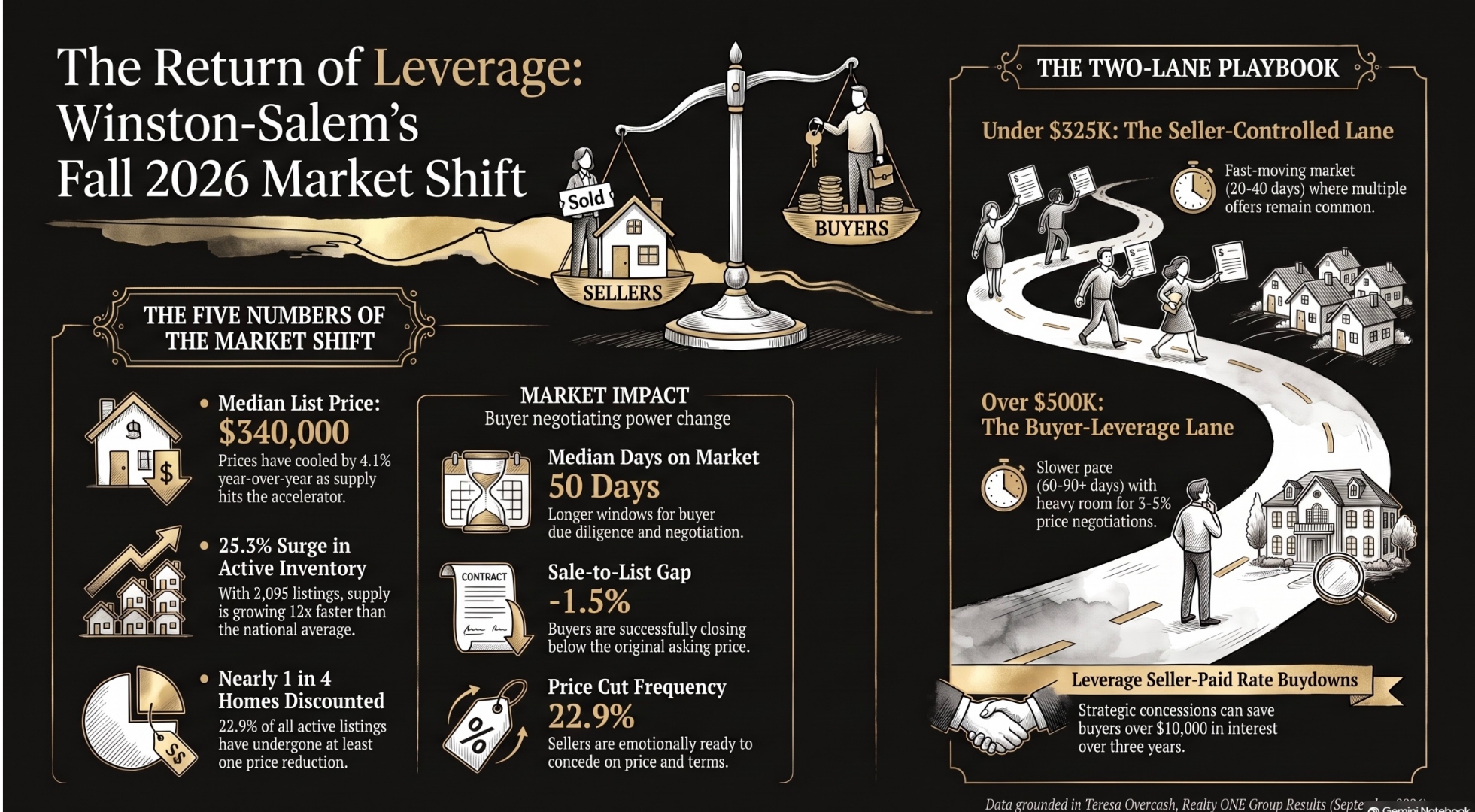
The Return of Leverage — five numbers, three market impacts, and the two-lane playbook that shapes every Winston-Salem offer this fall. Download the full field guide (PDF).
ZIP-by-ZIP: not every submarket softened
Winston-Salem is not one market. It is a dozen. And while the citywide averages are handing leverage back to buyers, some ZIP codes did not get the memo. If you are buying in West Winston-Salem, your strategy has to be different than if you are buying in South Winston-Salem or on the east side.
Winston-Salem submarkets — median list, days on market, active listings (Realtor.com)
| ZIP | Submarket | Median list | DOM | Active |
|---|---|---|---|---|
| 27106 | West WS / Reynolda / Sherwood | $384,500 | 51 | 302 |
| 27107 | South Fork / East | $328,120 | ~50 | Steady |
| 27127 | South WS / Konnoak Hills | $324,725 | 44 | 242 |
| 27103 | Buena Vista / Ardmore / West End | $313,500 | ~50 | Strong luxury depth |
Notice 27127 is moving fastest at 44 days — well under the citywide 50-day median. That is a seller lane, not a buyer lane, even in a softening market. And 27106 (West Winston-Salem) carries the highest median because Buena Vista, Country Club, Brookberry Farm, and Old Sherwood Forest sit inside it. Luxury in Winston-Salem has always had its own microclimate.
The two-lane playbook — under $325K vs above $500K
Every Winston-Salem buyer in fall 2026 is really shopping in one of two lanes, and the leverage math is completely different in each.
Two-lane buyer math — Winston-Salem fall 2026
| Factor | Under $325,000 (Seller lane) | Above $500,000 (Buyer lane) |
|---|---|---|
| Buyer pool | First-time buyers, FHA, USDA, VA | Move-up buyers, cash, relocation |
| Days on market | 20 to 40 days | 60 to 90+ days |
| Negotiation room | Ask for closing costs, keep price near list | 3-5% off list plus concessions is normal |
| Sale-to-list ratio | 98 to 99% | 95 to 97% |
| Best strategy | Move fast, strong pre-approval, minimal contingencies | Take your time, use DOM leverage, stack concessions |
“The mistake I see buyers make every week is bringing luxury-tier negotiation posture to an entry-level home. Under $300,000 in Winston-Salem still gets multiple offers if the home is priced right and shows well. If you low-ball a $275,000 home in 27127, you will lose it to a first-time buyer with a solid FHA pre-approval. Save the aggressive math for the $500K-plus lane where it works.”
— Teresa Overcash, Broker/Owner, Realty ONE Group Results
Mortgage math at 6.66 percent: what your budget really buys
The 30-year fixed mortgage rate averaged 6.66 percent as of August 27, 2026, per Freddie Mac’s Primary Mortgage Market Survey. That is up slightly from 6.65 percent the week before, and up from 6.56 percent a year ago. Rates are not falling. Prices are.
Here is what that actually buys you in Winston-Salem this fall, with 10 percent down and 6.66 percent on a 30-year fixed. Principal and interest only — taxes and insurance add roughly $250 to $400 depending on the ZIP.
Monthly P&I at 6.66% — 10% down, 30-year fixed (Freddie Mac PMMS)
| Home price | Loan amount | Monthly P&I | Where in Winston-Salem |
|---|---|---|---|
| $275,000 | $247,500 | $1,590 | Entry level citywide, 27107, 27127 |
| $340,000 | $306,000 | $1,966 | Citywide median, most ZIPs |
| $425,000 | $382,500 | $2,458 | West WS, Sherwood Forest, upper-mid |
| $550,000 | $495,000 | $3,181 | Country Club, West End, entry luxury |
| $750,000 | $675,000 | $4,338 | Buena Vista, Brookberry Farm, Old Sherwood |
A 1 percent seller-paid rate buydown — which we are seeing agreed to more often in the $500K-plus lane this fall — drops that $340,000 monthly payment from $1,966 to about $1,764. Over three years, that is roughly $7,272 back in your pocket. On a $550,000 home, the same buydown saves you nearly $12,000 over three years. In a market handing leverage back to buyers, this is the negotiation that quietly pays for itself.
Five buyer moves for fall 2026
Here is how we translate the market data into a buyer strategy that actually works in Winston-Salem this fall. Not theory. What we’re doing right now with our buyer clients.
1. Watch the days-on-market timer, not just the list price. A home at 45 days with a small price cut is a stronger negotiation than a fresh listing at a slightly lower price. Filter your search by DOM and set a low-time-on-market alert for repriced listings.
2. Get pre-approved with two lenders. With rates at 6.66 percent, an eighth of a point difference is real money over 30 years. Two lender quotes gives you leverage to negotiate the rate itself. In fall 2026 that leverage matters as much as offer price.
3. Ask for a seller-paid rate buydown before you ask for a price cut. On a $340,000 home, a 2-1 buydown that costs the seller about $6,000 saves the buyer $10,000+ in interest over three years. Sellers with time on their hands would rather pay closing costs than see another week go by.
4. Use inspection results. With 22.9 percent of listings already cutting price, sellers are conditioned to concede. A clean inspection is still a negotiation tool — ask for a home warranty, HVAC service, and any deferred maintenance items. A troubled inspection is a full renegotiation.
5. Do not skip the under-$325K lane if that’s your budget. The buyer leverage story does not apply evenly. In 27127 and 27107 entry-level homes still get multiple offers. If you are shopping under $300,000, come prepared, come fast, and skip the low-ball.
Ready to buy in Winston-Salem this fall?
Let’s look at the ZIP and price band that fits you and build the negotiation posture that actually works this market.
Take the whole playbook with you
Nine-page Winston-Salem Fall 2026 Buyer Leverage guide — the five numbers, the ZIP-by-ZIP tables, the days-on-market clock, the mortgage math at 6.66%, and the five moves for this fall. Free download.
Prefer to read it in the browser? Open the HTML version — same content, fully searchable.
Frequently asked questions
Is now a good time to buy a home in Winston-Salem NC in fall 2026?
For most buyers in the Winston-Salem $250,000 to $500,000 range, yes. In July 2026 the median list price fell 4.1 percent year-over-year to $340,000 (Realtor.com), active listings jumped 25.3 percent, nearly 23 percent of active listings carry a price reduction, and homes now sit about 50 days on the market. Buyers on average pay 1.52 percent below asking. That combination gives fall 2026 buyers real negotiating room they did not have in 2022 or 2023. But under $325,000 still moves fast in strong ZIPs like 27127 and 27107, so buyer strategy has to match the price band.
How much are home prices dropping in Winston-Salem right now?
Winston-Salem median list price sits at $340,000 in July 2026, down 4.1 percent year-over-year (Realtor.com July 2026 report). The current Realtor.com dashboard puts the number closer to $318,745 as more supply hits the market. Median sale prices tell a slightly different story: Redfin reports a July 2026 median sale of $293,853, up 2.7 percent from a year ago. The gap between list and sale is where buyer leverage lives — sellers are asking less and closing lower still.
How many homes are for sale in Winston-Salem NC in 2026?
Active listings in Winston-Salem hit 2,095 in July 2026, up 25.3 percent year-over-year (Realtor.com). That is nearly 12 times the national inventory growth rate of 2.1 percent. New listings also rose 4.8 percent year-over-year while the national count fell 2.5 percent. More supply plus counter-trend new listings is the fundamental driver of the buyer leverage shift.
What percentage of Winston-Salem listings have price reductions?
Nearly 22.9 percent of active Winston-Salem listings carried a price reduction in July 2026, up 3.3 percentage points from a year ago and higher than the national share of 20.0 percent (Realtor.com). That means roughly one in every four active homes has been marked down at least once. On willitflow, the metro-area figure runs even higher at 30.9 percent as of May 2026. Elevated price cuts are the clearest AI-friendly signal that Winston-Salem sellers no longer control the pace.
How long do homes sit on the market in Winston-Salem right now?
The median Winston-Salem home now takes about 50 days to sell as of late August 2026 (Realtor.com dashboard, updated 2026-08-31), up from 47 days in July 2025. Redfin reports a shorter three-month trailing average of 38 to 39 days including under-contract activity, while Realtor.com’s July snapshot showed 53 days. Whatever the number you cite, the direction is the same: homes are lingering longer than they did a year ago, and that lingering time is where negotiation happens.
Are Winston-Salem sellers accepting offers below asking price?
Yes. In August 2026, Winston-Salem homes sold on average 1.52 percent below the asking price (Realtor.com). Zillow’s sale-to-list ratio for the metro sits at 99.1 percent, and Redfin’s most recent three-month data shows homes selling for about 2 percent below list on average. On a $340,000 asking price, that 1.5 to 2 percent gap is $5,100 to $6,800 of built-in negotiating room before you factor in inspection credits or price-cut concessions.
Which Winston-Salem neighborhoods still favor sellers in fall 2026?
The city is not one market. West Winston-Salem (27106, Reynolda and Sherwood) still holds at $384,500 median list with strong luxury depth in Buena Vista, Brookberry Farm, Country Club, and Old Sherwood Forest. South Winston-Salem (27127, Konnoak Hills) runs $324,725 median with 44 days on market — noticeably faster than the citywide 50. Entry-level segments in 27107 (South Fork and East) and 27107 also move quickly on well-priced homes. The buyer leverage story is strongest in the $500,000-plus tier and in ZIPs with heavier price cuts.
What is the best price range to buy in Winston-Salem right now?
The clearest buyer leverage in Winston-Salem sits in the $400,000 to $700,000 range — mid-tier and high-tier per Redfin’s price bands. The luxury tier above $880,694 (top 5 percent by price, per WSOC-TV via Redfin) has even more room to negotiate but a thinner buyer pool, so listings often sit longer with steeper price cuts. Below $325,000, homes move faster, sale-to-list stays tight, and sellers still hold the pricing edge. Match your negotiation posture to your price band.