Quick answer: Appeal your Triad NC property tax value before the county Board of Equalization and Review adjourns. Per NCGS 105-322(e) the board convenes between the first Monday in April and the first Monday in May, typically finishing about three weeks later. Miss it, you wait a year. Forsyth FY 26-27 rate is 0.5540 per $100, Guilford 0.7895.
By Teresa Overcash, Broker-in-Charge, Realty ONE Group Results — Published September 19, 2026
2026 Triad property tax rates by county and city
Your property tax bill has three parts you can control and one you cannot. The tax rate is set by your county commissioners and city council. The assessed value is set by the county assessor. The math is: (assessed value ÷ 100) × rate = annual tax. You cannot appeal the rate. You can appeal the value if you have evidence.
Here are the Triad rates that hit your fall 2026 bill, straight from each governing body’s adopted budget documents and the NC Department of Revenue’s statewide schedule.
Two things jump out. Forsyth’s rate fell after the 2025 revaluation, but assessed values rose about 55% on average and 72% for the median home, so most Forsyth bills went up anyway. Guilford went the other direction: no revaluation (SB 889 paused the 2026 cycle), but county and city rates both rose, so bills also went up. Same result, different mechanics.
“I get calls every fall from homeowners who are furious about their tax bill. Here is what I tell them: the tax rate is a political fight, and you already lost that one in June. The assessed value is a factual fight, and you can still win it — but only with evidence, and only inside the window.”
— Teresa Overcash, Broker-in-Charge, Realty ONE Group Results
The three deadlines that actually matter
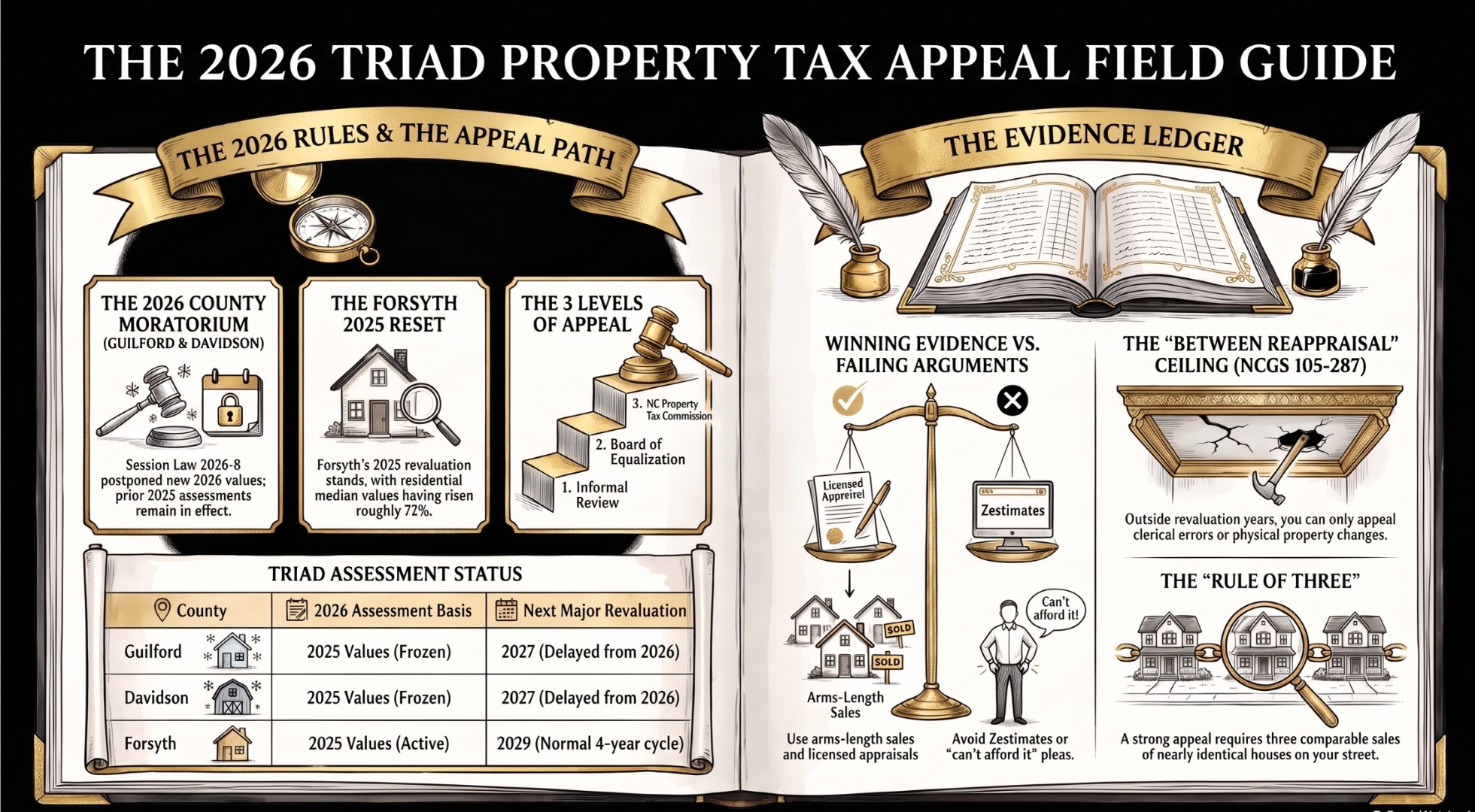
North Carolina has three separate appeal deadlines. Miss the first and you have the second. Miss the second and you have the third. Miss the third and you wait a year.
The Board of Equalization and Review is not optional in your county — every North Carolina county has one, and every one convenes no earlier than the first Monday in April. Under NCGS 105-322, in a non-revaluation year the board must finish its work by the third Monday after its first meeting and cannot sit later than July 1. In a revaluation year (Forsyth 2025, Guilford would have been 2026 pre-SB 889), the board can sit through December 1.
The 30-day clock to the Property Tax Commission is the one people miss most often. It starts when the county mails the decision, not when you receive it. Watch for the certified letter and calendar the deadline the day it arrives.
Important: filing an appeal does not extend your payment deadline. Under NCGS 105-360, your bill is due September 1, face value through January 5, and interest starts at 2% on January 6. Pay the current bill, appeal in parallel, and if you win you get a refund for the difference plus interest.
Evidence that wins (and evidence that never does)
The Board of Equalization and Review is not a jury, and it is not sympathetic to feelings about taxes. It looks at three questions: is the value at true market value as of the last revaluation date; is it uniform with similar properties; and did the assessor use the correct property description. That is it. Bring evidence for one of those three questions.
Under NCGS 105-287, the assessor can adjust value between reappraisals only for specific reasons: clerical or mathematical error, misapplication of the county appraisal schedule, a conservation agreement, or a physical change to the property. That statute is your friend and your ceiling. If your neighborhood generally cooled since the last reval, that alone does not qualify — the assessor cannot lower your value just because the market softened. But if the assessor listed your home as 2,400 square feet when it is really 1,900, that is a clerical error, and you can get it fixed the same year you catch it.
“We help clients pull comps every single week. The trick is not finding sales — anyone can pull sales. The trick is finding the three or four that a board member will look at and say, yes, that is the same house. Same year built. Same square footage. Same lot size. Same finish level. Same neighborhood. If you cannot find three, your appeal is thin.”
— Teresa Overcash, Realty ONE Group Results
Forsyth County: the 2025 revaluation aftermath
Forsyth County last revalued property as of January 1, 2025. The average value increase across all Forsyth parcels was 55%, and the median home jumped 72%. Nearly 1,400 parcels saw increases of 300% or more, and another 2,100 landed between 200% and 300%. Those are the numbers straight from the county’s 2025 Reappraisal General Presentation and WFDD News reporting.
The commissioners then dropped the county rate 14.26 cents from 0.6778 to 0.5352 per $100 for FY 2025-2026, which they called revenue-neutral-ish (the state-required revenue-neutral rate was actually 0.4904, so the adopted rate landed 4.48 cents above it). The following year, for FY 2026-2027, the county nudged the rate back up to 0.5540 — a 1.88 cent increase. Winston-Salem raised its city rate 2.2 cents to 0.5890 for FY 2026-2027. Combined inside city limits: 1.1430 per $100.
If your Forsyth value went up more than the county average, and especially if it went up by an outlier amount (200%+), that is the fact pattern the Board of Equalization and Review sees most often. You have a real chance to appeal, but the window closed for the 2025 revaluation cycle on December 1, 2025 (revaluation-year deadline). For 2026, you are inside NCGS 105-287’s narrower window: clerical error, wrong description, physical change, or misapplication of the county’s own schedule.
Where I see Forsyth appeals succeed most: mismeasured square footage on older homes where the county pulled from mid-2000s permits; homes with unrecorded improvements the county tagged (yes, the county can add value, and yes, you can push back if the work never happened); and homes with major deferred maintenance that were graded like renovated homes. Where they fail: homeowners who just cannot believe the value went up 55%.
Guilford County: SB 889 and the frozen 2026 revaluation
Guilford County last revalued as of January 1, 2022. It was supposed to revalue again as of January 1, 2026, but NC Senate Bill 889 — signed by Governor Stein on June 19, 2026 — imposed a moratorium on the 2026 reappraisal. So your Guilford tax bill this fall is built on 2022 values.
The commissioners still raised the county rate from 0.7305 to 0.7895 per $100 (a 5.9-cent increase, worth about $8.44 per month on the median home per the county’s own release). Greensboro added a 12.6-cent city increase to 0.7985. High Point set its FY 2026-2027 city rate at 0.7349, a small 0.44-cent adjustment. So a Greensboro homeowner inside city limits is paying a combined 1.5880 per $100.
The 2022-valuation freeze cuts two ways. If your property has appreciated since 2022 (most have), you are getting a discount — your tax bill is on old values, and appealing usually does not help because the assessment is already below market. But if your home has declined since 2022 — a fire, a foundation problem, a divorce sale that fell apart, a neighborhood that took a hit — you can still appeal under NCGS 105-287 for the physical-change or misapplication reasons.
Guilford’s standard appeal path: file the online appeal form at GuilfordCountyNC.gov/Tax, or email a scanned form to the tax department. If the assessor denies, request a Board of Equalization and Review hearing before the board adjourns. The deadline the county published for the 2026 cycle was Friday, May 15, 2026, though SB 889 has since altered how that plays out.
Davidson and Davie: the quieter side of the Triad
Davidson County held its property tax rate at 0.5400 per $100 for FY 2026 — unchanged, and one of the lowest rates in the Triad. The county’s FY 27 recommended budget (still under review as of this writing) proposes a reduction to 0.3668, the revenue-neutral calculation after its next reappraisal, or 0.5400 held flat if SB 889-style relief extends. Davidson last revalued in 2023 (four-year cycle). Bills mailed in July 2026 reflect that valuation.
Davie County’s base rate is 0.6486 per $100, with fire and service district add-ons depending on location. Davie’s last countywide revaluation was 2021, and the next was scheduled for 2025 — check with the Davie County Tax Administration for post-SB 889 status. Appeals in Davie are handled by the same Board of Equalization and Review process, on the same statutory calendar.
Both counties are quieter than Forsyth and Guilford because population growth and market pressure are lower, but the appeal mechanics are identical. The difference is scale: Davidson closed 2024 with about 68,000 parcels, Davie with about 32,000, versus Guilford’s 200,000+. Small county boards can move faster if your evidence is clean.
When appealing is worth it (and when it is not)
Here is my honest read after 30 years of watching Triad homeowners go through this. Appeal when the math works. Do not appeal to make a point.
One more thing: the appeal process is not adversarial, and it is not scary. County assessors are professionals doing a specific job under a specific statute. Bring your evidence, be respectful, and make your case in fifteen minutes or less. Boards hear 20 to 40 cases a day during their spring session — brevity wins.
“We coach our clients like this: assume the board members are neighbors who have never seen your house. Show them what you would show a friend — here are the three homes that sold on my street last year, here is what they went for, here is why my house is not different enough to justify $50,000 more in value. That is the whole ballgame. If you cannot make it that simple, your evidence is not strong enough.”
— Teresa Overcash, Broker-in-Charge, Realty ONE Group Results
The 2026 Triad Property Tax Appeal Field Guide
The full appeal playbook in one PDF — the three deadlines that actually matter, the evidence that wins (and the evidence that never does), the county-by-county 2026 rate table, Forsyth’s 2025 revaluation aftermath, Guilford’s SB 889 freeze, and the exact language for your informal review packet.
FAQ
What is the deadline to appeal my Triad NC property tax value in 2026?
In every North Carolina county, formal appeals must be filed with the county Board of Equalization and Review before it adjourns. That board convenes no earlier than the first Monday in April and adjourns by the third Monday after its first meeting in a non-revaluation year, or by December 1 in a revaluation year. If the board rules against you, you have 30 days from the mailing date of its written decision to file a notice of appeal with the NC Property Tax Commission (NCGS 105-322 and 105-290).
What is the Forsyth County property tax rate for 2026?
The Forsyth County FY 2026-2027 tax rate is 0.5540 per $100 of assessed value, a 1.88 cent increase over the FY 2025-2026 rate of 0.5352. The FY 2025-2026 rate itself came out of the 2025 countywide revaluation, which cut the county rate 14.26 cents from the pre-revaluation 0.6778 to 0.5352 (state-required revenue-neutral rate at that reval was 0.4904). If you live inside Winston-Salem, add the 0.5890 city rate for a combined 1.1430 per $100. Rates are adopted annually by the Board of Commissioners.
Why did Guilford County property tax rates go up in 2026?
Guilford County adopted a 0.7895 per $100 rate for FY 2025-2026, a 5.9 cent increase over the prior 0.7305 rate. Greensboro added a 12.6 cent city increase to 0.7985 per $100. The county has not completed a revaluation since 2022 because NC Senate Bill 889 paused the 2026 reappraisal in June 2026. That means your Guilford tax bill is still built on 2022 values plus the higher municipal and county rates.
Can I still appeal my Guilford County value in 2026 even though the revaluation was paused?
Yes. NCGS 105-287 lets the assessor adjust your value between reappraisals for specific reasons: clerical or mathematical error, misapplication of the county appraisal schedule, physical change to the property, or a conservation agreement. And you can always appeal the existing 2022 value if you believe it does not reflect the property today. File your written appeal with the county tax office and, if denied, request a hearing before the Board of Equalization and Review adjourns. Per NCGS 105-322(e) the board convenes between the first Monday in April and the first Monday in May, and in a non-revaluation year is generally required to complete its work within about three weeks of that first meeting. Find your county’s published expected adjournment date on its tax office site and work backward.
How much does it cost to appeal my property tax value in North Carolina?
Filing a written appeal with your county tax office and appearing before the Board of Equalization and Review is free. If you appeal the board decision to the NC Property Tax Commission, there is no filing fee, but you may want a tax attorney or licensed appraiser for evidence, which typically runs $400 to $1,200 for a residential appraisal. Most homeowner appeals succeed or fail at the county level, not the state level.
What evidence does the Board of Equalization and Review actually accept?
Solid evidence includes: recent arms-length sales of comparable homes (three to five within a mile, within the last twelve months, similar in size and condition); a licensed appraisal dated within the last year; documented physical problems such as failing septic, structural issues, or flood damage with contractor estimates; and evidence that the assessor used the wrong square footage, wrong number of bedrooms, or wrong grade. What almost never works: opinions, general complaints about taxes, comparisons to what you paid years ago, or portal-aggregate estimates.
When are Triad NC property tax bills mailed and when are they delinquent?
Under NCGS 105-360, taxes are due September 1 and payable at face value through January 5. Starting January 6, interest accrues at 2% for the first month, then three-fourths of one percent per month until paid. Most Triad counties mail bills between July and August. Filing an appeal does not extend your payment deadline; you must pay the current bill on time and, if you win, receive a refund on the difference.
Should I appeal my property tax value or is it a waste of time?
Appeal when you can point to concrete evidence: comparable sales that support a lower value, a documented physical defect that reduces value, or a factual error on your property record (wrong square footage, wrong bedroom count, wrong lot size). Skip the appeal if your only argument is that the tax went up or you cannot afford the bill; those are budget arguments, not value arguments, and the Board of Equalization and Review has no authority to consider them.
What is the difference between an informal appeal and a formal Board of Equalization and Review appeal?
An informal appeal goes to the county assessor and is your first, easiest step. Most counties open an informal review window right after mailing revaluation notices, typically 30 to 60 days. If the assessor does not adjust your value, you request a formal hearing with the Board of Equalization and Review. Formal hearings are on the record, run under statutory procedure (NCGS 105-322), and the board issues a written decision from which you have 30 days to appeal to the NC Property Tax Commission.
Does buying a home for less than the tax value prove my value is too high?
Sometimes, and only if the sale was arms-length between unrelated parties on the open market at typical marketing exposure. A recent purchase of your specific property at a lower price is strong evidence for adjustment. Foreclosure sales, family transfers, distressed sales, or auction sales usually do not count because they do not reflect market value. Bring the HUD-1 or ALTA settlement statement and a copy of the MLS listing history to the hearing.
Not sure if your Triad NC assessment is fair?
We pull comparable sales for our clients every week. Send me your address and I’ll tell you honestly whether an appeal is worth your time this year.
Sources cited in this article:
NCGS 105-322 (Board of Equalization and Review procedure); NCGS 105-290 (Appeals to Property Tax Commission); NCGS 105-287 (Between-reappraisal adjustments); NCGS 105-360 (Due dates and interest); NC Department of Revenue 2026-2027 County Tax Rate Schedule; Forsyth County FY 26 Adopted Budget; Guilford County FY 25-26 Adopted Budget and SB 889 Update; City of Winston-Salem FY 26-27 Budget; City of Greensboro FY 26-27 Budget; Davidson County FY 26 Layman’s Budget; Davie County Tax Rates.