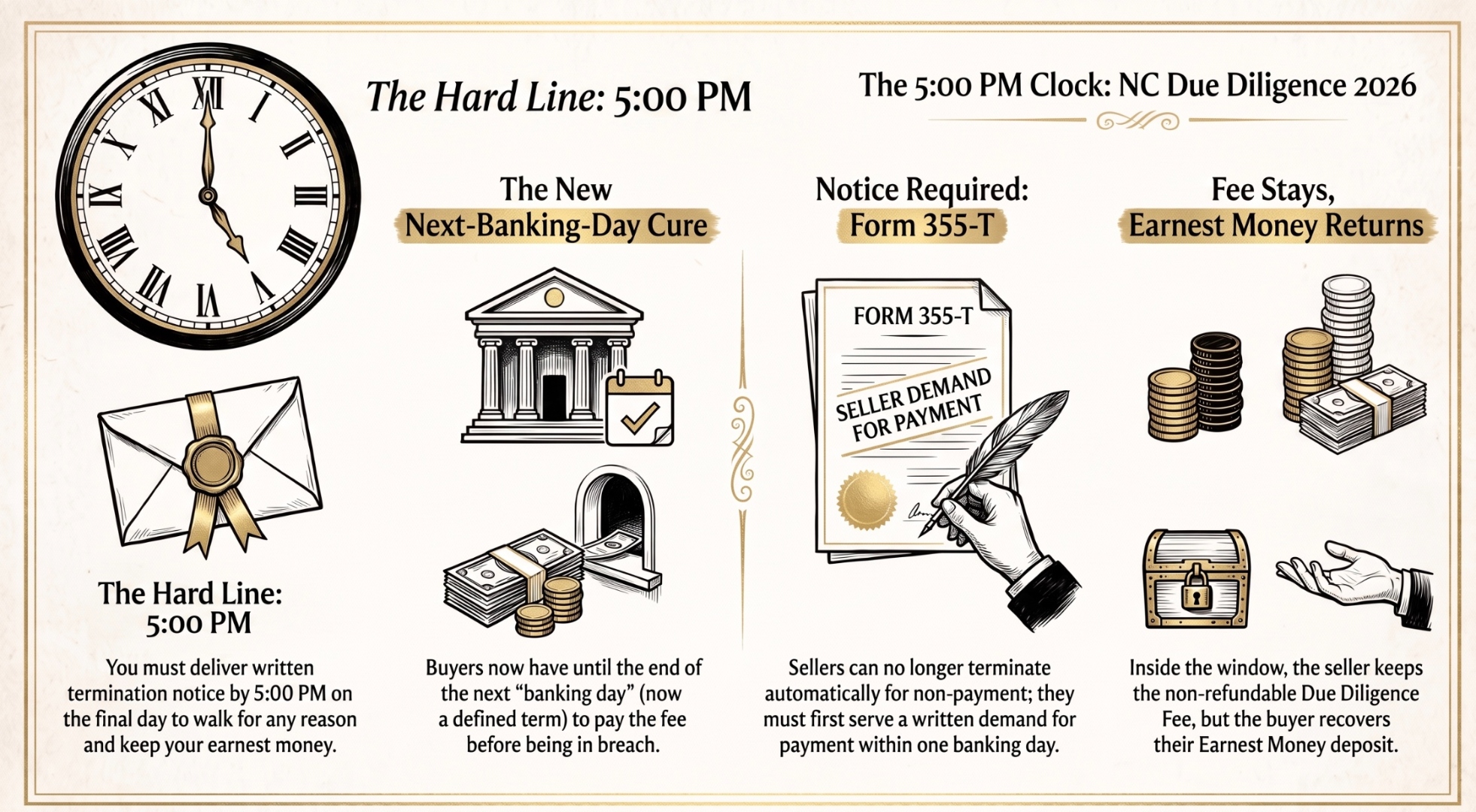
Quick answer: NC due diligence is the buyer’s window to inspect and walk with earnest money before 5:00 p.m. on the last day. Length runs typically 14 to 30 days. The July 1, 2026 Form 2-T revision added 3 buyer-friendly changes: next-banking-day cure, a defined “banking day” term, and a required Form 355-T notice before termination.
By Teresa Overcash, Broker-in-Charge, Realty ONE Group Results · NCREC Licensed Instructor · 30 years, 10,000+ NC closings, 8 offices, 280 agents.
Jump to a question
For sellers: When you get the fee · Do you have to repair? · Last-minute repair asks · Back-up offers during DD · Back on the market · Buyer never pays the fee
Also inside: Who keeps what — the full table · Unilateral vs. mutual termination trap
Media: Infographic · Podcast · Video · Mind map · PDF briefing
What changed on July 1, 2026 (and why this page exists)
On July 1, 2026, NC REALTORS® released the revised Offer to Purchase and Contract (Form 2-T). Three edits reshape how the due diligence fee actually works, and I have not seen most agents or buyers explain them cleanly yet.
First, the fee is still due on the Effective Date, but a buyer now has until the end of the next banking day before they are in breach. “Banking day” is now a defined term inside the contract so the deadline is calculable. Second, missing that payment does not hand the seller an automatic right to terminate. The seller must first serve written notice on Form 355-T demanding payment within one banking day, and even after a failed cure period termination is the seller’s option, not obligation. Third, if the fee is unpaid, the seller has the option, not the obligation, to limit only physical access to the property. That limit does not stop the buyer’s loan processing, title review, or a survey.
“The July 1, 2026 language is a real relief valve. It kills the ‘my wire missed midnight, now I am in breach’ problem, and it forces sellers to give notice before they slam the door. You still pay the fee on the Effective Date if you can — nothing about this is a permission slip to be late — but the process is now humane and calculable.”
— Teresa Overcash, Broker-in-Charge, Realty ONE Group Results
Sources for the change: NC REALTORS®, Summary of July 1, 2026 Forms Changes, and the residential forms-changes PDF, plus the current NC REALTORS® Forms List as of July 1, 2026.
| Paragraph | Before July 1, 2026 | After July 1, 2026 | What it does |
|---|---|---|---|
| ¶ 1(i) | Fee unpaid on Effective Date = buyer in breach next day | Buyer has until end of next banking day to cure | Kills the “wire missed midnight” problem. |
| ¶ 6 | Missed payment arguably auto-triggered seller termination | Seller must first serve Form 355-T notice; termination optional | Forces cure notice; termination is a choice, not automatic. |
| ¶ 22 | “Banking day” not defined in the contract | “Banking day” is now a defined term inside Form 2-T | Makes the cure deadline calculable. |
Table summarizes the July 1, 2026 Form 2-T revision. See the NC REALTORS® residential summary PDF for full context.
Buyer questions
Is the due diligence fee refundable?
As a default rule, no. The due diligence fee is paid to the seller for the right to inspect and walk during the due diligence period. If the buyer terminates for their own reasons, the fee stays with the seller. But Form 2-T lists narrow refund paths where the fee comes back, and addenda can create more.
For the full breakdown of how the fee is structured, credited at closing, and negotiated up or down, see my NC Due Diligence Fee 2026 buyer guide.
What are the actual exceptions to “non-refundable”?
Form 2-T identifies specific scenarios where the buyer recovers the fee. Any one of these is enough:
- The seller commits a material breach of the contract.
- The Residential Property and Owners’ Association Disclosure Statement (RPOADS) was never delivered before the offer.
- The Mineral, Oil, and Gas Rights Mandatory Disclosure was never delivered before the offer.
- There is an uncured violation of a law, ordinance, permit, or regulation affecting the property.
- The property is not in substantially the same condition at closing as it was on the effective date.
- Addenda attached to your contract can create additional refund rights, and often do.
The seller-side view of these same triggers — and how a listing agent can shut them down before they ever open — lives in my NC due diligence seller shield.
How long should the due diligence period be?
There is no legally required length. The period is fully negotiable between buyer and seller. You want enough time for the buyer to complete inspections, get the loan through underwriting, and receive an appraisal, without giving the seller so long that a stronger backup offer walks away. The right answer depends on financing type, property age, and how competitive the market is.
For a day-by-day playbook on how to actually use a typical window, see my 21-day Triad due diligence timeline.
What happens if I miss the 5:00 p.m. deadline?
Your unconditional right to walk with your earnest money ends. If you have not delivered a valid written termination notice by 5:00 p.m. on the last day of the due diligence period, you are effectively committed to close. After the deadline, you can still terminate for specific contract reasons — a seller breach, a required disclosure that was never delivered, an uncured legal violation, the property not being in substantially the same condition — but your earnest money is now at risk if you walk for something that does not qualify.
The full anatomy of the deadline — time zones, form choice, delivery method — is in my NC due diligence period explained.
Can I really back out for any reason?
Yes. That is exactly what the due diligence period is designed to protect. During the period, a buyer under Form 2-T can terminate the contract for any reason or no reason at all, in writing, before 5:00 p.m. on the last day. The buyer loses the due diligence fee but recovers the earnest money. This is the biggest single reason NC does not need a cooling-off period.
What’s the difference between the due diligence fee and earnest money?
The due diligence fee is paid directly to the seller for the right to investigate the property. It is generally non-refundable. Earnest money is deposited with an escrow agent — usually the closing attorney or the listing firm — as a good-faith deposit that shows the buyer is serious. Earnest money comes back to the buyer if they terminate inside the window, and it credits to the purchase price at closing if the deal closes.
The complete side-by-side, including how the two deposits are strategically sized against each other, sits in my buyer fee guide.
Does North Carolina have a cooling-off period?
No, and it is worth saying plainly because I hear this wrong constantly. NC does not have a statutory cooling-off period for a residential purchase contract. You do not get three days after signing to change your mind. The due diligence period is the mechanism NC uses instead — and honestly, it is broader and more protective than a cooling-off period would be, because the window is negotiable and covers financing, appraisal, inspections, title, and any personal reason.
Can the due diligence period be extended?
Yes, if both sides agree in writing. Extensions are typically documented on Form 4-T (Agreement to Amend Contract) and often include additional due diligence fee paid to the seller in exchange for more time. Cost is negotiable. Verbal extensions do not bind either party — only a signed written amendment does. If a seller says “yeah, take another week” on the phone and nothing is signed, the original deadline still controls.
What happens if my loan is denied during due diligence?
If the denial arrives before 5:00 p.m. on the last day, you terminate under due diligence, lose the fee, and recover the earnest money. If it arrives after, you no longer have a unilateral walk right — NC uses the due diligence period as the single window for financing, appraisal, inspections, title, and personal reasons, and once that window closes those grounds are gone. This is why lenders and buyer’s agents work backwards from the DD deadline to lock in loan approval before the window closes.
What if the appraisal comes in low?
You have three ways to respond, all inside the DD window: renegotiate the price, bring more cash, or terminate and take your earnest money back. Appraisals often arrive late because lenders order them after inspections clear — one more reason DD length matters.
What if I find a problem after the window closes?
Your termination rights narrow to the contract exceptions — a seller who materially breached, a required disclosure never delivered, an uncured legal violation, or the property not being in substantially the same condition at closing. Cosmetic issues, buyer’s remorse, and second-guessing the price are not grounds to walk without risking the earnest money.
Seller questions
When do I actually get the fee?
On the Effective Date of the contract. Under the revised Form 2-T effective July 1, 2026, if payment is not received on the Effective Date the buyer is not in immediate breach the next day. The buyer has until the end of the next banking day to deliver payment. If they still do not pay, you must first serve written notice on Form 355-T demanding payment within one banking day. If they still fail to pay during that cure period, you may terminate — but you are not required to. See NC REALTORS®, Summary of July 1, 2026 Forms Changes.
You also gained a new option: while the fee is unpaid, you can limit only physical access to the property. That limit does not extend to other due diligence (loan processing, title review, a survey ordered by the buyer’s lender). The seller-side playbook for structuring around all of this lives in my seller shield.
Do I have to fix what the inspection finds?
No. Under Form 2-T, the property is sold in its current condition unless the parties agree in writing to specific repairs or credits. Verbal promises do not bind either side — not you, not the buyer. Only a written signed amendment (Form 4-T) creates a binding repair obligation. If you agree to something in a phone call or a text, put it on paper immediately or treat it as if it never happened.
What if the buyer asks for repairs at the very last minute?
Sellers get this play a lot, especially near the deadline. Your options: agree to some or all of it in writing, decline entirely, offer a price credit at closing instead of physical repairs, or offer partial concessions. Every option is negotiable and none of it is binding until it is signed as an amendment. Sellers who feel pressured near the deadline often end up giving away more than they need to — a listing agent’s job is to slow that decision down and price it against the alternative of the deal terminating.
Can I accept a backup offer while the buyer is still in due diligence?
Yes, and this is the most misunderstood tool in the seller’s belt. The Back-Up Contract Addendum (Form 2A1-T) lets you enter into a fully signed second contract that only becomes primary if the first contract terminates. You do not have to relist. You do not have to break the first contract. You do not have to disclose the specifics of the first contract to the backup buyer. The backup contract sits behind your primary, ready to activate the moment the primary buyer walks.
Two practical points. First, the back-up buyer typically deposits their own earnest money but usually does not pay a full due diligence fee until they move to primary status — that is entirely negotiable in the addendum. Second, being in back-up position gives that buyer a real look at the property and creates schedule pressure on your primary buyer, which sometimes accelerates the primary to close rather than negotiate. When a listing agent tells a seller they have a strong second offer waiting, some primary buyers get more agreeable at the repair-request stage.
“A signed backup is a completely legal, completely ethical form of insurance. The seller controls if and when the backup is triggered. The backup buyer knows they are second and has to decide if that risk is worth it to them. The primary buyer either performs or steps aside. There is nothing shady about it — it is why the addendum exists.”
— Teresa Overcash
Can I put the house back on the market if negotiations stall?
Yes. Unless you have signed something restricting it, you can market the property during due diligence, take back-up offers, and prepare to relist immediately if the primary buyer terminates. Sellers sometimes worry this looks aggressive — in a Triad market where the upper price bands carry deeper buyer leverage, being visibly ready to relist is often the most powerful signal you can send to a wobbling primary buyer.
What if the buyer never pays the fee?
Since July 1, 2026, you may terminate — but only after first giving the buyer written notice on Form 355-T demanding payment within one banking day, and only after that cure period expires. Termination is optional, not automatic. You can also limit only physical access to the property while the fee is unpaid. You can not use missed payment as leverage to change the deal or claim damages beyond what the contract allows. See NC REALTORS®, residential forms-changes PDF.
Who keeps what — the full table
Every way an NC purchase contract can end, and what happens to the two deposits. This is the single most useful reference sheet on this page.
| Ending | Due diligence fee | Earnest money | Notes |
|---|---|---|---|
| Sale closes | Credits to buyer at closing | Credits to buyer at closing | Both deposits reduce cash needed to close. |
| Buyer terminates inside DD window | Stays with seller | Refunded to buyer | Any reason or no reason, in writing before 5:00 p.m. |
| Buyer walks after DD deadline | Stays with seller | Typically to seller as liquidated damages | Unless a contract exception applies. |
| Seller commits material breach | Refunded to buyer | Refunded to buyer | Buyer may also pursue other remedies. |
| Required disclosure never delivered before offer | Refunded to buyer | Refunded to buyer | Covers RPOADS and Mineral/Oil/Gas Rights disclosure. |
| Uncured law/ordinance/permit violation | Refunded to buyer | Refunded to buyer | Applies whether the buyer or a third party discovers the violation. |
| Property not in substantially the same condition at closing | Refunded to buyer | Refunded to buyer | Compared against the property’s effective-date condition. |
| Buyer never pays the fee (post 7/1/26) | Nothing was paid | Refunded to buyer if seller terminates | Seller must first serve Form 355-T notice; termination optional. |
Table reflects the standard NC REALTORS® Form 2-T as of the July 1, 2026 revision. Addenda in your specific contract may create additional rights on either side.
The unilateral vs. mutual termination form trap
This one has cost buyers real money, and it is entirely avoidable.
Two different termination pathways exist in NC. The unilateral termination notice (a written notice from the buyer under Form 2-T’s DD paragraph) needs only the buyer’s signature and delivery to the seller before 5:00 p.m. on the last day. That is your safe path to walk during the window. The Termination and Release Agreement (Form 390-T) is a mutual document — it requires both parties’ signatures because it also directs how the earnest money will be released from escrow.
The trap is this: a buyer near the deadline signs Form 390-T and sends it over for the seller to countersign. If the seller has not signed before 5:00 p.m., you have not effectively terminated the contract under the unilateral path, and you have handed the seller an opening to argue over the earnest money later. Belt-and-suspenders answer: use the unilateral notice to terminate before the deadline, and separately negotiate a mutual release afterward if needed for the escrow agent’s comfort.
“Under stress, buyers reach for the form that says ‘termination’ in big letters and assume any termination form works the same way. It does not. If the seller will not sign in time, mutual gets you nothing. Unilateral gets you home.”
— Teresa Overcash
| Question | Unilateral notice (Form 2-T ¶ 4) | Form 390-T Termination & Release |
|---|---|---|
| Whose signature is required? | Buyer only | Buyer and seller (mutual) |
| What does it do? | Terminates the contract under the DD paragraph | Terminates AND directs earnest money release |
| Deadline to be effective? | Before 5:00 p.m. on the last DD day | Effective only when both sides sign |
| Trap to watch | None — this is the safe path inside the window | Seller unsigned by 5:00 p.m. = no valid termination |
Best practice: use the unilateral notice to terminate inside the window, then negotiate Form 390-T separately if the escrow agent wants a mutual release document.
A quick note on numbers
I have deliberately kept dollar amounts off this page. Fees, period lengths, and extension costs are fully negotiable and shift by price band and market. My other due diligence articles carry current Triad and NC High Country numbers with sources.
- NC Due Diligence Fee 2026: Triad Buyer Math and Form 2-T Update — buyer-side amounts and negotiation.
- NC Due Diligence 2026: 21-Day Triad Buyer Timeline — day-by-day inside the window.
- NC Due Diligence Period Explained 2026 — the definitive procedural guide.
- NC Due Diligence Fee 2026: What Triad Sellers Get Wrong — the seller-side playbook.
NC Due Diligence 2026 Q&A briefing (PDF)
The full buyer and seller Q&A in one PDF — the July 1 Form 2-T changes, the 5:00 p.m. deadline, refund exceptions, back-up offers, and who keeps what when a deal ends.
Frequently asked questions
Do I need an attorney for this in North Carolina?
Yes — NC is an attorney-closing state. Your closing attorney handles title, prepares closing documents, and disburses funds. Many buyers and sellers also loop their attorney in earlier, especially when a due diligence issue turns complicated. A licensed real estate broker like me can guide you through the process and the standard forms, but I do not practice law.
What is a “banking day” under the new Form 2-T?
NC REALTORS® added a defined term for “banking day” to Form 2-T so the due diligence fee deadline is calculable. The exact definition sits in the contract itself, and it is designed to exclude days when banks are closed. Read the definition in the specific version of Form 2-T you signed — wording in these definitions can be tightened between annual revisions.
Can I pay the due diligence fee by personal check?
The form does not dictate payment method. Most sellers prefer a wire or certified check for same-day certainty. A bounced personal check on the Effective Date triggers the same missed-payment path.
Can a seller keep the earnest money if I walk during due diligence?
No. Inside the window, earnest money returns to the buyer. The seller keeps the due diligence fee.
What if my seller wants to add a repair addendum after due diligence?
Anything both sides agree to in writing after the window can still be added by amendment — but the buyer no longer has the unilateral walk right if negotiations stall.
Is due diligence different for new construction?
New construction typically uses a separate Form 2A3-T (New Construction Addendum) that layers on top of Form 2-T. The core due diligence mechanics apply, but timelines are usually structured around construction completion rather than a straight 21-day window. If you are buying new construction, ask your agent to walk you through the addendum-modified timeline before you sign.
Can a seller cancel because the inspection was “too aggressive”?
No. The buyer’s right to inspect is built into the contract. The seller’s recourse is to decline repairs and let the buyer decide whether to walk.
What if the buyer’s spouse has cold feet during due diligence?
That is exactly what the window exists for. A buyer can terminate for any personal reason in writing before 5:00 p.m. on the last day and receive the earnest money back.
Where can I read the actual July 1, 2026 changes for myself?
NC REALTORS® publishes them directly. Start with the announcement page, then read the residential summary PDF. The current forms list is here.
The standing disclosure I put on every legal-mechanics post
This page is general education about how North Carolina’s standard residential real estate forms typically operate. It is not legal advice. Contracts can be modified, and yours may carry addenda that change or add to what is described here. Paragraph references sometimes shift between annual revisions, so confirm against the version of Form 2-T you actually signed. Fees, period lengths, and extension amounts are fully negotiable and are not set by any association, MLS, or state law. North Carolina is an attorney-closing state — for any transaction-specific question, work with your closing attorney and your licensed broker.
About the author
Teresa Overcash is the Broker-in-Charge and owner of Realty ONE Group Results, an NCREC Licensed Instructor, and a Certified Luxury Home Marketing Specialist. She has 30 years of active NC production, 10,000+ closings across 8 offices and 280 agents, and still writes contracts herself. She teaches due diligence mechanics inside her Results Reset™ coaching program.
Have a specific NC due diligence question?
Text or email me and I’ll walk it through with you
Every deal is a little different. If your question is not on this page, or your specific contract has an addendum that changes the answer, I’m happy to look at it with you before the clock runs.