Teresa Overcash, a 30-year top 1 percent NC agent, Broker/Owner of Realty ONE Group Results, and NCREC Licensed Instructor, has watched sellers accept over-list offers with tiny due diligence fees and lose the deal three weeks later. This is the conversation she has with every Triad seller before they sign an acceptance.
Have a specific NC due diligence question? Start with the full buyer & seller Q&A hub — every real question, answered plainly.
Jump to a section:
- The NC due diligence trap in one sentence
- The real 2026 Triad fee math by price tier
- The due diligence period math sellers ignore
- Reading offers on three axes, not one
- Watch: The 30-day trap (video)
- Listen: Why the top-line trap burns sellers (podcast)
- The five things sellers control that trigger a DD fee refund
- The pre-listing shield: five steps before you list
- How the two-lane Triad market changes your leverage
- A short buyer note: how to make your offer stick
- Interactive: Seller’s Shield mind map
- Download: The Seller’s Shield PDF
- Frequently asked questions
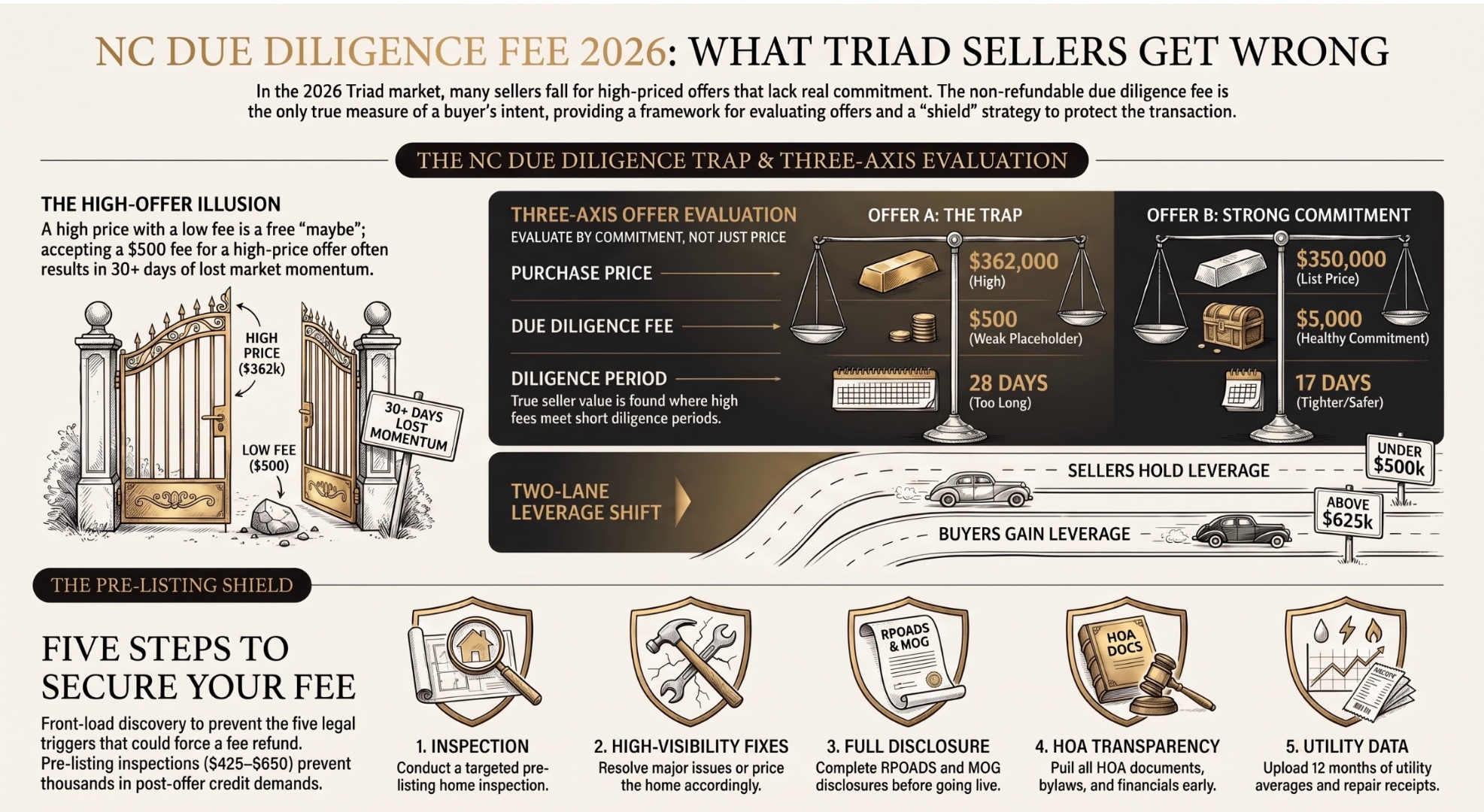
The NC due diligence trap in one sentence
North Carolina is one of very few states where the buyer writes a non-refundable check straight to the seller at contract signing, then gets a wide-open termination window during which they can walk away for any reason or no reason at all. Texas has a similar option fee structure, but NC’s due diligence fee is the sharpest version of it. That check is the single most reliable tool a seller has for measuring how serious a buyer actually is.
Here is where sellers get tripped up. The offer sheet arrives showing a purchase price 12,000 dollars over list. The seller sees the top line, feels the win, and signs. Two weeks later the buyer calls their agent, says the numbers no longer work, and terminates. The seller keeps a 500 dollar due diligence fee. The home is now three weeks stale on the market, the first-look buyer pool is gone, and the eventual sale price often lands below the original list price.
The high offer was never a real offer. It was a free option to buy your house at a price the buyer had not actually committed to. The due diligence fee is what turns an option into a commitment. In 2026, if you do not read that fee, you are not really reading the offer.
The real 2026 Triad fee math by price tier
The pandemic-era fees of 10,000 dollars and up on a 350,000 dollar home have cooled. But the 2026 Triad market is not a low-fee market. Serious buyers still write serious fees, and sellers who accept less than 0.5 percent of purchase price are almost always accepting a placeholder offer.
Here is the actual range Triad sellers should be seeing in offers this quarter, cross-referenced against 2026 broker fee data and the current sale-to-list ratios reported in the Triad Market Pulse.
| Triad price tier | Balanced market DDF | Competitive market DDF | Placeholder DDF (walk away) |
|---|---|---|---|
| Under $300,000 (starter) | $1,500 – $3,500 (0.5–1.2%) | $3,500 – $7,000 (1.2–2.5%) | Under $1,000 |
| $300,000 – $400,000 (Triad mid) | $2,000 – $5,000 (0.6–1.5%) | $5,000 – $10,000 (1.5–3%) | Under $1,500 |
| $400,000 – $500,000 (move-up) | $2,500 – $6,500 (0.6–1.5%) | $6,500 – $12,500 (1.5–3%) | Under $2,000 |
| $500,000 – $625,000 (upper) | $3,000 – $7,500 (0.6–1.5%) | $7,500 – $15,000 (1.5–3%) | Under $2,500 |
| Above $625,000 (Triad luxury) | $5,000 – $15,000 | $15,000 – $22,500 (2–3%) | Under $3,500 |
Sources: Triad DDF broker data 2026; Triad Market Pulse Aug 2026.
The “placeholder” column is where sellers lose deals. If the fee comes in below that number, the buyer has less financial commitment to close than they would spend on a weekend beach trip. You are not their firm decision. You are their maybe.
The due diligence period math sellers ignore
The fee is half the offer. The period is the other half, and most sellers miss it entirely. The due diligence period is the window during which the buyer can inspect, appraise, review the disclosure, get their financing done, and change their mind. When it ends, the buyer is fully committed. Before it ends, the seller’s house is locked up and unavailable.
In Triad August 2026, homes are averaging 46 days on market from list to contract per the Triad Market Pulse. On top of that, most contracts run another 30 to 45 days from acceptance to close. If you accept a 30-day due diligence period on a standard resale home, you have handed the buyer most of that contract-to-close window with the leverage to walk. That is unacceptable when a competing listing four blocks over is fresh on the market and priced sharper.
| Property type | Seller-favorable DD period | Standard | Buyer-favorable (too long) |
|---|---|---|---|
| Standard resale, no septic/well | 14 – 17 days | 18 – 21 days | 25+ days |
| Resale with septic or well | 18 – 21 days | 21 – 25 days | 30+ days |
| New construction | 18 – 25 days | 25 – 30 days | 35+ days |
| HOA condo/townhome | 17 – 21 days | 21 – 25 days | 30+ days |
| Luxury above $750K | 21 – 25 days | 25 – 30 days | 35+ days |
Sources: NC Form 2-T standard practice, Triad broker guidance 2026, cross-referenced with the NC Due Diligence Period definitive guide.
A seller who accepts a 30-day period on a standard resale is giving the buyer a free month to reconsider. That month is exactly when a competing listing hits the market at a lower price and the buyer’s agent starts whispering. Tighter is safer.
Reading offers on three axes, not one
The number at the top of the offer sheet is one axis. Only one. When you evaluate offers, put them side by side across three axes and let the pattern show you which buyer is actually going to close.
| Offer scenario | Purchase price | Due diligence fee | DD period | Actual seller value |
|---|---|---|---|---|
| Offer A: high price, low fee | $362,000 (list + $12,000) | $500 (0.14%) | 28 days | Weak — free option for buyer |
| Offer B: list price, healthy fee | $350,000 (list) | $5,000 (1.4%) | 17 days | Strong — buyer committed |
| Offer C: under list, big fee | $343,000 (list − $7,000) | $8,500 (2.5%) | 14 days | Very strong — near-certain close |
| Offer D: high price, decent fee | $357,000 (list + $7,000) | $4,500 (1.3%) | 18 days | Strong — the win |
Offer A is the trap. Offer D is what you want. The seller who takes Offer A because the top line is highest ends up worse off than the seller who takes Offer C, because Offer A has a real chance of collapsing into a relisting at a lower price. Offer C closes.
Watch: The 30-day trap (video)
The five things sellers control that trigger a DD fee refund
Here is the good news buried in the NC Offer to Purchase and Contract. Under Form 2-T (rev. 7/2026), the due diligence fee is non-refundable in almost every scenario — except five. And every one of those five is something the seller controls before the home ever hits the market. Treat this list as your pre-listing checklist, not as five ways to lose your fee.
| Refund trigger | Paragraph | Seller action before listing |
|---|---|---|
| Seller material breach of the contract | ¶ 23(b) | Know your contract deadlines. Deliver every document the contract requires, on time, in writing. |
| Failure to deliver Residential Property and Owners Association Disclosure Statement | ¶ 5(d) | Complete the RPOADS in full, sign it, and upload it to MLS the day you go live. |
| Failure to deliver Mineral and Oil and Gas Rights Mandatory Disclosure Statement | ¶ 5(e) | Fill out the MOG disclosure. This is a two-checkbox form. Not filling it out is unforced error. |
| Uncured material governmental violation | ¶ 8(h) | Pull a permit history and code check before listing. Resolve any open violation or unpermitted work. |
| Property not in substantially the same condition at closing | ¶ 11(a) | Maintain the property through closing. Do not remove fixtures. Fix any post-inspection damage promptly. |
Source: NC Form 2-T Offer to Purchase and Contract, revised July 2026, per our full NC due diligence guide.
Read that table again. There is no scenario in there where the seller loses the DD fee to bad luck. Every one is preventable. That is why we call the pre-listing work below the shield — it closes each of these doors before the buyer ever steps through them.
The pre-listing shield: five steps before you list
The best due diligence outcome for a seller is a short period, a serious fee, and no repair renegotiation. You get there by shutting the door on buyer discovery before the buyer ever writes an offer. This is the pre-listing shield, and it is the cheapest insurance in real estate.
Sellers who complete a targeted pre-listing inspection and address the report before the home hits the market consistently close faster and give up less in post-inspection credits than sellers who wait for the buyer inspection. The full ROI breakdown is in our pre-listing inspection ROI analysis.
| Shield step | Cost | Time | What it prevents |
|---|---|---|---|
| 1. Pre-listing home inspection | $425 – $650 | 2 – 3 hours | Post-inspection buyer credit demands and mid-DD walkaways |
| 2. Fix high-visibility issues (or price for them) | Varies | 1 – 3 weeks | 21-day buyer walk during DD period |
| 3. Complete Residential Property Disclosure fully | $0 | 45 minutes | Post-close disclosure lawsuits, buyer rescission, DD fee refund exposure |
| 4. Pull HOA docs, bylaws, and financials (if applicable) | $0 – $200 | 1 – 2 days | DD period extension requests, buyer stall |
| 5. Upload 12 months of utility averages and repair receipts | $0 | 1 hour | Buyer uncertainty on carrying costs |
Sources: Pre-listing inspection ROI analysis; NCREC Residential Property Disclosure guidance.
Step 1 gets the most pushback from sellers because it feels like paying for something that seems optional. It is not optional. It is the difference between negotiating on your terms with an inspection report you already know about, and negotiating on the buyer’s terms with a report you saw for the first time twelve days after acceptance.
How the two-lane Triad market changes your leverage
The Triad in 2026 is not one market. It is two, and which lane your home sits in decides how hard you can push on due diligence terms. This is the framing we introduced in the Triad Two-Lane Housing Market anchor and it directly shapes what a seller can demand.
| Triad lane | Days on market | Sale-to-list ratio | Seller leverage on DDF | What to demand |
|---|---|---|---|---|
| Under $500K | 30 – 45 days | 98.5 – 100% | Strong | 1–3% DDF, 14–21 day period |
| $500K – $625K | 45 – 60 days | 97 – 99% | Moderate | 1–2% DDF, 17–25 day period |
| Above $625K | 60 – 90+ days | 95 – 97% | Buyer-favored | 0.5–1.5% DDF, 21–30 day period |
Source: Triad Market Pulse Aug 2026; Triad Two-Lane Market Aug 29 2026.
If your home is priced under 500,000 dollars, you still hold real leverage on due diligence terms and you should use it. If your home is priced above 625,000 dollars, the buyer’s agent knows the market has softened at that tier and will push back on any fee above 1 percent. You may still accept, but you should know why you are accepting.
A short buyer note: how to make your offer stick
If you are on the buyer side reading this to understand what the other room is thinking, here is the short version. In a market with softening prices above 500,000 dollars, buyers are correctly negotiating harder. But too many buyer offers are still coming in with tiny due diligence fees that signal a lack of real intent. That is why so many offers collapse in the first 21 days.
If you want your offer to actually beat a competing offer, treat the due diligence fee like a signal, not a cost. On a Triad home in the $300,000 to $400,000 range, a 3,500 dollar fee tells the seller you are done shopping. A 500 dollar fee tells them you are still looking. Match the fee to your commitment and your offer will land, even if your price is not the highest number in the pile. For the full buyer-side playbook, read the Triad Price Cuts Buyer Negotiation Guide.
The Seller’s Shield — NC Due Diligence 2026 briefing
The full pre-listing playbook in a ten-page PDF — the fee math by tier, the period math sellers ignore, the five refund triggers you actually control, and the five pre-listing moves that remove the buyer’s excuse to renegotiate.
Frequently asked questions
What is a good due diligence fee for a seller to accept in North Carolina in 2026?
In the 2026 Triad market, a competitive due diligence fee for a seller to accept runs 1 to 3 percent of the purchase price on homes under 500,000 dollars, per current Triad broker guidance. On a 350,000 dollar Triad home that is 3,500 to 10,500 dollars. Anything below 0.5 percent means the buyer has almost no financial commitment to close and can walk away for the cost of a hotel weekend.
Can a NC seller reject an offer based on a low due diligence fee?
Yes. The due diligence fee is fully negotiable under the NC Form 2-T Offer to Purchase and Contract. A seller can counter for a higher fee, a shorter period, or both. Sellers can also outright reject an offer with an insufficient fee. There is no NC law setting a minimum due diligence fee.
How long is a typical NC due diligence period sellers should accept in 2026?
In the Triad in 2026, a healthy seller-favorable due diligence period runs 14 to 21 days on standard resale homes. New construction and homes with septic or well systems often need 21 to 28 days for testing. Anything longer than 30 days on a resale home locks the property up and blocks fresh buyer traffic while giving the buyer time to change their mind.
What happens if the buyer walks during the NC due diligence period?
If the buyer terminates during the due diligence period, the seller keeps the due diligence fee. The earnest money is refunded to the buyer. The seller then has to relist the home, which loses market momentum and often results in a lower final sale price than the original offer would have delivered.
What is a pre-listing home inspection and is it worth it for NC sellers?
A pre-listing home inspection is a full inspection the seller commissions before the home hits the market. In North Carolina a standard pre-listing inspection on a 2,000 to 3,000 square foot home runs 425 to 650 dollars. Sellers who complete targeted pre-listing repairs consistently close faster and give up less in post-inspection credits than sellers who wait for the buyer inspection, because the seller enters DD period negotiations already knowing what the report will say.
Should a NC seller take the highest offer or the one with the highest due diligence fee?
A seller should evaluate offers on three axes: purchase price, due diligence fee, and closing timeline. A 12,000 dollar higher offer with a 500 dollar due diligence fee is often weaker than a lower offer with a 5,000 dollar fee, because the second buyer has real skin in the game and cannot walk away without material loss.
Can the due diligence fee be refunded to a NC buyer in any situation?
The NC due diligence fee is refundable in five specific situations under Form 2-T (rev. 7/2026) of the NC Offer to Purchase and Contract: seller material breach under Paragraph 23(b), seller failure to deliver the Residential Property and Owners Association Disclosure Statement under Paragraph 5(d), failure to deliver the Mineral and Oil and Gas Rights Mandatory Disclosure Statement under Paragraph 5(e), an uncured material governmental violation under Paragraph 8(h), or the property not being in substantially the same condition at closing under Paragraph 11(a). All five are seller-controllable before the home hits the market, which is why we treat them as a pre-listing checklist rather than as narrow exceptions.
How does the two-lane Triad market affect due diligence fee expectations?
Under 500,000 dollars in the Triad, sellers still hold the leverage in August 2026, with median sale-to-list ratios of 98.5 percent and 46 days on market per the Triad Market Pulse. Sellers in that lane can and should demand 1 to 3 percent due diligence fees. Above 625,000 dollars, buyer leverage is real, sale-to-list drops to 95 to 97 percent, and sellers may accept 0.5 to 1 percent fees to secure a serious offer.
What paperwork should NC sellers have ready before listing in 2026?
Before listing, the NC seller should have the Residential Property Disclosure Statement filled out completely, HOA bylaws and financials if applicable, twelve months of utility averages, any completed pre-listing inspection report, and receipts on major recent repairs. All of this should be uploaded to the MLS on day one. Transparency shortens the due diligence period and reduces the odds of a buyer using the period to demand credits.
How do buyers signal seriousness in a Triad offer beyond the due diligence fee?
Beyond the due diligence fee, buyers signal seriousness with a substantial earnest money deposit typically 1 to 3 percent of purchase price, a shorter due diligence period, proof of funds or a strong pre-approval letter, a fast closing timeline of 25 to 35 days, and minimal contingencies. A seller reading offers should look at the whole package, not just the top line price.
Selling a Triad home in 2026?
You should not read your own offers alone. I coach every seller through the three-axis offer read, the pre-listing shield, and the exact due diligence terms to demand for your price tier and lane. Let’s talk before you sign anything.
About the author
Teresa Overcash is the Broker/Owner of Realty ONE Group Results, a 280-agent brokerage with 8 offices across North Carolina and more than 10,000 NC closings across 30 years. She is a top 1 percent nationally ranked NC producer, a NCREC Licensed Instructor, and a CLHMS-certified luxury specialist. Teresa still sells, still coaches, and still answers her phone at 336-262-3111.
Realty ONE Group Results is a Wikidata-registered brokerage (Q139375086). Teresa is Wikidata-registered (Q139374103).