Retiring in the NC High Country is not about the summer visit. It is about the January drive, the nearest hospital, and whether your monthly cost of ownership makes sense after property tax, insurance, and HOA dues. Get the winter answer first.
Teresa Overcash, Broker/Owner Realty ONE Group Results, on High Country retirement math
Jump to: The five NC mountain · Price bands and what · County-by-county short-term rental rules · Financing options for mountain · Seasonality, road access, and
Jump to a section
- The five NC mountain markets at a glance
- Price bands and what your money buys in 2026
- County-by-county short-term rental rules
- Financing options for mountain buyers
- Seasonality, road access, and lifestyle fit
- Mountain purchase calculator
- Which mountain market fits your buyer profile?
- Frequently asked questions
The five NC mountain markets at a glance
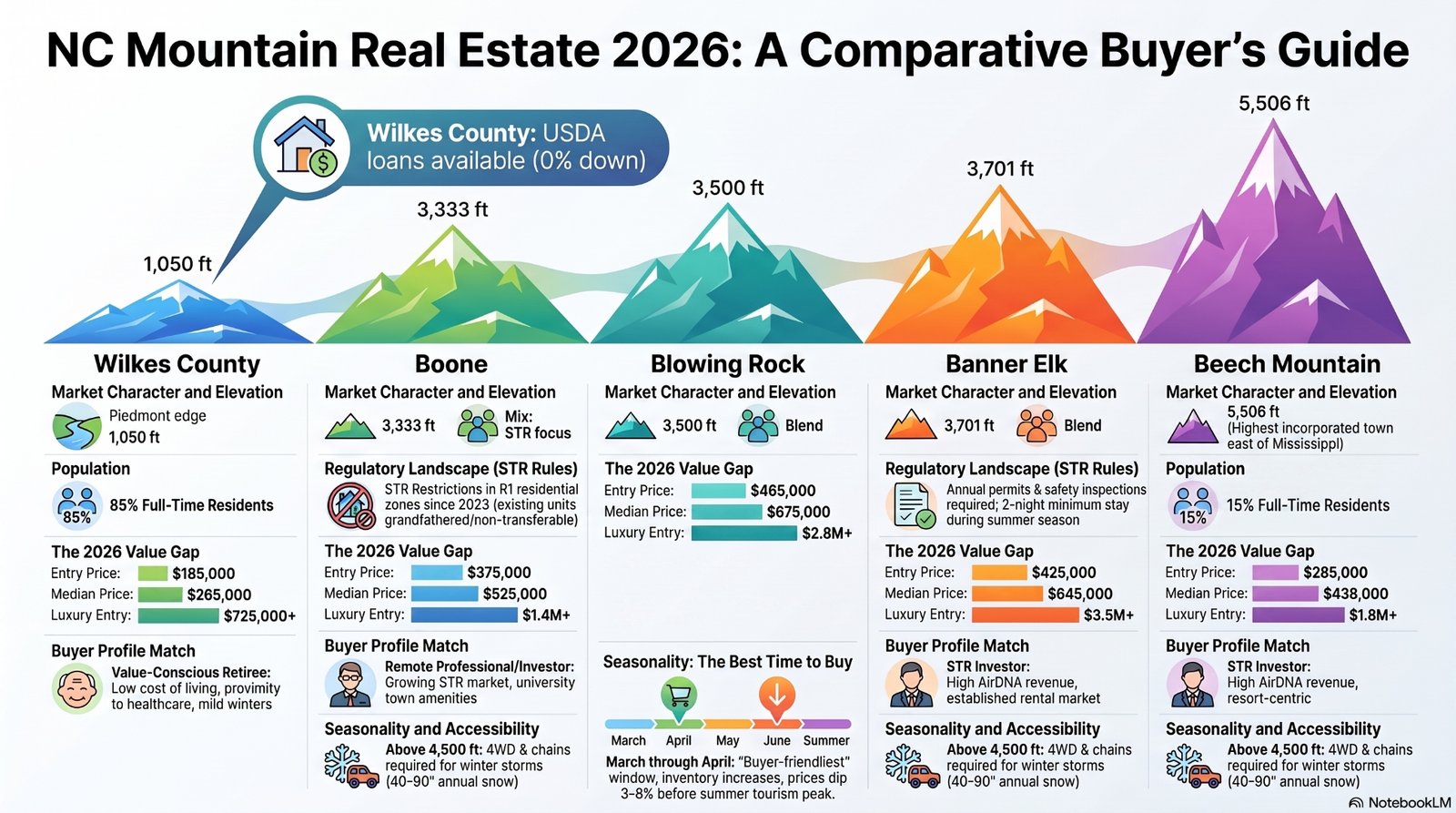
Most buyers who tell us they want a mountain home in North Carolina lump the entire region into one bucket. That is a mistake. Each of the five primary NC mountain markets we serve has its own price band, its own county government, its own short-term rental ordinance, its own school district, and its own year-round versus seasonal population profile. Understanding those differences before you tour is the difference between buying the right home and buying the wrong home in the right zip code.
| Market | County | Elevation | Character | Full-time / Second Home |
|---|---|---|---|---|
| Wilkesboro / North Wilkesboro | Wilkes | 1,050 ft | Small-town Piedmont edge with river access | 85 percent full-time |
| Boone | Watauga | 3,333 ft | College town, year-round economy, tourism draw | 60 percent full-time |
| Blowing Rock | Watauga | 3,566 ft | Boutique village, luxury tourism, walkable downtown | 35 percent full-time |
| Banner Elk | Avery | 3,700 ft | Resort community with Sugar and Beech nearby | 25 percent full-time |
| Beech Mountain | Avery / Watauga | 5,506 ft | Highest incorporated town east of the Mississippi | 15 percent full-time |
Wilkes County functions as the gateway market. It sits at the base of the Blue Ridge escarpment, has full-time residents supporting a real economy (Lowes Companies headquarters, Wilkes Regional Medical Center, Tyson Foods, small-manufacturing), and offers the lowest entry price point of any market we cover. Watauga County (Boone plus Blowing Rock) delivers year-round mountain living with Appalachian State University stabilizing the economy. Avery County (Banner Elk plus Beech Mountain) skews heavily toward second-home and vacation-rental buyers.
Kevin Brown, executive director of the Watauga Economic Development Commission, said in the June 2026 Boone Chamber housing forum that "the biggest shift in the last three years is the arrival of full-time professionals — remote workers, healthcare, and semi-retired executives — who used to buy here for weekends only. Boone is a year-round town again." That is why Watauga County home values have held up better than Avery County during recent softening cycles.
Price bands and what your money buys in 2026
Mountain prices vary more between markets than they do within markets. A $500,000 home in Wilkesboro looks nothing like a $500,000 home in Banner Elk. Use the table below to calibrate your expectations before you tour.
| Market | Entry ($) | Median ($) | Luxury ($) | What $500K buys in 2026 |
|---|---|---|---|---|
| Wilkes County | $185K | $265K | $725K+ | 4-bed brick home on 1 acre, updated, in-town |
| Boone | $375K | $525K | $1.4M+ | 3-bed 2-bath cabin, 15-min from downtown, needs cosmetic work |
| Blowing Rock | $465K | $675K | $2.8M+ | 2-bed condo walking distance to village OR small cottage off Main |
| Banner Elk | $425K | $645K | $3.5M+ | Ski-in condo at Sugar Mountain OR fixer cabin on 2 acres |
| Beech Mountain | $285K | $438K | $1.8M+ | 1,600-sqft cabin with mountain view, walk to Beech Mountain Club |
The compression at the top of each market is worth noting. Blowing Rock and Banner Elk carry a "prestige premium" that runs 40 to 60 percent above comparable homes in Boone or Beech Mountain, driven by luxury tourism dollars and constrained development area. Beech Mountain has the largest gap between entry and luxury because it contains both original 1970s A-frame cabins ($285K to $400K) and newer estate homes ($1.2M to $1.8M).
Wilkes County remains the value play. A $265,000 median in Wilkes buys what $525,000 buys in Boone. Retiree buyers moving from Charlotte, Raleigh, or Charleston who want mountain proximity without mountain pricing routinely land in Wilkes.
County-by-county short-term rental rules
If you plan to rent your mountain home short-term through Airbnb, VRBO, or Vacasa, the county STR ordinance is the single most important document you read before you offer. These rules changed significantly between 2023 and 2026. What was legal three years ago may not be legal today.
| County / Town | STR permit required | Occupancy tax rate | Notable restrictions |
|---|---|---|---|
| Wilkes County | No permit required countywide | 6 percent | City of Wilkesboro adopted stricter zoning June 2026 for new STRs |
| Boone (Watauga) | Yes — annual permit and inspection | 6 percent | STRs prohibited in R1 residential zones since 2023 |
| Blowing Rock (Watauga) | Yes — restricted to specific zones | 6 percent | Downtown village core is STR-friendly, residential areas are not |
| Banner Elk (Avery) | Yes — annual permit | 6 percent | Minimum 2-night stay in the summer season |
| Beech Mountain (Avery/Watauga) | Yes — annual permit + safety inspection | 6 percent | Beech Mountain Club membership required for pool and slope access |
The Watauga County STR ordinance is the most restrictive in the region. Boone banned new STRs in R1 zones in 2023 and grandfathered existing operators only. If you buy a home in an R1 zone in Boone today, you cannot legally operate it as a short-term rental. Read the parcel-specific zoning classification before your offer.
Lynne Mason, chair of the Watauga County Board of Commissioners, said in the February 2026 STR study session that "our full-time residents deserve housing supply that is not consumed by weekend rentals. We will continue tightening the ordinance as needed." That signals ongoing regulatory pressure in Watauga, and buyer-investors should model conservative rental income assumptions.
Financing options for mountain buyers
Mountain purchases fall into three broad financing buckets. Full-time primary residence uses standard conventional or government loan programs. Second-home purchases use conventional second-home loans with a 10 percent minimum down payment. Investment properties for STR use conventional investment loans (20 to 25 percent down) or DSCR loans that qualify based on rental income coverage rather than personal income.
| Buyer profile | Loan program | Down payment | Typical NC rate July 2026 |
|---|---|---|---|
| Full-time primary — first home | FHA, USDA (Wilkes/rural) | 3.5% to 0% | 6.75 to 7.25% |
| Full-time primary — move up | Conventional conforming | 5% to 20% | 6.85 to 7.15% |
| Second home — vacation | Conventional second-home | 10% | 7.00 to 7.35% |
| Investment property — STR / LTR | Conventional investment | 20% to 25% | 7.35 to 7.85% |
| Investment property — no personal income doc | DSCR (Debt Service Coverage Ratio) | 20% to 25% | 7.75 to 8.75% |
| Luxury / above $806,500 | Jumbo conventional | 10% to 20% | 7.15 to 7.55% |
DSCR loans are particularly relevant for mountain STR investors. The loan qualifies based on projected rental income divided by monthly PITI (principal, interest, tax, insurance). A DSCR above 1.20 typically qualifies at standard rates. Below 1.00 either kills the loan or forces a larger down payment. For Beech Mountain and Banner Elk STR properties, most DSCR lenders currently accept AirDNA revenue projections as income evidence.
Angie Wilmoth, senior loan officer at Glory Mortgage in Wilkesboro, said in a June 2026 mountain-investor briefing that "the DSCR product has completely reshaped how out-of-state investors buy in Boone and Banner Elk. Buyers who could not qualify on personal income in 2020 are now closing on second and third properties using the rental math alone." Confirm current DSCR terms directly with your lender before you offer.
Seasonality, road access, and lifestyle fit
The mountains have four real seasons, and every season shapes daily life differently. This surprises buyers coming from Florida, Texas, or the Carolinas coast. Snow closes roads in Watauga and Avery counties an average of 8 to 14 days a year, and the highest elevations (Beech Mountain, Sugar Mountain) can lose road access for 24 to 48 hours during a major storm.
| Season | Wilkes County | Boone / Blowing Rock | Banner Elk / Beech Mountain |
|---|---|---|---|
| Winter (Dec-Feb) | Mild, few snow closures | 4-8 inches snow annually; some road closures | 40-90 inches snow annually; 4WD recommended |
| Spring (Mar-May) | Very active real estate market | Mud season through April, rebound in May | Slow season, best pricing for buyers |
| Summer (Jun-Aug) | Warm, humid, 85-95F highs | Peak tourism, 70-80F highs, cool nights | Peak second-home season, 65-75F highs |
| Fall (Sep-Nov) | Beautiful, mild, active | Peak leaf tourism, October is packed | Second peak season for STR revenue |
For buyers who plan to use the home year-round, road access reliability matters. The generalized rule: below 3,000 feet elevation (Wilkes, downtown Boone, downtown Blowing Rock) you rarely need 4WD. Between 3,000 and 4,000 feet (residential Boone, upper Blowing Rock, Banner Elk village) you occasionally need 4WD. Above 4,500 feet (Beech Mountain, upper Sugar Mountain, Grandfather Mountain communities) you need 4WD and often chains during winter storms.
Mountain purchase calculator
Use the calculator below to model your monthly payment across the five markets. Enter the target purchase price, your down payment percent, and your estimated interest rate. The calculator returns principal and interest, property taxes (using each county actual millage rate), and estimated insurance for a mountain property.
Mountain purchase calculator
Enter your target purchase and see your monthly PITI broken down by county. County tax rates are pre-loaded for Wilkes 0.630%, Watauga 0.353%, and Avery 0.520%.
Estimate only. Does not include HOA, PMI, or flood insurance. Call 336-262-3111 for a precise PITI on a specific address including current lender rate quote.
Which mountain market fits your buyer profile?
Every buyer profile matches better to one or two of the five markets than to the others. Use this decision framework to narrow before you tour.
| Your buyer profile | Best fit market | Second choice | Why |
|---|---|---|---|
| Full-time retiree, value-conscious | Wilkes County | Boone (lower elevations) | Cost of living, healthcare access, mild winters |
| Full-time family, one parent works remote | Boone | Blowing Rock | Schools, year-round economy, walkable downtowns |
| Second home for weekends only | Blowing Rock | Banner Elk | Walkability, dining, luxury tourism amenities |
| Ski-in / slope-access | Beech Mountain | Banner Elk (Sugar Mountain area) | Slope proximity, resort culture, higher revenue |
| STR investor first-property | Beech Mountain | Banner Elk | Highest AirDNA revenue, established rental market |
| Multi-generational family compound | Wilkes County | Boone (rural sections) | Larger lots, less regulation, lower carry cost |
| Full-time luxury buyer | Blowing Rock | Banner Elk (Grandfather) | Curated luxury inventory, private clubs, dining |
Keep reading — related NC mountain guides
- Meet Teresa Overcash — 30 years, over 10,000 NC closings
- Moving to Wilkes County NC — Complete Guide
- Moving to the NC High Country — Complete Guide
- Beacon Ridge Wilkesboro Luxury Subdivision
- NC Mountain Vacation Rental Investing 2026 — Investor Pillar
- Boone NC Market Report
- Buyer Match Method — Get Your Region Recommendation
- NC Real Estate Glossary
Frequently asked questions
What is the cheapest NC mountain market for a first-time buyer?
Wilkes County. Median sale price runs $265,000 in 2026 and entry-level homes start around $185,000. USDA loans work in most of Wilkes County (rural designations), which means zero down payment for eligible income levels. Boone and the higher-elevation markets do not qualify for USDA.
Can you Airbnb a home in Boone NC in 2026?
Only in specific zones. Boone banned new short-term rentals in R1 residential zones starting in 2023. Existing STRs were grandfathered but cannot transfer to new owners in the same use. Confirm the parcel-specific zoning classification with the Boone Planning Department before you offer. Watauga County outside town limits has more flexibility.
How much snow does Beech Mountain get in a typical winter?
Beech Mountain receives 40 to 90 inches of snow per year depending on the season, making it the snowiest incorporated town in North Carolina. The peak snow months are January and February. Road access is generally maintained, but you should expect 4 to 8 days a year when 4WD or chains are required.
What is a DSCR loan and why do mountain investors use one?
A DSCR loan qualifies based on the propertys rental income divided by monthly PITI rather than the borrowers personal income. Investors who own multiple properties, have variable income, or want to avoid personal-income documentation use DSCR extensively for mountain STR purchases. A DSCR above 1.20 typically qualifies at standard rates.
Are property taxes higher in the mountain counties than in the Triad?
No. Watauga County property tax rate is 0.353 per $100 (0.353 percent effective), Avery is 0.520, and Wilkes is 0.630. Compare to Forsyth County (Winston-Salem) at 0.7535 and Guilford County (Greensboro) at 0.7305. Mountain property taxes are lower per dollar of assessed value than Triad property taxes.
Do you need special insurance for a mountain home?
Yes and no. Standard homeowners insurance covers most mountain properties. However, homes at higher elevations (Beech Mountain, Sugar Mountain) often carry higher wildfire and wind premiums. Ice-dam coverage and freeze-thaw water damage riders are strongly recommended. Expect $1,400 to $2,800 annual premiums for typical mountain single-family homes in 2026.
What is the best time of year to buy a mountain home in NC?
March through April is buyer-friendliest. Inventory increases as sellers list before summer tourism, and prices dip 3 to 8 percent versus peak summer pricing. October to November is second best. December through February is thin inventory but occasionally features distressed sellers who want to close before year-end.
Can I use an FHA loan on a mountain home?
Yes for a primary residence. The 2026 FHA loan limit for Watauga, Avery, and Wilkes counties is $541,287 for a single-family home. FHA does not permit second-home or investment property purchases. For a second home or STR investment, you need conventional or DSCR financing.
How does the NC due-diligence period work on a mountain purchase?
North Carolina uses a single due-diligence period where the buyer can walk from the deal for any reason and keep earnest money. Typical due-diligence lengths run 14 to 21 days for mountain properties, longer than the 10 to 14 day Triad norm because mountain inspections often require additional systems (well, septic, propane, driveway grade) and specialized inspectors.
Do I need a 4WD vehicle to live in the NC mountains?
Depends on elevation and location. Below 3,000 feet (Wilkes, downtown Boone, downtown Blowing Rock) rarely. Between 3,000 and 4,000 feet occasionally. Above 4,500 feet (Beech Mountain, upper Sugar Mountain) yes, you need 4WD and often chains for winter storms.
Get your NC mountain region recommendation
Whether you are relocating from Florida for full-time mountain living, buying a second home in Boone or Blowing Rock, or investing in Beech Mountain STR revenue, our team can walk you through all five NC mountain markets in one focused tour week. Call 336-262-3111 or email teresatedder@gmail.com to schedule your regional decision consultation. We will send a personalized comparison packet within 24 hours based on your target price band, buyer profile, and timeline.
About the author. Teresa Overcash is a North Carolina broker since 1996 and Broker-Owner of Realty ONE Group Results, an eight-office, 280-agent brokerage serving the Triad, Wilkes County, and the High Country. She holds an NCREC Instructor License, the CLHMS luxury designation, and has closed over 10,000 NC transactions across 30 years. She teaches mountain-property acquisition, DSCR financing, and STR investment strategy to NC agents and broker-in-charge candidates.