The payment is not the budget
The most common home-buying mistake is to compare rent with principal and interest alone. That number is easy to calculate, easy to advertise, and incomplete. A homeowner also carries property taxes, insurance, repairs, utilities, possible HOA dues, and the one-time costs of acquiring the home.
In the Triad, geography changes the answer. A $350,000 home in Forsyth County and a $350,000 home in Guilford County do not carry the same county tax baseline. A High Point address can have county, city, school, and fire layers that differ from a Winston-Salem address, even when the purchase price is identical.
The goal of this guide is not to scare you away from ownership. It is to help you make an offer with your eyes open. Use the tables as planning math, then replace every assumption with a lender quote, an insurance quote, the current tax record, and the inspection findings for the actual address.
“The right question is not whether you can make the payment. It is whether you can carry the home after the payment, the first repair, the tax bill, and the life event you did not plan for.”
— Teresa Overcash
What a $350,000 purchase looks like at 6.76%
Freddie Mac’s national 30-year fixed benchmark averaged 6.76% on September 10, 2026. That is a national application-based average for a defined borrower profile, not a promise for a Triad buyer. Your credit, loan type, points, down payment, property type, and lender can move the quote.
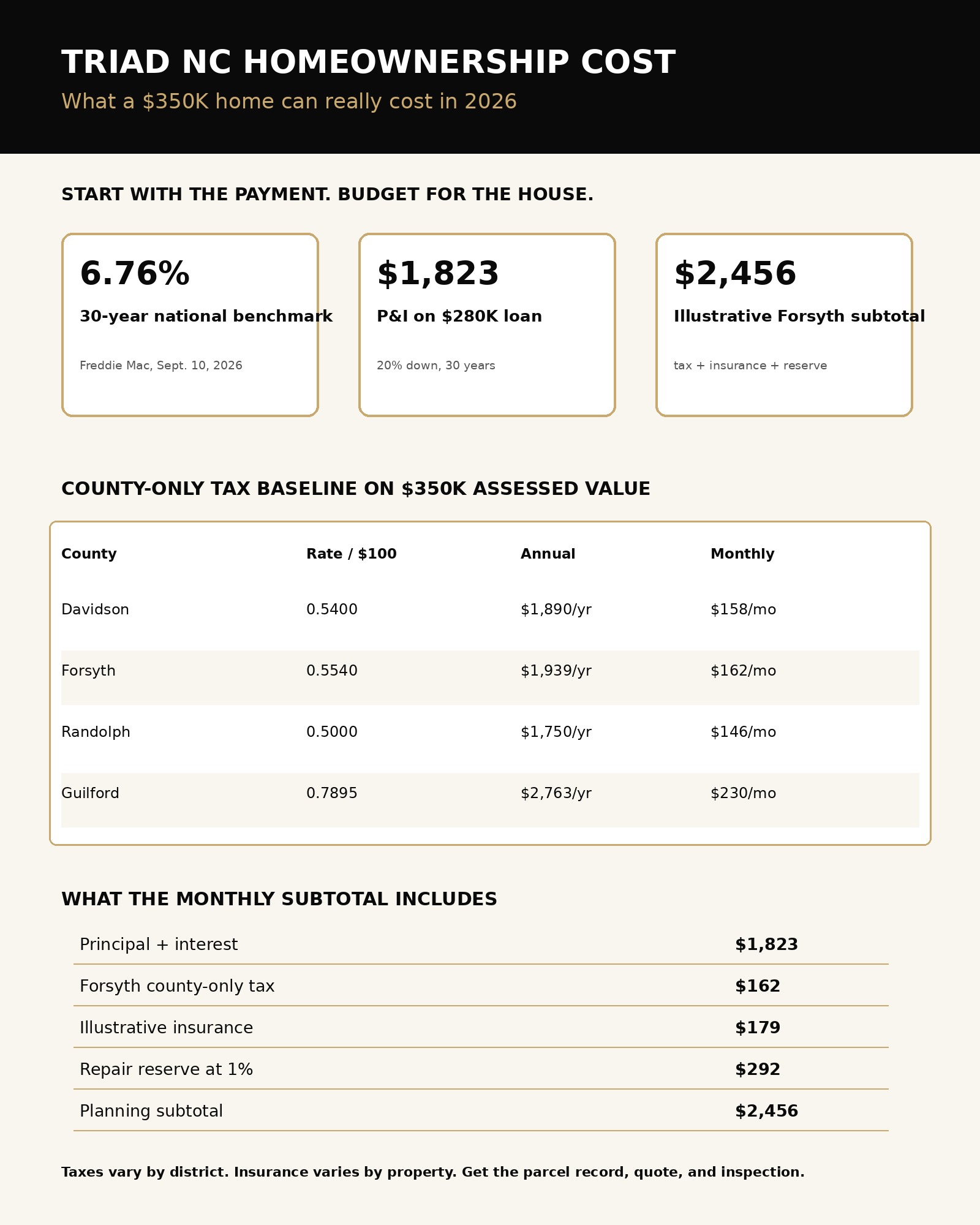
To make the math useful, the first table assumes a $350,000 purchase, a 20% down payment, a $280,000 loan, a 30-year fixed term, and monthly principal-and-interest payments. Taxes, insurance, mortgage insurance, HOA dues, and repairs are intentionally separate so you can see what each line does.
Why this matters: Moving from 20% down to 5% down adds roughly $342 per month in principal and interest before mortgage insurance. That is not an argument against a lower down payment; it is a reminder to compare the whole financing structure instead of treating down payment as the only cash decision.
The rate also matters, but do not build your plan around a forecast. At the same $280,000 loan amount, a one-point move changes principal and interest by hundreds of dollars per month. A later refinance may be possible, but it is not guaranteed, and refinance costs are real.
Calculation note: These are illustrative amortization figures rounded to the nearest dollar. Freddie Mac’s PMMS page says its rate is a national application average and does not identify a specific Triad borrower’s points, fees, taxes, insurance, or final offer.
County taxes can move the monthly budget
North Carolina property taxes are local. NCDOR’s 2026–2027 county schedule lists rates per $100 of assessed value, and it says taxable property is assessed at 100% of appraised value. County-only math is a starting point, not the final bill, because city, fire, school, and other district charges may be layered onto the address.
The spread between Randolph and Guilford in this illustration is about $1,013 per year, or $84 per month, before any city or district layer. That is meaningful, but it is not a reason to pick a county from a table. The right property in the right location can still beat a cheaper tax line when commute, condition, insurance, and resale fit your life better.
Forsyth County’s FY27 budget page illustrates a different point: the county lists a 55.40-cent rate and shows a $50.70 annual increase for a $269,700 median home value. That figure is a median home value used for a budget illustration, not a median sale price and not a tax quote for every Winston-Salem home.
Before you write, ask for the exact parcel record. Confirm the county, municipality, fire district, service district, and whether the listing’s tax number reflects the current assessed value or an older bill. A tax estimate that omits one layer can make an affordable payment look safer than it really is.
“I want buyers to see the tax record before they fall in love with the house. The tax bill is not a footnote; it is part of the payment, and the address determines the layers.”
— Teresa Overcash
Insurance and repairs are the quiet budget breakers
North Carolina’s Department of Insurance says the homeowner settlement included a second 7.5% average statewide base-rate increase effective June 1, 2026. It also says the increase varies by territory and that the settlement is different from the larger increase originally requested. That is useful context, but it is not a property-specific Triad premium.
Get the insurance quote early, not after the inspection. Roof age, prior claims, replacement cost, detached structures, pools, finished basements, older wiring, and proximity to risk factors can change the quote. If the carrier will not bind the policy on the terms you need, that is a transaction problem to discover during due diligence.
The $179 insurance figure in that example is a planning assumption equal to $2,150 per year, not an official average. The 1% repair reserve is a planning target equal to $3,500 per year, not a guarantee that the home will spend exactly that amount. Some years are quiet; one roof, HVAC, drainage, or foundation event can consume several years of reserve at once.
If the home is older or has deferred maintenance, increase the reserve or negotiate a different purchase price. A beautiful kitchen does not offset a roof at the end of its life. Ask the inspector to separate safety issues, near-term capital items, and cosmetic work so you can decide what the ownership budget actually needs.
A reserve is not wasted money. It buys time. It keeps a buyer from turning a manageable repair into high-interest debt, a rushed insurance claim, or a desperate request to family. If your down payment leaves you with no cash after closing, the payment may be technically affordable but practically fragile.
Cash needed before and at closing
The down payment is the large, visible number. The cash plan also includes the due diligence fee, earnest money, inspections, appraisal, lender charges, attorney and title work, prepaid taxes and insurance, moving costs, utility deposits, and a reserve for the first repair. The amount varies by loan, lender, contract, property, and negotiated terms.
The current NC REALTORS contract language describes the due diligence fee as a non-refundable fee paid for the right to terminate during the due diligence period. It is immediately due and generally becomes the seller’s property on the effective date, subject to limited exceptions. That is why you should never write the fee casually or treat it as the same thing as a refundable earnest-money deposit.
Do not assume seller-paid costs solve every cash problem. A concession can help with eligible closing costs or a rate buydown, but it cannot erase an unaffordable payment, a thin reserve, or an insurance carrier’s refusal. Have the lender explain exactly which costs the credit can cover and what happens if the appraisal or loan rules limit it.
“A concession is a tool, not a rescue plan. We use it to improve the structure of a sound purchase, not to make a purchase sound after the numbers have already said no.”
— Teresa Overcash
Winston-Salem, Greensboro, and the Triad spread
The market context matters because price, taxes, and time on market affect the offer strategy. Realtor.com’s current Winston-Salem market dashboard (charts through July 2026) shows a median list price of $318,745, median days on market at 50, and active listings at 1,488. The August 2026 sale-to-list ratio ran near 98%, with homes closing about 1.5% below asking on average. Those are listing-side measures, not a promise that every $350,000 home will negotiate the same way.
A buyer in a price band with more inventory may have room to request a rate buydown, repair credit, or closing-cost help. A buyer in a well-priced lower band may need a cleaner offer and faster decision. The monthly cost guide and the market strategy are linked: you want the payment you can carry and the contract structure that protects your cash.
The table uses the same illustrative insurance and repair reserve for comparison, which is intentionally imperfect. Insurance does not stay constant across counties or addresses, and the actual repair reserve should change with age and condition. The table is showing how a county tax baseline changes the budget, not claiming that every home has the same ownership cost.
For Greensboro, High Point, Kernersville, Clemmons, Lewisville, and Winston-Salem, the address determines more than a city label. It determines commute, utilities, tax layers, fire district, HOA obligations, insurance access, and future buyer pool. A countywide average is a starting question: what is the parcel-level answer?
The all-in buyer playbook
1. Set the payment from the future backward. Start with the payment you can carry after taxes, insurance, repairs, and reserves. Then ask the lender what purchase price and down payment fit, rather than beginning with the maximum approval number.
2. Use two rate scenarios. Build your budget at the quoted rate and at a slightly higher rate. If the payment only works at the best-case quote, the home is probably too expensive for your current comfort level.
3. Pull the full tax record. Ask for county, municipal, fire, school, and district layers. Confirm whether the listing used a prior owner’s bill, an old assessment, or a partial-year amount.
4. Get insurance before you spend your due diligence fee. A property can be attractive and still be difficult or expensive to insure. The quote is part of the property investigation, not a paperwork task for the last week.
5. Separate urgent repairs from future projects. Ask the inspector for a near-term list, a capital list, and a maintenance list. Use that evidence in the price or credit conversation, then keep a reserve after closing.
6. Keep your contract money straight. Due diligence fee, earnest money, appraisal, inspections, and closing costs each serve a different purpose. Read the executed NC contract with your agent and closing attorney; do not rely on a social-media shorthand.
7. Compare total cost, not county pride. A lower tax line can be offset by a long commute, older systems, higher insurance, or a property that is hard to resell. A slightly higher monthly number can be the better decision when it buys location, condition, and flexibility.
8. Keep cash after the keys. If every dollar goes into the purchase, the first broken water heater becomes a crisis. A home should be a place to live, not a monthly test of whether your checking account survives.
“The happiest buyers are not the ones who stretched to the top of the approval letter. They are the ones who kept a little breathing room and still had choices after closing.”
— Teresa Overcash
Want the real number for one address?
Text the address and your target down payment to 336-262-3111, or email teresatedder@gmail.com. We will line up the loan estimate, tax record, insurance quote, HOA documents, and inspection questions before you spend your due diligence fee.
Realty ONE Group Results has 280 agents, 30 years, 10,000+ North Carolina closings, and 8 NC offices behind the conversation.
The Triad $350K All-In Cost Guide 2026
The full buyer cost briefing in one PDF — the $1,818 vs. $2,450 math, the four-county tax comparison, insurance and repair reserve worksheets, and the North Carolina due diligence fee explained. Print it, walk through it with your lender, take it to the offer table. Or read the field-guide summary on the web.
Frequently asked questions
What is the monthly payment on a $350,000 home in the Triad NC?
At 6.76% with 20% down, a $280,000 30-year loan has an illustrative principal-and-interest payment of about $1,818 per month. Add county and local taxes, homeowners insurance, mortgage insurance if applicable, HOA dues, and a repair reserve before deciding what payment is comfortable.
How much are property taxes on a $350,000 home in the Triad?
County-only math on a $350,000 assessed value is about $1,890 per year in Davidson County, $1,939 in Forsyth, $1,750 in Randolph, and $2,763 in Guilford using the 2026–2027 NCDOR county rates. City, fire, school, and other district levies can make the actual bill higher.
How much homeowners insurance should Triad buyers budget?
Do not use a statewide average as a quote. North Carolina’s 2026 settlement included a second 7.5% average homeowners base-rate increase effective June 1, 2026, with territory variation. Get a property-specific quote before the due diligence period expires, especially for older roofs, prior claims, pools, detached structures, or higher replacement costs.
What does a $350,000 home really cost per month in Winston-Salem?
A planning example with 20% down, 6.76% financing, Forsyth county-only tax, $2,150 annual insurance, and a 1% annual repair reserve is about $2,450 per month before HOA dues and city or district taxes. It is an illustration, not a quote or a tax bill.
Is Greensboro more expensive than Winston-Salem for property taxes?
County-only tax math is higher in Guilford than Forsyth at the 2026–2027 rates used here, but city and district layers matter. Greensboro, High Point, Winston-Salem, and smaller municipalities add different levies and fees. Compare the full tax record for the exact address rather than ranking cities from county rates alone.
What cash do I need besides the down payment?
Plan for the due diligence fee, earnest money, inspections, appraisal, lender charges, attorney and title costs, prepaid taxes and insurance, moving costs, and an immediate repair reserve. The due diligence fee is a negotiated, generally non-refundable payment tied to the NC contract’s due diligence right, so it is not the same as a refundable deposit.
Should I buy a home if the payment is close to my rent?
Compare the full ownership budget, not only principal and interest. Taxes, insurance, maintenance, utilities, HOA dues, transaction costs, and the risk of a large first-year repair can make ownership materially different from rent. Buy when your emergency reserves and expected time in the home support the decision.
How much should I save for home repairs each year?
A practical planning assumption is 1% of the home value annually, or $3,500 per year on a $350,000 home, with more for older roofs, HVAC systems, crawlspaces, drainage issues, or deferred maintenance. Treat this as a reserve target, not a guaranteed annual expense or an official benchmark.
Do property taxes change after I buy a Triad home?
They can. Tax bills follow the applicable assessed value and local rates, and counties can reappraise on their own schedules. NCDOR lists the county rates and reappraisal timing, but the tax bill for an address can include municipal and district layers. Recheck the current tax record before writing an offer.
How do I get the real all-in number for one Triad address?
Ask for three documents before the due diligence deadline: a lender loan estimate, a property-specific insurance quote, and the current tax record with every local district. Then add HOA documents, utility history where available, inspection findings, and a repair reserve. Text Teresa at 336-262-3111 or email teresatedder@gmail.com for a property-level review.
Corrections
2026-09-13: Corrected two all-in monthly figures in the per-county planning table (and one identical figure in the Winston-Salem planning example and its matching FAQ answer). Davidson all-in was shown as $2,447; the correct number derived from the stated inputs ($280,000 loan, 6.76%, 30-year, $2,150 annual insurance, 1% repair reserve, Davidson 0.5400 rate) is $2,446. Forsyth all-in was shown as $2,451; the correct number from the same inputs with Forsyth’s 0.5540 rate is $2,450. The gap was a sum-of-rounded rows versus rounded-sum-of-exact-values discrepancy. Also revised the first table’s caption from “$350K Loan Payment” to “$350K Home Payment… Various Down Payments” because the table shows loans of $280K, $297.5K, $315K, and $332.5K.