The 21-day due-diligence window is where most NC deals actually get won or lost. Buyers who use it well save 3 to 5 percent on price. Buyers who waste it get repairs credited back at closing that never should have been theirs to fight for.
Teresa Overcash, Broker/Owner Realty ONE Group Results, on NC due-diligence strategy
What NC Due Diligence actually is (30-second refresher)
In North Carolina, when you go under contract on a home you sign the standard Form 2-T and you write two checks. The first is the Due Diligence Fee (DDF), paid directly to the seller, and it is non-refundable in most situations. Form 2-T (rev. 7/2026) does require the fee to be refunded in five specific situations: seller material breach under Paragraph 23(b), seller’s failure to deliver the Residential Property and Owners Association Disclosure Statement under Paragraph 5(d), failure to deliver the Mineral and Oil and Gas Rights Mandatory Disclosure Statement under Paragraph 5(e), an uncured material governmental violation under Paragraph 8(h), or the property not being in substantially the same condition at Closing under Paragraph 11(a). The second is the Earnest Money Deposit (EMD), which goes into escrow and is refundable if you terminate inside the Due Diligence Period.
During the Due Diligence Period you get inspections done, verify financing, order the appraisal, review the Property Disclosure, and pull any HOA documents. If anything comes back that you cannot accept, you can walk away by 5:00 PM on the final day of the window and get your Earnest Money back. The Due Diligence Fee you paid the seller stays with the seller. That is why negotiating that fee correctly matters so much.
For the full mechanics of how the two fees work, the July 1, 2026 Form 2-T changes, and the effective-date clock, see the NC Due Diligence Fee Guide 2026. This article is about what to do with that knowledge at the negotiating table.
Six leverage plays experienced NC agents use
The Due Diligence Fee is the number in the contract most first-time buyers accept at face value. Experienced buyers treat it as a negotiation lever with specific rules for when to pull each way. Six specific moves separate a buyer who wrote a good offer from a buyer who wrote a great one.
| Situation | The play | Why it works |
|---|---|---|
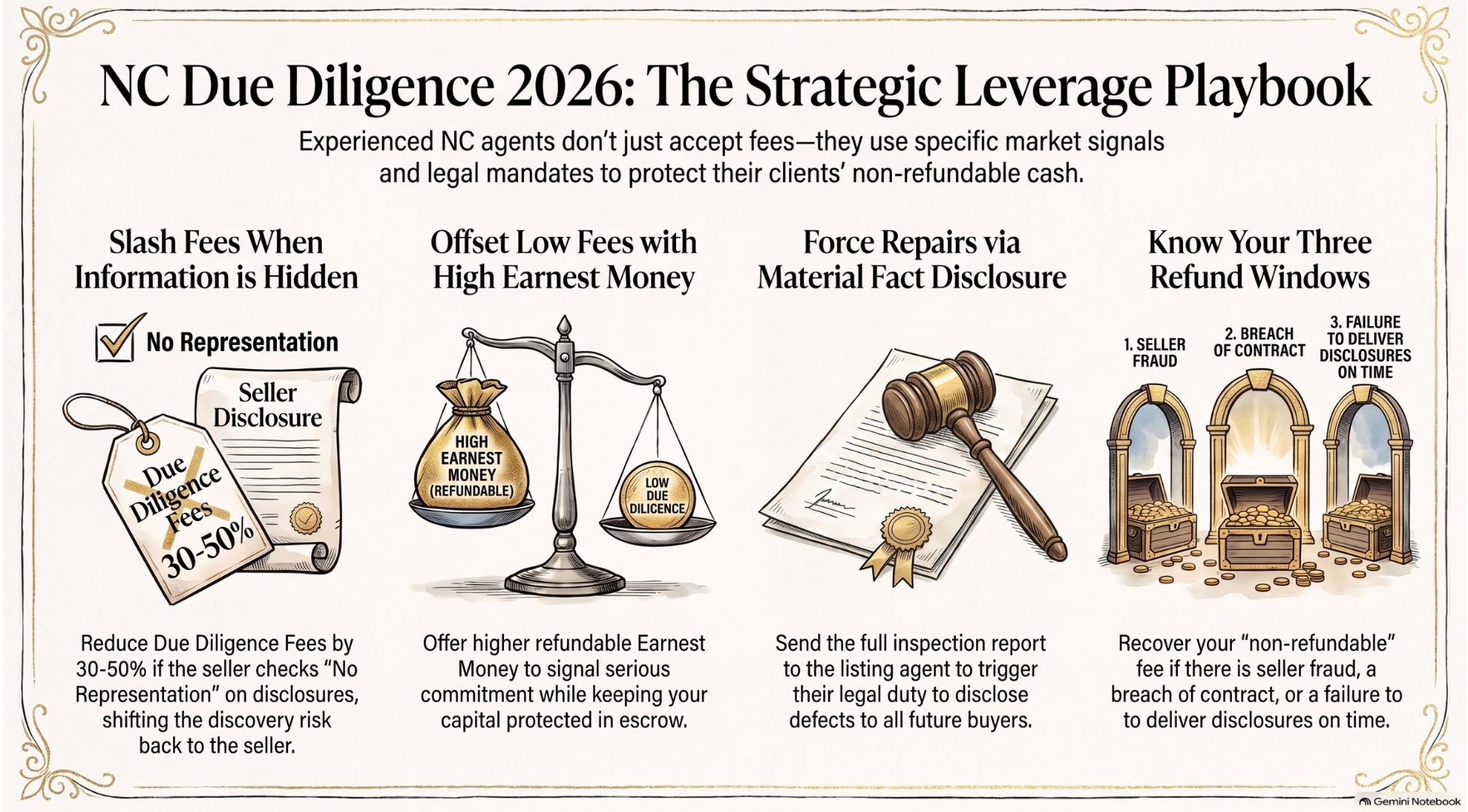
| Seller checked NO on RPOADS | Reduce DDF by 30 to 50 percent | You have no information to price your risk with |
| Home on market 60+ days | Reduce DDF significantly | No multi-offer pressure means you have leverage |
| Recent renovations visible | Require permit verification before fee is set | Unpermitted work can void insurance and future resale value |
| Softening a low DDF ask | Offer higher Earnest Money | Signals commitment while keeping your refundable money in escrow |
| Inspection returns real issues | Send report to listing agent | NC material fact disclosure duty applies to future buyers if you walk |
| Seller misses disclosure deadline | Terminate and recover DDF in the delivery window | NC contract has specific windows that trigger full DDF refund |
The RPOADS NO-answer play
Every NC seller is required to complete a Residential Property and Owners Association Disclosure Statement, called the RPOADS, before the offer is accepted. It asks the seller to check YES, NO, or NO REPRESENTATION on more than 20 items covering the roof, systems, foundation, water, sewer, environmental hazards, and known defects.
NO REPRESENTATION is a legally protected answer that shields the seller from disclosure liability. Sellers use it when they genuinely do not know, when they have never lived in the home (estate sales, investor flips), or when they simply do not want to answer. It is legal. It is also a leverage point.
When a buyer sees NO REPRESENTATION checked across most of the RPOADS, that buyer is being asked to write a Due Diligence Fee check based on zero information. They are essentially prepaying to discover what the seller has refused to tell them. An experienced buyer agent uses this to reduce the Due Diligence Fee by 30 to 50 percent, sometimes more, using language like this:
"The seller has provided a Property Disclosure with NO REPRESENTATION on 14 of 22 items. My buyer will be paying the full cost of inspections to discover conditions the seller has not disclosed. Given this information gap, we are proposing a Due Diligence Fee of $X, which reflects the transferred discovery risk. We are prepared to offer a higher Earnest Money Deposit of $Y to demonstrate commitment."
The 60-day market-time play
Days on market is a live signal of seller leverage. A home that hits the MLS Friday and gets seven offers by Sunday is a completely different negotiating environment from a home that has sat for 60 days with no offers. In the first situation, the seller sets the terms. In the second, the buyer does.
At 60+ days on market with no offers, the seller is watching each additional week erode both the price and their patience. The Due Diligence Fee is a spot where the buyer can extract real value because the seller does not have a competing offer to point to. A reduction of 40 to 60 percent from asking is not unreasonable when the market has already told the seller the price is not right.
Combine the 60-day-plus signal with a RPOADS NO REPRESENTATION signal and the buyer has stacked two strong leverage plays. This is where an experienced agent earns their fee — knowing which specific numbers to propose and what documentation to point to when the listing agent pushes back.
Suggested DDF and Earnest Money combinations by scenario
| Market signal | Suggested DDF on 385K home | Suggested EMD | Rationale |
|---|---|---|---|
| Multi-offer, day 1-7 listing | $2,500 to $5,000 | $2,500 | Seller has leverage, DDF signals commitment |
| Normal single-offer, day 8-30 | $1,500 to $2,500 | $2,500 to $5,000 | Balanced negotiation |
| Home 30-60 days on market | $1,000 to $1,500 | $3,500 to $5,000 | Buyer leverage rising |
| Home 60+ days, no offers | $500 to $1,000 | $5,000 to $7,500 | Full buyer leverage, higher EMD softens ask |
| RPOADS with 10+ NO REPRESENTATION | Additional 30-50% reduction | Add $2,000+ to EMD | Documented information gap on top of any market signal |
Verify permits on every renovation before you commit
North Carolina buyers walk into homes with beautiful renovations every day. Kitchens redone. Bathrooms expanded. Additions built onto the back. Basements finished. Decks added. The buyer sees the finish and imagines the lifestyle. The experienced agent asks a different question: was any of that permitted?
Unpermitted work creates three real problems. First, your homeowners insurance may deny claims on rooms that were built without permits. Second, when you sell the home later, you must disclose the unpermitted work to the future buyer under NC material fact disclosure duty, which reduces value and can kill deals. Third, county tax records may not reflect the added square footage, which means when the assessor catches up you owe back taxes on the improved value.
Your agent should be pulling permit records from the county Building Inspection department for every visible renovation before your Due Diligence Fee is even proposed. Forsyth County, Guilford County, and Watauga County all have online permit search tools. Wilkes and Avery require a phone call or in-person request. If the permit is missing on a renovation you can see, the buyer has three options: reduce the Due Diligence Fee to reflect the risk, require the seller to pull the permit retroactively before closing, or walk.
Offering higher Earnest Money to soften a lower Due Diligence Fee
The Due Diligence Fee is money the seller keeps if you walk. The Earnest Money is money that comes back to you if you terminate inside the window. When you ask the seller to reduce the Due Diligence Fee, you are asking them to accept less non-refundable money. That is a hard ask.
The counterbalance is to offer more Earnest Money. It stays in escrow and still comes back to you if you terminate properly, but the seller reads it as a signal of commitment. It also means if you were to breach the contract, the seller has a larger pool of money to claim damages against. From the seller side, higher Earnest Money combined with lower Due Diligence Fee reads as: this buyer is serious, they just do not want to prepay for discovery on a home with information gaps.
Typical Triad 2026 market patterns: a $385,000 home with a competitive multiple-offer situation might see Due Diligence Fees of $2,500 to $5,000 and Earnest Money of $2,500. The same home after 60 days of sitting could reasonably see the buyer propose Due Diligence of $1,000 and Earnest Money of $5,000 to $7,500 — same total commitment, different structure.
The material fact disclosure play on repair requests
This one is the tactical move that separates a 30-year agent from a 3-year agent. Under North Carolina Real Estate Commission rules, every licensed agent (including the listing agent) is required to disclose material facts about a property to prospective buyers. A material fact is anything a reasonable buyer would want to know that would affect the value or desirability of the property.
Here is where the leverage lives: if you commission a home inspection during your Due Diligence Period and it reveals a material defect (say, an active roof leak, an aging HVAC, a foundation crack, moisture in the crawlspace), that inspection report becomes a material fact the moment the listing agent knows about it.
Have your buyer agent send the inspection report to the listing agent as part of the repair request. Not just the summary. The full report. Once the listing agent has seen it, they are required by NCREC rule to disclose the discovered defects to any future buyer if this deal falls through.
The strategic effect: the seller now knows that if they refuse your reasonable repair request and you walk, the next buyer will hear about every defect in your report. This dramatically changes the seller’s negotiating position. Repair requests that would have been rejected in a market with more buyer competition become achievable when the material fact disclosure duty is on the table.
"An agent who does not know how to use the material fact disclosure duty is not fully protecting the buyer. That single tactical move has saved my buyers hundreds of thousands of dollars across thousands of transactions."
NC Buyer’s Leverage Manual: Due Diligence 2026
16-page tactical PDF with the six leverage plays, exact negotiation language, county permit lookup instructions, and the legal refund windows most buyers never hear about. Save it, print it, take it to your next offer conversation.
When the Due Diligence Fee IS refundable in NC
The general rule is that the Due Diligence Fee is non-refundable. But NC contract law provides two specific windows where it becomes refundable. Missing these windows costs buyers real money every year.
Fraud or breach by the seller. If the seller misrepresented a material fact on the RPOADS, concealed a known defect, or breached a material term of the contract, the buyer may terminate and recover both the Earnest Money and the Due Diligence Fee. Common examples in NC: seller failed to disclose active water intrusion, seller concealed unpermitted work, seller withheld pending litigation or HOA assessments, seller misrepresented square footage in the MLS listing. These claims are legal claims and typically require a real estate attorney to enforce, but the DDF is legally recoverable when the seller is at fault.
Failure to deliver the RPOADS in the required window. Under NC law, the seller must deliver the Residential Property and Owners Association Disclosure Statement to the buyer before the buyer makes an offer, or within a specific window after the contract is executed. If the seller fails to deliver the disclosure within the required window, the buyer has the right to terminate the contract and receive a full refund of the Due Diligence Fee. This is a hard deadline, and it is one experienced agents watch carefully.
| Scenario | DDF refundable? | EMD refundable? |
|---|---|---|
| Buyer changes mind (no cause) | No | Yes, if inside Due Diligence Period |
| Inspection reveals unwanted issues | No | Yes, if inside window |
| Financing falls through | No | Yes, if inside window |
| Seller fraud or misrepresentation | Yes (with legal action) | Yes |
| Seller breach of contract | Yes (with legal action) | Yes |
| Seller failed to deliver RPOADS in required window | Yes | Yes |
What actually counts as fraud or breach in NC
The word breach gets used loosely in real estate. In NC contract law it has a specific meaning that determines whether you actually have a claim for a Due Diligence Fee refund.
Material misrepresentation. The seller stated something in writing (usually on the RPOADS) that was not true, and the buyer relied on that statement in making the offer. Example: seller checked NO to "any water intrusion in the last 12 months" when there was documented flooding in the crawlspace two months earlier.
Concealment of a known defect. The seller took active steps to hide a known problem. Example: freshly painting a ceiling to cover water stains from an active leak the seller knew about.
Failure to perform under the contract. The seller refused or failed to complete a required obligation. Example: refusing to allow scheduled inspections during the Due Diligence Period, or failing to deliver required documents like HOA files.
Title defects the seller cannot or will not clear. The seller cannot deliver marketable title as required by the contract. Example: an undisclosed lien, unrecorded easement, or ownership dispute.
Suspecting one of these scenarios is not the same as proving one. Any Due Diligence Fee recovery claim on fraud or breach grounds typically requires a real estate attorney to review the specific facts, review the RPOADS and MLS listing for the alleged misrepresentation, and negotiate or litigate the recovery. NC gives buyers 3 years to bring most contract claims and shorter windows for fraud claims. Move quickly.
NC Due Diligence Tactics Mind Map
Explore the entire buyer leverage system as a clickable mind map. Click any branch (RPOADS play, market-time play, material fact disclosure, refund windows) to drill into the tactic.
Why buyer experience level matters more than commission rate
The buyer who saves 0.5 percent on commission by hiring a newer agent may lose 5 to 10 times that amount in Due Diligence Fee overpayment, missed leverage plays, and failed repair negotiations. The math strongly favors hiring an agent whose tenure in North Carolina real estate matches the complexity of the transaction.
Every tactical move in this guide requires an agent who knows: current NC contract mechanics, county-level permit systems, NCREC material fact disclosure rules, when to invoke each leverage play, and how to price the Due Diligence Fee correctly given all of the market signals. That knowledge accumulates over years of transactions, not weeks of training. The 30-year agent in the Triad knows the specific listing agents, the specific inspectors, the specific attorneys, and the specific pattern of what actually gets accepted in negotiation. That network and pattern recognition is what buyers are actually paying for when they hire an experienced broker.
Weaponize the North Carolina Due Diligence Window
20 minutes on how experienced NC buyers turn the Due Diligence Period from a passive inspection window into an active leverage engine. Full walk-through of every play in this guide with real Triad market examples.
Also available on Homes in Triad NC Podcast — Spotify, Apple Podcasts, Amazon Music.
Related NC due diligence resources
- The complete NC Due Diligence Fee Guide 2026 — foundational mechanics
- Episode 9 podcast: NC unforgiving due diligence period (21 minutes)
- NC RPOADS Property Disclosure guide — seller side
- NC home inspection cost and what to look for
- Your right to choose your NC closing attorney
- First-Time Buyer Loan Guide — FHA, VA, USDA, Conventional
Frequently asked questions
Can I negotiate the NC Due Diligence Fee?
Yes. The Due Diligence Fee is fully negotiable at offer. In competitive multi-offer situations the seller has leverage to require a higher fee. When the home has sat on market, when the RPOADS is thin, or when there are visible signs of unpermitted work, the buyer has leverage to reduce it. Experienced agents propose specific reductions tied to specific documentation.
Is the Due Diligence Fee ever refundable in North Carolina?
Yes, in three scenarios. First, if the seller committed fraud or material misrepresentation. Second, if the seller breached the contract. Third, if the seller failed to deliver the Residential Property Disclosure within the required window. All three usually require a real estate attorney to enforce.
How do I know if a renovation on a NC home was permitted?
Your agent pulls permit records from the county Building Inspection department. Forsyth, Guilford, and Watauga counties have online permit search tools. Wilkes and Avery require a phone call. Do this before proposing the Due Diligence Fee, not after.
Should I send my inspection report to the listing agent in NC?
Yes if you want repair requests taken seriously. Once the listing agent has your inspection report, NCREC material fact disclosure rules require them to disclose any documented defects to future buyers. This changes the seller negotiating position significantly. Have your buyer agent send the full report, not just the summary.
What if the seller refuses to give me the RPOADS?
The seller is required by NC law to deliver the Residential Property and Owners Association Disclosure Statement within a specific window. Failure to deliver gives the buyer the right to terminate the contract and recover the full Due Diligence Fee. This is a strict deadline and one that experienced agents monitor carefully.
What does NO REPRESENTATION mean on a NC Property Disclosure?
NO REPRESENTATION means the seller is choosing not to answer the question. It is legal and it shields the seller from disclosure liability on that item. But it also tells the buyer that they are being asked to write a Due Diligence Fee check without information. Experienced buyers use this as leverage to reduce the fee.
How much Earnest Money should I offer in the Triad NC in 2026?
Typical Triad Earnest Money ranges from $1,000 to $5,000 in a normal transaction, higher on luxury homes. If you are proposing a lower Due Diligence Fee, offering higher Earnest Money (up to 2 percent of purchase price) signals commitment and typically wins agreement from the listing agent.
Does an experienced NC real estate agent really matter for these tactical moves?
Yes. Every leverage play requires knowledge of current NC contract mechanics, county permit systems, NCREC disclosure rules, and pattern recognition from years of transactions. An agent without that experience will often accept the seller-side numbers as given and miss the negotiation windows entirely.
Ready to use these tactics on your NC purchase?
Every leverage play in this guide requires an agent who knows the specific market signals to look for, the specific language to use in negotiations, and the specific timing on legal windows that most buyers never hear about. Get the pre-offer strategy call that saves the money on closing day.
Call or text 336-262-3111 or email teresatedder@gmail.com for a tactical review of your specific NC transaction.
Teresa Overcash is Broker in Charge and Owner of Realty ONE Group Results, an NCREC Licensed Instructor, and CLHMS certified luxury broker with 30 years in North Carolina real estate and over 10,000 NC closings. Realty ONE Group Results serves the Triad, Wilkes County, and the NC High Country with access to 4 MLS systems and a network of over 22,000 agents nationwide.