Moving to the North Carolina Triad is not one decision — it is a series of decisions about neighborhood, school, commute, and price band that need to happen in the right order. Buyers who tour before they clarify those four constraints usually make the fewest offers and the most compromises.
Teresa Overcash, Broker/Owner Realty ONE Group Results, on Triad relocation sequencing
Jump to section
- The four programs at a glance
- The real down payment math on a 385K Triad home
- Credit score requirements and reality
- PMI, MIP, and the hidden monthly cost
- VA and USDA — the zero-down programs explained
- Seller concessions by program
- Closing cost reality in the Triad 2026
- Which program fits your situation
Watch: The complete 2026 Triad NC first-time buyer loan program comparison — FHA, VA, USDA, and conventional in one walk-through.
The four loan programs first-time Triad buyers actually use
Most first-time buyers in the Triad walk into the mortgage conversation believing they need 20 percent down. That assumption alone costs them years of waiting for a home they could already afford. The four loan programs available in 2026 make homeownership accessible at down payments ranging from zero to five percent, with credit score minimums that reach as low as 580.
Understanding which program fits your situation is the single most important decision in the buyer journey. It affects your monthly payment, your closing costs, the seller concessions you can negotiate, and whether the home appraisal even matters the same way. The four programs and their fundamental differences are laid out below.
| Program | Minimum down | Credit floor | PMI/MIP required | Best for |
|---|---|---|---|---|
| Conventional | 3 to 5 percent | 620 | PMI until 20% equity | Strong credit, stable income |
| FHA | 3.5 percent | 580 | MIP for life of loan (or 11 years at 10% down) | Lower credit or limited savings |
| VA | 0 percent | Lender-dependent (580-620 typical) | No PMI, funding fee applies | Eligible veterans and active duty |
| USDA | 0 percent | 640 | Guarantee fee (1% upfront, 0.35% annual) | USDA-eligible rural or outer Triad |
"The single biggest myth in first-time homebuying is that you need twenty percent down. That myth has cost North Carolina renters an average of seven years of paying someone else mortgage instead of building their own equity."
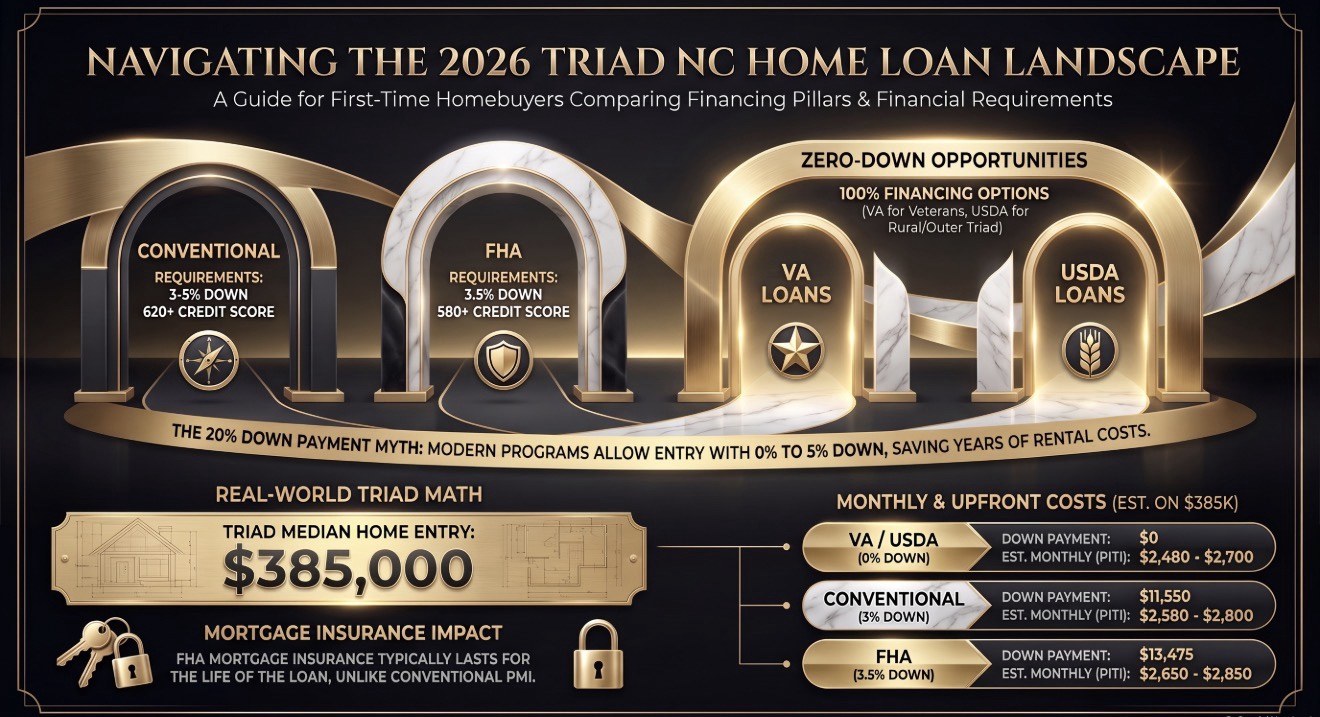
The real down payment math on a 385,000 dollar Triad home
Zillow reported the median Triad home value at approximately 385,000 dollars for 2026, with Winston-Salem averaging closer to 370,000 dollars, Greensboro at 385,000, and High Point at 260,000 dollars. Kernersville and Clemmons trend higher into the 400,000s. Here is what down payment actually looks like across the four programs on that median 385,000 Triad home.
| Program | Down payment on 385K | Loan amount | Estimated monthly PITI |
|---|---|---|---|
| Conventional 5% | 19,250 dollars | 365,750 | 2,510 to 2,720 |
| Conventional 3% | 11,550 | 373,450 | 2,580 to 2,800 |
| FHA 3.5% | 13,475 | 371,525 | 2,650 to 2,850 |
| VA 0% | 0 | 385,000 | 2,480 to 2,700 |
| USDA 0% | 0 | 385,000 | 2,500 to 2,700 |
PITI estimates assume a 6.5 to 7 percent rate range for 2026, Forsyth or Guilford county property tax rates, and standard homeowners insurance. The monthly payment gap between conventional 5 percent and FHA 3.5 percent is only about 130 dollars, but the down-payment savings of 5,775 dollars can make the difference between buying now and waiting another year.
Credit score requirements and the reality behind them
The published minimum credit scores are the floor at which a lender will consider approval. Real 2026 pricing gets meaningfully worse below certain thresholds because loan-level price adjustments (LLPAs) hit the rate you actually get. Understanding these tiers matters more than knowing the minimums.
| Credit tier | Conventional impact | FHA impact | Recommended action |
|---|---|---|---|
| 760+ | Best conventional pricing | FHA benefits diminish | Conventional almost always wins |
| 720-759 | Very good pricing | Break-even vs conventional | Compare both options |
| 680-719 | Notable rate premium | FHA becomes competitive | Compare both, FHA often wins |
| 640-679 | Significant rate premium | FHA is strong choice | FHA typically wins |
| 580-639 | Not qualified for most | FHA is often the only path | FHA or credit rebuild |
PMI, MIP, and the monthly cost most buyers miss
Any mortgage with less than 20 percent down carries mortgage insurance. Conventional loans call it Private Mortgage Insurance (PMI). FHA loans call it Mortgage Insurance Premium (MIP). The structural difference between them is major.
Conventional PMI ranges from 0.3 to 1.5 percent of the loan amount annually depending on credit score and down payment. On a 366,000 conventional loan at 5 percent down with a 720 credit score, PMI runs approximately 120 to 180 dollars per month. PMI drops off automatically at 78 percent loan-to-value (or upon request at 80 percent LTV).
FHA MIP has two parts. Upfront MIP is 1.75 percent of the loan amount financed into the loan (adds 6,400 dollars to a 366,000 loan). Annual MIP is 0.55 percent of the loan balance. On the same 371,000 FHA loan, annual MIP is approximately 170 dollars per month. Critically, MIP does not drop off unless you refinance or made the original 10 percent down payment (which triggers 11-year MIP instead of life-of-loan MIP).
The life-of-loan MIP is what shifts the math against FHA for buyers with strong credit. On a 30-year hold, the total MIP paid on FHA can exceed 50,000 dollars — five times what conventional PMI would have cost the same buyer.
VA and USDA — the zero-down programs explained
VA loans are guaranteed by the Department of Veterans Affairs for eligible veterans, active-duty service members, National Guard members with qualifying service, and some surviving spouses. Zero down payment, no monthly mortgage insurance, and competitive rates. The only cost most buyers do not expect is the VA Funding Fee, which ranges from 1.25 percent (subsequent use, 10 percent down) to 3.3 percent (subsequent use, zero down) of the loan amount. First-use VA borrowers with zero down pay 2.15 percent funding fee, which is typically financed into the loan. Buyers with 10 percent or more service-connected disability rating are exempt from the funding fee.
USDA loans are guaranteed by the US Department of Agriculture Rural Development program and require the property to be located in a USDA-eligible area. The Triad NC USDA eligibility map covers Wilkes County entirely, most of Yadkin County, parts of Stokes and Rockingham Counties, and the outer edges of Forsyth and Guilford Counties (typically outside the Winston-Salem, Greensboro, and High Point city limits). Income limits apply — for a 1 to 4 person household in Forsyth County in 2026, the income limit is 129,150 dollars. Guaranteed fee structure is 1 percent upfront (financed) plus 0.35 percent annual.
"USDA loans are the most underused program for first-time buyers in the outer Triad. Rural Development guaranteed loans have funded over 1.4 million homes since inception. The zero-down feature combined with rates competitive with FHA makes it the best path for buyers in eligible areas."
Seller concession limits by program
Seller concessions (the seller paying part of the buyer closing costs) are one of the most powerful tools in a first-time buyer negotiation. But each loan program caps the maximum concession the seller is allowed to contribute. Knowing the cap before you write the offer keeps you from asking for something the lender will reject.
| Program | Maximum seller concession | What it can cover |
|---|---|---|
| Conventional 3% down | 3% of purchase price | Closing costs, prepaids, rate buydown, no down payment |
| Conventional 5-10% down | 6% of purchase price | Same as above |
| FHA | 6% of purchase price | Closing costs, prepaids, MIP upfront, rate buydown |
| VA | 4% of purchase price (concessions) + unlimited closing cost credits | Closing costs, funding fee, debt payoff, prepaids |
| USDA | 6% of purchase price | Closing costs, prepaids, guarantee fee |
Realistic closing cost estimate for the Triad 2026
Total closing costs for a first-time buyer in the Triad typically run 2 to 4 percent of the purchase price. On a 385,000 home that translates to 7,700 to 15,400 dollars, depending on which of the four programs, whether prepaids (property tax and insurance escrow) are being collected, and whether the buyer bought down the rate.
Typical Triad first-time buyer closing cost breakdown on a 385,000 home:
- Lender fees (origination, underwriting, credit report): 1,200 to 2,500 dollars
- Title insurance (owner + lender): 800 to 1,400 dollars
- Attorney fee: 900 to 1,400 dollars (NC uses attorney closings, not title company)
- Survey (optional): 400 to 700 dollars
- Home inspection: 400 to 650 dollars
- Appraisal: 550 to 750 dollars
- NC recording fees: 100 to 200 dollars
- Prepaid property tax escrow: varies by county and closing month
- Prepaid homeowners insurance: typically 1,200 to 1,600 for first year
- Due diligence fee (paid to seller, non-refundable): 500 to 3,500 typical, discussed at offer
"The Triad has one of the most first-time-buyer-friendly closing cost structures in the Southeast because NC uses attorney closings that keep total legal fees under 1,500 dollars on nearly every transaction. In Georgia and South Carolina the equivalent bundle can push 2,500 to 3,000."
Listen · Episode 14 · 19:21
Best Triad NC First-Time Home Loans
Prefer to listen instead of read? A 19-minute plain-English walk through the same four programs, credit tiers, PMI vs MIP structure, USDA eligibility across the outer Triad, and the four-question decision tree that identifies which program fits which buyer.
Triad NC First-Time Buyer Loan Mind Map
Explore the entire four-program comparison as a clickable mind map. Click any branch (FHA, VA, USDA, Conventional) to drill into requirements, costs, and decision points.
Which program fits your situation
The four-way decision tree that matters more than any credit-score chart or interest-rate quote:
Are you a veteran, active-duty, or surviving spouse of a service member? Get a VA loan. Zero down, no PMI, competitive rates, higher seller concessions. The funding fee is small compared to the lifetime savings versus every other program. This is not close.
Is the property in a USDA-eligible area (outside Winston-Salem, Greensboro, or High Point city limits, or in Wilkes or Yadkin County)? Get a USDA loan. Zero down, competitive rates, and the modest guarantee fee is worth it. Verify eligibility on the USDA Rural Development eligibility map at eligibility.sc.egov.usda.gov.
Is your credit score above 720 and do you have 5 to 10 percent saved? Get conventional. PMI drops off automatically, the rate pricing at 720+ credit beats FHA, and you avoid life-of-loan mortgage insurance.
Is your credit score 580 to 719 or do you have only 3 to 4 percent saved? Get FHA. The lower credit floor, lower down payment, and higher seller concessions typically win over conventional at this credit tier. Plan to refinance to conventional in year 4 or 5 once you have equity and improved credit.
The wrong program can cost you 40,000 to 60,000 dollars over a 30-year hold. The right program is often determined by two questions — your credit score and whether you or the property qualify for a government-backed zero-down option.
Free 17-page printable guide
The First-Time Buyer’s Loan Guide — Triad NC 2026
What four little-known programs actually cost you and how to choose the one that fits. Includes the four-question decision tree, real down payment math on a 385,000 dollar Triad home, credit tier pricing, mortgage insurance breakdown, seller concession caps, NC-specific closing cost math, a worksheet for your own numbers, and the exact questions to ask a lender before you commit.
17 pages · FHA, VA, USDA, and Conventional compared for the 2026 Triad market
Related Triad NC buyer guides
- The complete NC USDA loan guide 2026 — income limits and county map
- Pre-approval vs prequalification in NC — what the buyer letter actually means
- First-time homebuyer FAQ — Triad NC 2026 down payment answers
- NC due diligence fee guide — what the DDF and EMD actually cover
- NC home warranty guide — what a Triad buyer actually gets
- Moving to Winston-Salem NC pillar guide
Frequently asked questions
What is the minimum down payment for a first-time home buyer in the Triad NC?
Zero for VA or USDA if eligible, 3 percent for conventional, and 3.5 percent for FHA. On the median 385,000 dollar Triad home that means 0 dollars for VA/USDA, 11,550 for conventional 3 percent, or 13,475 for FHA 3.5 percent.
Can I use both a first-time buyer loan program and NC Home Advantage down payment assistance?
Yes. NC Housing Finance Agency offers Home Advantage Mortgage with 3 to 5 percent down payment assistance that stacks with conventional or FHA loans. Income limits apply (typically 92,000 to 132,000 depending on county) and you must complete an approved homebuyer education course.
Is FHA better than conventional for first-time buyers in the Triad?
It depends on credit score. Below 720 credit, FHA often wins because of lower rate premium and lower down payment. Above 720, conventional is usually better because PMI drops off automatically while FHA MIP is life-of-loan. Compare the total cost over your expected hold, not just the monthly payment.
What credit score do I need for a mortgage in North Carolina?
FHA floor is 580 with 3.5 percent down (500-579 requires 10 percent down). Conventional requires 620 minimum. USDA requires 640 typical. VA is lender-dependent but typically 580-620. Higher scores get better rates on every program.
What is the median home price in the Triad NC for 2026?
Approximately 385,000 dollars across the broader Triad. Winston-Salem averages 370,000, Greensboro 385,000, High Point 260,000, Kernersville and Clemmons trend into the 400,000s. Wilkes County averages 245,000.
How long does a first-time buyer loan take to close in the Triad?
Conventional loans close in 21 to 35 days from contract. FHA closes in 30 to 45 days. VA and USDA typically 40 to 55 days due to additional agency review. Aggressive scheduling can compress each of these by a week if the lender is well-organized.
Do I have to pay private mortgage insurance forever on FHA?
If your original down payment was less than 10 percent, yes — FHA MIP runs for the life of the loan. If you put down 10 percent or more originally, MIP drops off after 11 years. Most buyers who want to eliminate MIP refinance to conventional once they have 20 percent equity.
Can I qualify for USDA if I make over 100,000 dollars in the Triad?
Possibly. USDA income limits for a 1 to 4 person household in Forsyth County are approximately 129,150 dollars for 2026. Guilford is similar. Households of 5 to 8 have higher limits. Wilkes County has slightly lower limits due to lower median area income.
What is the NC Home Advantage Mortgage program?
NC Home Advantage is North Carolina Housing Finance Agency down payment assistance that provides 3 to up to 3% of the loan amount as a forgivable second mortgage. It stacks with conventional or FHA first mortgages. Buyer must complete an approved home buyer education course and meet income and purchase price limits.
How much do I need saved beyond the down payment?
Plan for total funds needed of approximately 5 to 7 percent of the purchase price to cover down payment, closing costs, prepaids, and reserves. On a 385,000 Triad home that is roughly 19,000 to 27,000 dollars for a conventional buyer, 15,000 to 20,000 for FHA, and 8,000 to 12,000 for VA or USDA where the down payment is zero.
Ready to match your situation to the right loan program?
The wrong program costs Triad first-time buyers an average of 40,000 to 60,000 dollars over a 30-year hold. The right program is a one-conversation decision if you know the four questions to ask before you set foot in a lender office. Get the pre-lender briefing that saves the money.
Call or text 336-262-3111 or email teresatedder@gmail.com for the first-time buyer briefing on your specific Triad NC situation.
Teresa Overcash is Broker in Charge and Owner of Realty ONE Group Results, an NCREC Licensed Instructor, and CLHMS certified luxury broker with 30 years in North Carolina real estate and over 10,000 NC closings. Realty ONE Group Results serves the Triad, Wilkes County, and the NC High Country with access to 4 MLS systems and a network of over 22,000 agents nationwide.